In Melania, the Emperor Has a Lot of Clothes
It’s hard to imagine viewers who end up tuning in to the new hagiographic Melania Trump documentary, Melania, having a reaction other than “time to sharpen our guillotines.”
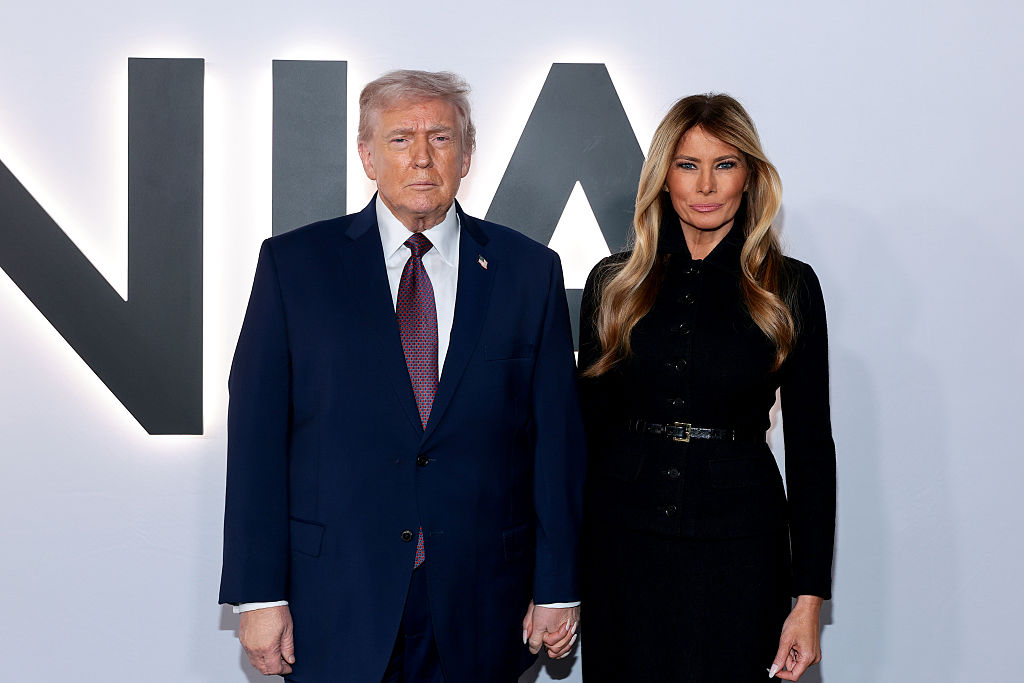
In her new documentary, Melania, Melania Trump is Marie Antoinette’s spiritual successor. (Dimitrios Kambouris / Getty Images)
As the documentary Melania prepared to debut on Friday, its promotional posters across Los Angeles were vandalized with graffiti that transformed Melania Trump into a kind of Third Reich Barbie. She was accessorized with a drawn-on Hitler moustache and rechristened “Eva Braun.” A subtle touch.
A better comparison, made painfully obvious by watching Melania, is Marie Antoinette, and the Trumps as the decadent French monarchy. Marie Antoinette didn’t design the ancien régime or engineer France’s late eighteenth-century fiscal collapse. History remembers her less for governance than for her vibe: the garish gowns, the immaculate gardens, the lavish parties, and her refusal to cut expenses as the peasants starved. Melania Trump, as captured in this film, is her spiritual successor, albeit one who prefers Botox to bustles and Manhattan penthouses to the Petit Trianon; a decorative emblem of a ruling class that has retreated into self-absorbed aesthetics even as the streets beneath it seethe.
The documentary is framed as a behind-the-scenes look at the real Melania in the three weeks leading up to the 2025 presidential inauguration, but there’s almost comically little revealed about the life and personal politics of our two-time first lady. We learn that she loves her mother, her son Barron, and the music of Michael Jackson. For much of the run time, Melania glides from vast gold-embossed rooms in glass towers to limos to private jets to fly to manicured estates in Mar-a-Lago or ritzy ballrooms in Washington, DC, in impossibly expensive gowns crafted by her small army of designers and attendants. It’s all framed as if she were a luxury brand ambassador for MAGA’s imperial America.
There’s even a subplot in which she discusses a preinauguration candlelit dinner, with the color scheme to be her signature white and gold, and each guest — including Elon Musk and the rest of Trump’s court of tech barons — will be served a gold egg filled with caviar.
It’s less a political biography than a slow, glossy mood piece. It’s a wonder there’s dialogue at all. Melania speaks rarely, and when she does, it’s with the careful neutrality of someone afraid to raise anyone’s eyebrows. Most of the speaking is her stilted narration with lines like “Every day I lead with nurturing and devotion,” which sounds like it was written by ChatGPT. (Maybe it is — after all, she’s stolen at least one speech from Michelle Obama). Instead, the camera lingers on her symmetry, posture, and garments as she meets with foreign first ladies and queens. This emperor is wearing a lot of clothes.
This matters because of when Melania arrives. The United States in the 2020s is not prerevolutionary France, but it is a country defined by yawning inequality, institutional decay, and a growing sense that elite life operates on a different plane of existence. That sense has metastasized under the second Trump administration.
In the aftermath of the failed assassination of Donald in Butler, Pennsylvania, in mid-2024, Trump’s self-mythology has curdled into something that feels almost theological. He wasn’t just lucky to survive; he was spared, and God had intervened. Trump, never one to undersell himself, leaned into this idea of his divine right. His online presence began flirting openly with monarchic imagery, including artificial-intelligence-generated images of himself crowned like a king: Caesar by way of Caesar’s Palace.
The joke, though, is that Trump’s kingship fantasy has not remained confined to AI slop and social media braggadocio. In his second term, he has governed in a way that increasingly resembles a man testing how much of the modern state can be bent into a personal dominion before anyone stops him. The Border Patrol and Immigration and Customs Enforcement (ICE) have been reshaped into something resembling a personal army that attacks and even assassinates political opponents with impunity. In foreign policy, the administration’s new National Security Strategy pivots the United States away from Europe and toward the Western Hemisphere under a “Trump Corollary” to the Monroe Doctrine, a nineteenth-century assertion of hemispheric dominance updated with modern force. NATO, once a mutual defense pact, is now routinely treated as a protection scheme whose members must “pay up” to remain under the American shield, and everything in the hemisphere (from Venezuela to Mexico to Canada to Greenland) is a vassal state or a vassal to be. It’s as if Trump wants to become the emperor of the Americas.
Meanwhile, the Trump White House has turned itself into something resembling an imperial court. Plans to carve out a 90,000-square-foot ballroom at the White House — almost as large as the existing residence — are being pursued with the zeal of a monarch building another throne room. His affinity for ostentation has extended to twenty-four-karat gold adornments in the Oval Office, heroic portraits of himself hung in federal buildings, and even proposals for monumental arches in Washington (even nicknamed Arc de Trump) meant to immortalize his reign long after he’s gone.
This is where Melania stops being merely a vanity project bundled into an expensive quid pro quo deal with Jeff Bezos and starts to look like a propaganda film that soft-pedals tyranny and offers to let us eat cinematic cake. In monarchies, the queen’s role is often not to govern but to sanctify the image of rule. While Trump bellows about enemies and betrayals, she glides through New Versailles, serene and unbothered, embodying a fantasy of rule that transcends politics altogether. Melania wants you to feel calm. It wants you to forget the noise of politics outside, take a Xanax, and admire the views.
There are times when you can almost imagine the film’s director, Brett Ratner, canceled during the #MeToo era after half a dozen women accused him of sexual harassment and assault, hinting at this. The movie opens with Melania sitting in silence as the Rolling Stones’ “Gimme Shelter” blares with Mick Jagger singing that war, rape, and murder are just “a shot away.” Another time, the jangly guitars from Tears for Fears’ ’80s anthem “Everybody Wants to Rule the World” play as a Trump-branded jet rolls on a runway. But it’s likely that no one cares about the juxtaposition.
After all, as the documentary gives us footage of Melania walking down yet another corridor during Inauguration Day, her narration says the following almost listlessly: “I felt the weight of history intertwined with my own journey as an immigrant, a reminder of why I respect this nation so deeply. Everyone should do what they can to protect our individual rights. Never take them for granted, because in the end. no matter where we come from, we are bound by the same humanity.”
Paired with the release of new Epstein files on the very day of the film’s premiere, the effect of watching this interminable pageant of one — a feckless $40 million, two-hour Instagram reel — will probably leave viewers with a single instinctive response: “Time to sharpen the guillotine.”