Your Individual Boycotts Aren’t Helping

Boycotts against corporations can be powerful tools. But they have to be waged as part of larger collective struggles with real plans to win — not simply as acts for frustrated individuals to take on their own.
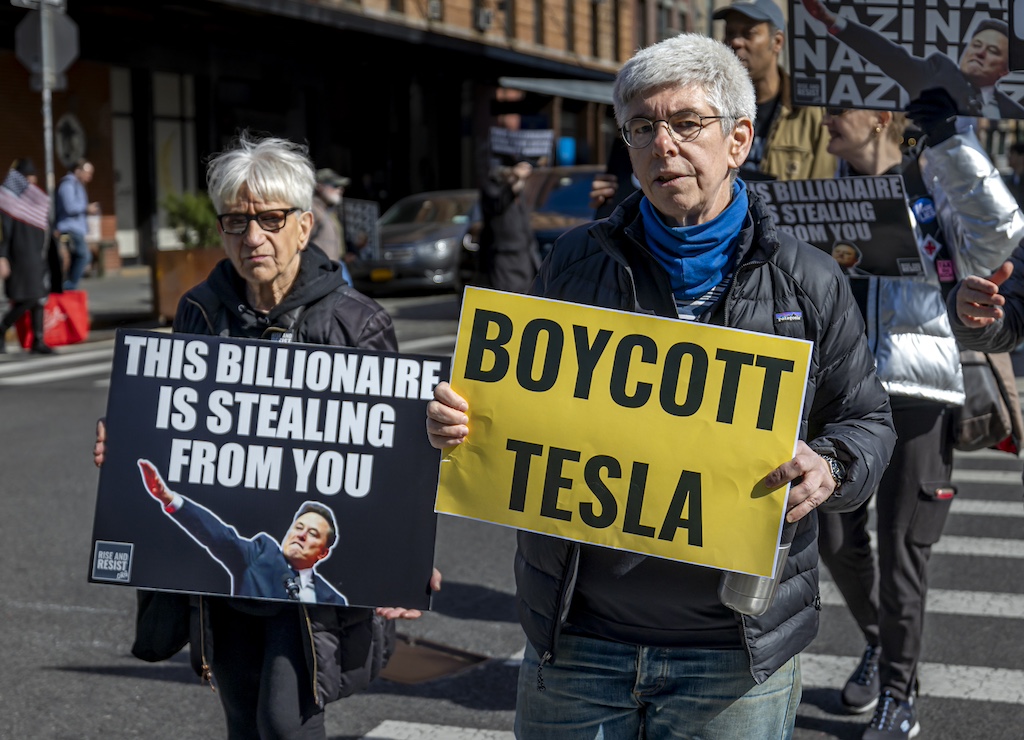
Widescale popular involvement in a struggle generally requires not only a widely and deeply felt demand but a clear path to victory. (Michael Nigro / Pacific Press / LightRocket via Getty Images)

An Instagram post of mine about Immigration and Customs Enforcement’s (ICE) top corporate collaborators went viral a few weeks ago. The fact that it got over four million views and over 35,000 shares suggests that people are starting to grasp the central role private businesses play in enabling Donald Trump’s paramilitary thugs. But I was puzzled and a bit frustrated by most people’s reactions. I explicitly underscored that I wasn’t making yet another online-based call for individuals to stop shopping at bad companies:

We don’t need vague calls to stop shopping at these places or one-off rallies — we need sit-ins, pressure campaigns, *organized* boycotts, employee and consumer petitions, sickouts, demands from elected officials, and non-violent disruption to force these companies to immediately break from ICE.

Yet to my surprise, almost every reply treated my post as a push for individual consumption changes. Here’s a representative sample of comments:

  • I already boycott Home Depot, and to see Lowe’s on this list makes me sad. I don’t have a local hardware store to choose from. 😢
  • I cancelled Prime last summer. I promise you’ll save money and be fine 🙏🏼
  • Good luck avoiding business with Amazon.

Why was a call for collective organized action almost universally seen as a manifesto for personal shopping advice? Part of the answer may just be that people don’t read Instagram captions. But there’s also something deeper going on: individualism and atomization pervade our culture, and even action to change the world can, by many people, only be imagined as individual consumption choices rather than taking action together with other people.

This atomization is a relatively new phenomenon. America used to be a country full of clubs, labor unions, churches, neighborhood associations, and bowling leagues. But now, as sociologist Robert Putnam famously put it, we are “bowling alone.”

Without strong membership organizations in our daily lives, and with social media exacerbating our isolation, political consumption has become fundamentally personal rather than collective. Consider the influential quote from Anna Lappé in Oprah Magazine two decades ago: “Every time you spend money, you’re casting a vote for the kind of world you want.”

Consumer choices can be powerful. But it is misleading to suggest that consumption decisions by isolated individuals matter that much. To effectively use your purchasing power to combat corporate injustices such as ICE’s private sector collaboration, you need to join an organized effort. Like bowling, boycotting is best done together.

For a consumer action to spread and sustain itself, we need to actively persuade everyday people that participating will make a tangible difference. We need to show that many others are also participating. We need to choose targets and tactics wisely. And we need to lean on membership organizations and highly visible campaigns to maintain and deepen forward momentum.

Class and Consumption

A problem with most online calls for boycotts is that they underestimate how challenging it is for everyday people to “buy ethically.” If you have lots of disposable income and time, it’s not that hard to engage in political consumption. But for everyone else, it’s not so easy to find the money or the free time to look up bad companies or to find and purchase alternatives.

Scholarly research confirms this dynamic. One quantitative study of large-scale survey data concludes that “people in higher-class positions use their purchasing power as a means of political voice more often than people in lower-class positions.” Studies of low-income Americans show that even when they’d prefer to buy a more virtuous product, they often do not pull the trigger because such products tend to be more expensive.

That’s why it’s unhelpful for efforts like the new Big Beautiful Boycott against pro-Trump companies to say that “every dollar is a choice.” Not everybody has the same amount of freedom to choose different products. Nor, contrary to Lappé’s suggestion, are working people voting for the policies of Jeff Bezos when they order something on Amazon — or when they use the internet, which at this point almost inevitably means interacting with an app or website reliant on Amazon Web Services.

Exhortations to shop differently too often end up blaming the victim rather than the real enemy: the handful of billionaires that control our country’s wealth and political power. And it’s a logic that dovetails with the classic right-wing claim that leftists are hypocritical to criticize capitalism because we buy its products (as if we had any other choice).

This doesn’t mean that it’s impossible to tap the purchasing power of the working-class majority. In fact, boycotts were a central and effective tactic of the labor movement a century ago — and they can be a central tool to help end American authoritarianism, especially when they are one part of a larger organized, collective campaign.

Effective and Ineffective Boycotts

What kind of boycott can actually stop ICE and pull away Trump’s pillars of corporate support?

A prominent example of a suboptimal initiative is Resist and Unsubscribe, entrepreneur and marketing professor Scott Galloway’s push to get people to stop shopping with a dozen Trump-supporting companies. On the one hand, it’s great he is drawing attention to ICE’s corporate collaborators — this is certainly a step forward from his 2019 endorsement of billionaire Michael Bloomberg for president. But Galloway’s effort also feeds into the prevailing assumption that everyday people have no power to change the world through organized collective action.

Resist and Unsubscribe insists upon a strategic false dichotomy. Galloway claims that the only two options for resistance are pursuing tactics like “citizen outrage,” which he says that Trump will ignore, or hitting Trump-collaborating corporations in their pocketbooks by unsubscribing. What this framing ignores is not just that public outrage still does matter — as we’ve seen in Trump’s retreat from Minneapolis — but that there are more effective ways to inflict economic costs on these companies than boycotting alone.

Think about labor strikes. Companies can’t make any profits when nobody shows up to work. Yet Galloway dismisses workplace leverage and dubiously insists that “over the past several decades, unions have proven they don’t work.” Recent experience suggests otherwise.

Delegates to the Denver Area Labor Federation convention marching in support of the United Farm Workers boycott, February 27, 1976. (Denver Post via Getty Images)

Minneapolis’s January 23 anti-ICE, union-backed mass strike and consumer boycott had a serious economic impact and helped pressure the state’s cowardly CEOs to call for ICE to de-escalate. Threats of work stoppages, slowdowns, and internal company disruption similarly provide leverage to exciting new campaigns like iceout.tech, an initiative by and for tech employees to force their companies — including all of the tech giants on Galloway’s list — to break from ICE. In that same spirit, Google workers in 2018 forced their firm to stop working on the Pentagon’s Project Maven, an initiative to make drones powered by artificial intelligence more efficient.

But even if we leave aside the question of workplace power, Resist and Unsubscribe still falls short. Galloway is right that consumers have a huge amount of potential power. But it will take organized campaigns to tap it. There are plenty of examples of effective consumer boycotts that we can learn from: the 1955–56 Montgomery Bus Boycott, the United Farm Workers (UFW) grape boycotts of the late 1960s, the late 1970s boycott of Coors, and the recent Tesla Takedown. These experiences highlight six key takeaways for effective consumer boycotts.

1) Have Clear and Winnable Demands 

If you want a boycott to make a difference, you need to be very clear about what you’re asking companies to do to get your business back. The UFW’s grape boycott, for instance, demanded companies recognize the farmworkers’ union. But neither the Big Beautiful Boycott nor Resist and Unsubscribe make any demands; as such, they don’t concentrate pressure on companies to do anything specifically different. If businesses think you are done with them forever no matter what they do, what’s their incentive to change their behavior?

Demands should also be winnable. Since the biggest obstacle to social change is the public’s sense of resignation and powerlessness, it’s crucial to hone in on ambitious but realistic fights. Most ordinary people don’t make personal sacrifices unless they see a plausible way their participation could make a real difference. And successful campaigns like the recent push to get Avelo Airlines to end its ICE contract are key levers to build momentum and inspire other similar fightbacks.

2) Push for Big Numbers

The more participants join a boycott, the more impact it will have. This might seem like an obvious point, yet it’s remarkably rare for consumer boycotts to actively push to involve the big numbers of people necessary to make a real economic difference. The reason this is so rare is simple: you need organization to even try to get to scale. Just posting a meme or a website isn’t enough.

Here’s how organizer Stephen Lerner described the behind-the-scenes efforts that made the UFW grape boycott so effective:

To pull this off at scale, you have to do real organizing on the ground, that’s the only way you can do sustained and escalating activity. Support for the farm workers was intensely organized in city after city, neighborhood after neighborhood, churches and synagogues. It wasn’t just a general call for a boycott. We focused on building self-sustaining committees of supporters that could drive the work locally — the pickets, the actions, all that. It was a massive operation around the country, with thousands of active supporters and hundreds of full-time volunteers working on this.

Similarly, we saw in Minnesota that the January 23 day of “no school, no shopping, no work” caught on in large part because it was called by strong organizations with broad popular legitimacy like Service Employees International Union (SEIU) Local 26 and Unidos MN. In contrast, the day of action on January 30 fell flat in large part because the call came from small, left-leaning student groups.

It’s true that there are exceptional moments where calls for boycotts can go viral even in the absence of organization behind it. That’s what happened when pro-Palestinian customers boycotted Starbucks in late 2023 and when Americans immediately canceled Disney and Hulu subscriptions after Jimmy Kimmel was indefinitely suspended last September.

Such instances, however, are the exception that prove the rule — most successful boycotts are organized and most unorganized boycotts are failures. And because the latter have no structure for onboarding and developing new activists, they don’t leave behind a sediment of organization necessary for sustaining the battle. Moments have to be seized, but defeating authoritarianism requires more than volcanic eruptions of activity.

3) Keep the List Short

The more companies you add to a boycott list, the harder you make it for most people to participate. That’s why long lists of corporations to boycott like the Big Beautiful Boycott or Resist and Unsubscribe tend to be disempowering. In practice, it’s almost impossible for most people to keep track of all the bad companies out there, let alone to find convenient and affordable alternatives.

This point was hammered home to me yesterday in a text message I received from an old friend: “I just saw a post by Scott Galloway about all the companies to divest from and it felt like literally all of the main ones people use and their alternatives lol.” But because she had read the recent interview I did with Sunrise Movement leader Aru Shiney-Ajay, my friend added that she didn’t get discouraged this time: “I just heard Aru’s voice in my head saying how overwhelming it is, if you give a list of 50 companies to avoid to someone.” As Aru noted, “That can be paralyzing. It doesn’t move people into action, and it doesn’t get people into organized formations.”

4) Make Your Impact Measurable

Just hurting a company’s profits is not enough to move them. If they can’t assess the particular impact of your boycott, they might attribute their business troubles to all sorts of different sources, from supply chain troubles to labor costs. That’s why you need to make it as clear as possible how much your organized efforts are making an impact. Unfortunately, Resist and Unsubscribe has no way to measure its participation or economic impact beyond Galloway’s questionable estimate of how many people he expects to delete apps after seeing his web page.

In contrast, Tesla Takedown put a central focus on publicizing the decline in Tesla profits after they began protesting Elon Musk’s Department of Government Efficiency (DOGE) wrecking ball. And without organizing so many public Tesla protests, they would have had a much less credible case that anti-Musk energy was driving the company’s troubles.

A campaign led by the Twin Cities Sunrise Movement has led to an impressive string of local victories, including getting a local Hilton to refuse service to ICE. (Bridget Bennett for the Washington Post via Getty Images)

A measurable public impact is also critical for involving large numbers. It’s a classic collective action problem that most people don’t participate in joint actions unless they know lots of others are joining too. Just seeing an online post or website is not enough to move most people; you need to do everything possible to show them that their action is part of a wave.

5) Make the Boycott Time-Bound

If you do end up targeting a large number of businesses, or a huge corporation like Amazon or Google that most people cannot realistically extricate themselves from, it’s important to make your boycott short enough for most people to actually be able to participate. For example, January 23 was a one-day boycott of all companies in Minneapolis, and May 1 will be a similar action nationwide. In the same spirit, Starbucks Workers United called for customers to boycott the company for the duration of their strike this winter. Time-bound boycotts also have much more measurable impact than indefinite ones, because you can compare before and after profit margins.

6) Target Intermediary Institutions

Widescale popular involvement in a struggle generally requires not only a widely and deeply felt demand but a clear path to victory. That’s why the quickest path toward serious economic disruption is often to target big intermediary institutions like schools or local governments over which we have an exceptional degree of leverage. Schools and colleges in particular have often been in the vanguard of successful divestment fights, from the anti-apartheid movements in the 1980s to more recent efforts to divest from fossil fuel companies.

It’s an encouraging sign that students, professors, staff, and their unions have launched a new escalating campaign, Schools Drop ICE, to force colleges to end contracts with five corporate targets that are essential to enabling ICE: Enterprise, Hilton, Target, Flock Safety, and ICE air carriers. Winnable campaigns like this provide a unique opening for developing new organizers and for going on the offensive against ICE, so that sustaining momentum doesn’t take more horrors like the murders of Alex Pretti and Renee Good.

Don’t Just “Do Your Part”

A common response to these criticisms is that “every little piece of consumer action helps the resistance.” And in a certain sense that’s true. All other things being equal, it’s a good thing if people stop shopping at bad companies.

But it’s not self-evident that this positive contribution outweighs the negative impact of so many well-meaning Americans feeling like they are “doing their part” purely through individual consumption choices. The goal of a boycott is not to make ourselves feel better. The goal is to make society better.

With millions of Americans’ resistance still limited to consumer choices plus attending an occasional protest, we’re leaving a lot of potential people power on the table. If even a fraction of these individuals became active participants in campaigns and organizations, our chances of victory over ICE and Trumpism would increase significantly.

You don’t have to take my word for it. Two decades after Lappé made her famous quote about voting with your dollar, she reflected on the limitations of this approach:

It’s not that I disagree with this time-tested sentiment: yes, when we shop, our choices make ripples — sometimes huge ones. But I know that in order to make the transformative changes we need . . . we’re going to have to organize. We’re going to have to realize that only together can our voices, and purchases, have the kind of world-changing impact we so need.

Lappé is right. It’s time to stop boycotting alone.