The Capitalist Interests Behind Donald Trump

Trumpism is often cast as a personalist project representing no coherent capitalist interest. But it is also the product of splits within the ruling class and a new power bloc uniting the tech-military complex, crypto-capital, and extractivists.
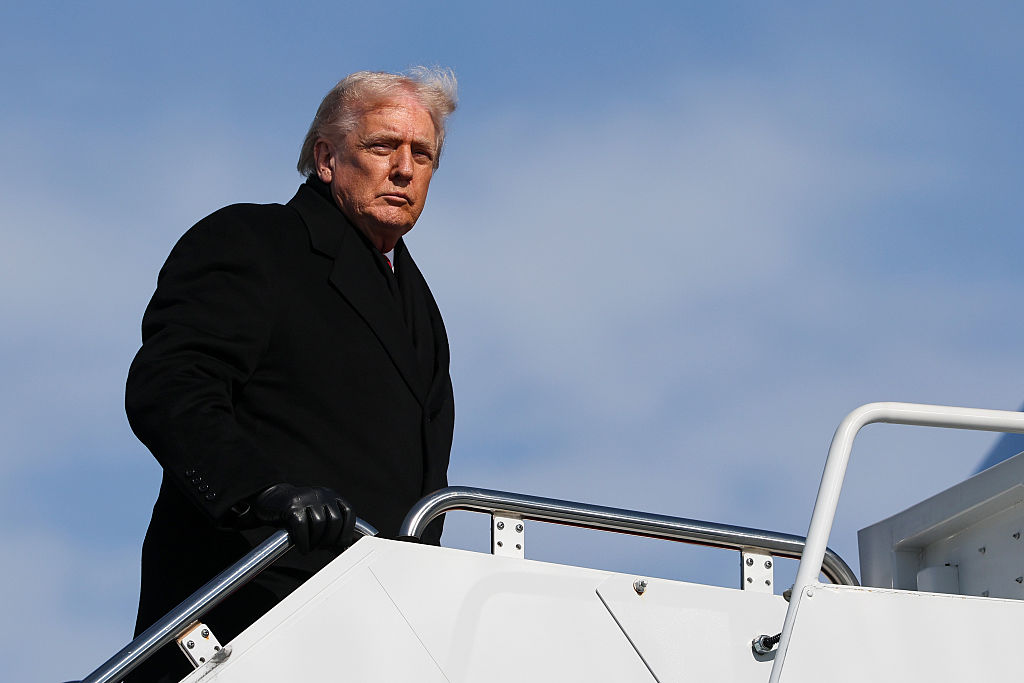
Many mainstream accounts of Donald Trump’s rise focus on his electoral appeal in the Rust Belt — but his misses a key aspect of his success: his support among important sections of capital. (Win McNamee / Getty Images)

The rise, fall, and second coming of Donald Trump represent one of the most puzzling and heavily scrutinized political developments of the last decade. Yet much commentary has barely scratched the surface.

The main focus is on Trump’s reactionary rhetoric and personalist politics. The more farsighted analysts identify broader processes like deindustrialization or the corporate capture of the Democratic Party as root causes of his popular appeal among the US working class. But they stop there.

The prevailing reading of Trumpism sees it as “a revolt from below” of disenfranchised social groups left behind by (neo)liberal globalization. There is more than a grain of truth to this (even though Trump’s share of working-class voters is often overstated). But is this the full picture?

Voter-centric narratives tend to obscure the fact that political parties are vehicles of cross-class alliances based upon — but not limited to and not even led by — their voter base. That is particularly the case in US politics, where the power of wealthy donors is notoriously second to none.

If, like me, you’ve been left wanting by the endless string of accounts about how Trump won over the Rust Belt or made inroads into traditionally Democrat-voting ethnic minorities, then Paul Heideman’s Rogue Elephant: How Republicans Went from the Party of Business to the Party of Chaos comes like a breath of fresh air. The book spotlights how the relationship between class and party plays out beyond the ballot box.

Disunited

Rogue Elephant neatly sets out its core argument from the very start. Trump has seized the Republican Party, seemingly against all odds, for two main structural reasons. First, due to a range of historical and institutional factors — most prominently the loose regulations around political donations — the two big parties are not as cohesive and centralized as, for example, their European counterparts. This creates windows of opportunity for insurgent candidates to emerge and get elected independently of the party establishment, sometimes in open opposition to it. Throughout the postwar era, these candidates have steadily pushed the GOP more to the Right, on both economic and so-called “cultural” issues, thus paving the way for the Trumpist far-right project we have seen unfolding for the past decade.

Second, while the Republicans are resolutely the party of business, the US capitalist class has rarely organized as a single class united by an awareness of its common interest. The few times when that did happen were in reaction to the political organization of labor and heightened class struggle. When class unity is weak on one side, it is on the other side too, as has been the case for most of US history (at least when compared to other advanced capitalist countries).

The big exception came in the 1970s and ’80s, when big business mobilized against the legacy of the New Deal and threw its full weight behind the Reagan administrations’ neoliberal project. But that unity did not last long and was followed by growing cleavages among different fractions of capital. Karl Marx called capitalists “a band of warring brothers” for a reason, yet few left-wing accounts attempt to unpack this struggle within the capitalist class; Heideman’s comes closer than most in that respect.

If the first chapters sometimes feel saturated with intricate details about intraparty machinations, Heideman is at his best in the chapters on the administrations of Bill Clinton and George W. Bush. He provides concrete and compelling evidence that substantiates capital’s instrumental power over the state. It’s the kind of evidence that Marxist authors often lack when theorizing about the capitalist state and which mainstream political scientists blissfully ignore in their single-minded focus on voting behavior (which is crucial to maintaining the illusion of pluralist democracy).

Take, for example, the failure of Clinton’s health care reform: initially backed by manufacturers who were dreading the rising costs of their workers’ health care plans and by the big insurance companies looking to expand their customer base, it eventually lost corporate backing once the plan meant permanent price controls on insurance premiums. Or take the more specific case of Republican congressman Tom Tancredo, who dropped his proposal to tax the money sent home by immigrants following backlash from the banks in his district.

Heideman’s account has the merit of embedding such examples in a consistent narrative on the relationship between the US capitalist class and its main political party. He also tells us how the cleavages within that class shape political struggles over agenda-setting and policymaking.

While the author doesn’t venture into the theoretical debates about the state, his account forcefully shows how capital not only exerts, as a class, structural sway over the state due to its sheer economic preeminence but also how its distinct fractions seek to exert direct, instrumental power in pursuing their distinct, sometimes incompatible, interests and policy preferences.

It might be, after all, that what has been called the “relative autonomy of the state” from capital has been somewhat exaggerated: as Heideman’s rich range of examples shows, even when the main party of capital seemingly went against the general interests of capital, it still acted in the interests of one of its fractions, as with the saga around Clinton’s impeachment. Most of corporate America opposed the campaign against Clinton, but it was fiercely backed by a tobacco industry that he wanted to heavily regulate.

Trump’s Capitalists

Heideman’s book thus explains how the Republicans ceased to represent the unity of capitalist interests. Surprisingly, though, in the book’s final two chapters, which cover Trump’s ascendancy and first administration, the analysis of how particular fractions of capital compete over the GOP and, through it, over state policy (and state contracts, etc.) is rather thin.

Here, the reader is brought back to familiar territory, where Trump is cast as an erratic political entrepreneur who seized the opportunity presented by a divided business class and decentralized party. Bar the tensions between export- and import-based industries around the border adjustment tax (BAT), those intra-capitalist divisions are never properly mapped.

There is a passing discussion of how Trump’s policymaking aligns with some fractions of capital (e.g., certain manufacturing industries) more than others. Yet the mechanisms that mediate that relationship — otherwise well-documented in the previous chapters on Clinton and Bush — are barely mentioned. We could also be told more about the fractions of capital still backing the Democrats and their reasons for doing so.

The book’s subtitle suggests that the GOP, no longer the party of business, has instead been taken into the hands of a chaotic and personalist leader. Yet this is misguided, repeating the same blind spot as most mainstream analysts: mistaking Trumpism for Trump, intra-class conflict for chaos. Trump may well be in it purely for the enrichment of himself and his family. He may well lack an internally consistent ideology and a full-fledged class project. But Trumpism is bigger than the man himself. It includes a coalition of capitalist fractions as well as subordinate class fractions (both petty bourgeois and working-class).

Beyond the president’s personal views, thanks to “Project 2025” Trumpism has a domestic and foreign policy agenda that is more comprehensive, coherent, and, so far, closely implemented than most administrations in recent history have had. As disparate accounts have documented, at the core of this new power bloc we find certain manufacturing industries (e.g., steel, aluminum), extractive industries, private equity (rather than publicly listed companies), crypto capitalists (rather than traditional banking giants), and the new tech-military complex (rather than the established industrial-military one).

The latter fraction, centered around the likes of OpenAI and Palantir, seems to be in the driving seat of the Trumpist hegemonic project: authoritarian-neoliberalism at home and belligerent imperialism abroad — more of a radicalization of than a break with the American status quo.

In particular, Trump’s neo-imperialism is the rogue elephant in the room that Heideman never really talks about. The US-centric framework is understandable for many reasons. But precisely because the United States is so central to the global economy and world politics, any attempt to explain Trumpism that only looks at domestic factors is inevitably incomplete. Are his trade wars merely meant to spread “chaos” across the globe, or do they serve specific class fractions with specific interests? Is the prospected increase of the military budget by more than 50 percent the product of “personalist” politics, or is it set to benefit a certain industry and, indeed, a select few companies? What about the hawkish quest for natural resources, as illustrated not only by the recent assault on Venezuela and threats over Greenland but also by the deal struck with Ukraine over access to minerals?

Sure, some of these developments occurred after the book was published, but all these policy goals were already evident in Trump’s first mandate, then in Project 2025, and in the transparent interests of some of his most prominent collaborators and donors.

The book’s US-centrism is also reflected in the lack of comparative insights that could have shed more light on the nexus between class and party. It has been argued, for example, that the fragmentation of capital was also responsible for other notable successes of far-right “populism” over the last decade, such as Brexit.

Like Trumpism, Brexit succeeded not merely due to British capital’s weak class organization to mobilize in support of the European Union, as during the 1975 referendum campaign (when trade unions rightly opposed integration into the European Community). It was also about a deep division within the capitalist class, as forcefully shown by Marlène Benquet and Théo Bourgeron in their illuminating recent book: there was a split between traditional, city-based finance capital that benefitted from access to the Single Market (large banks, insurance companies, pension funds) and the “alt-finance” fraction for whom the EU was not neoliberal enough, and which seeks even more deregulation (hedge funds, private equity funds, real estate funds).

This intra-class conflict is still very much at play, with the rise of Reform UK as virtually the main party of the British right, indeed largely funded by similar capitalist fractions to Trump: fossil fuel, hedge funds, and crypto. But Heideman’s analysis is deprived of such fruitful parallels.

All in all, in its ambitious attempt to explain one of the most significant developments of our political age, Rogue Elephant has the undeniable merit of shifting our gaze away from the mainstream’s myopic focus on discourse and voters and toward the role of class interests. While not consistently carried out throughout the book, this is a valuable example of what an empirically informed account of the relationship between class and party, between base and superstructure, can look like. At the same time, a full-fledged materialist account of Trumpism, which maps and explains its cross-class alliance, with its distinct political economic project as well as internal contradictions, is yet to be written.