Evo Morales Was the Americas’ Greatest President
On the day of Bolivia's presidential election, we look at the legacy of Evo Morales — who won power in South America's poorest country, tripled its GDP, and lifted millions out of extreme poverty.
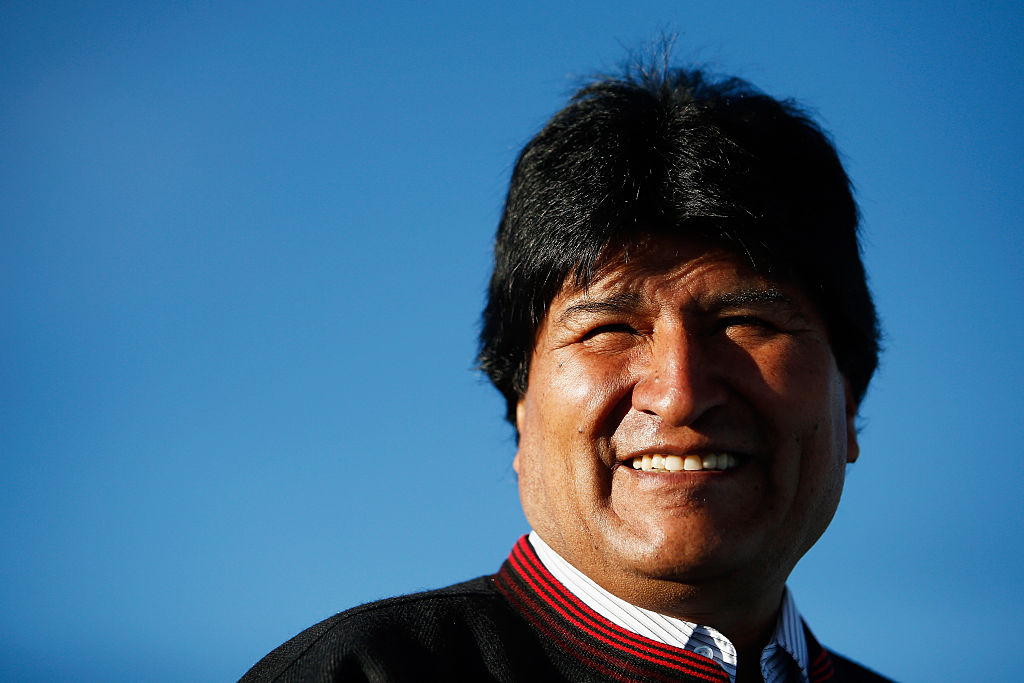
Evo Morales on January 11, 2015 in Bolivia. (Dean Mouhtaropoulos / Getty Images)
In October 2003, Bolivia was in the grips of revolutionary insurrection. Residents in El Alto, the neighboring city of La Paz, were blocking the supply of fuel to the capital in protest at a deal to sell off Bolivian gas to Chile on unfavorable terms. To quash the protest, the government ordered the military to fire on the unarmed civilians, killing dozens.
This was the peak of the Bolivian gas war, a spate of struggles over popular control of natural resources that forced the resignation of neoliberal president Gonzalo “Goni” Sánchez de Lozada. These uprisings between 2000 and 2004 saw the mobilization of peasants, miners, and indigenous groups against the privatization of the country’s resources and other neoliberal policies. This groundswell also led to the election of ex-president Evo Morales and the social movement-backed party Movement Toward Socialismo (MAS) in 2005.
MAS had emerged during the mid-nineties as the organized political wing of CSUTCB, the landworkers’ union, and played a key role in the uprisings of the early 2000s. Its core bases of support have historically been with Bolivia’s peasantry and coca growers, and is conditionally supported by the COB, the powerful miner-led trade union federation which led the struggle for democracy during the dictatorships of the seventies and eighties. And during the mid-2000s “Pink Tide,” when left-socialist governments swept to power across the continent, MAS became internationally known for their ambitious attempts at implementing socialist reforms.