After the Afghanistan Disaster, NATO Is Already Planning the Next War
The occupation of Afghanistan was a disaster — but the US’s failure is already being used to justify even longer “humanitarian interventions.” As after Vietnam, military men are using scenes of disorderly departure to prepare the ground for the next war.
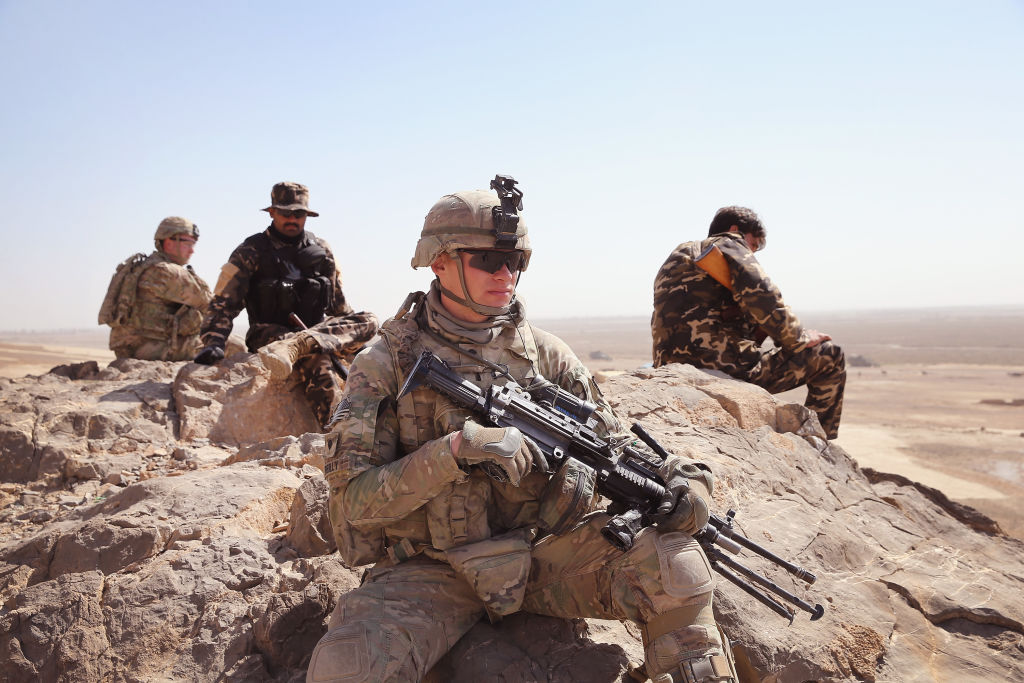
US soldiers on patrol with police from Afghanistan’s National Defense Service near Kandahar, Afghanistan, 2014. (Scott Olson / Getty Images)
In Tim O’Brien’s celebrated anti–Vietnam War novel Going After Cacciato, a deserter is pursued by the narrator and his squadmates in a fever dream. The chase breaks out of the southeast Asian country, taking the war on tour around the world. Indeed, after the last helicopter left Saigon, the Vietnam War’s legacy did pursue the United States across multiple continents.
Defeat in Vietnam haunted the military and security establishment — but they bounced back stronger. The United States’ conventional war machine was overhauled, as the Cold War entered a new phase. The inflexible Pentagon buckled enough for theories of maneuver warfare to take root that tried to learn from insurgents. This was combined with a new technological plan for aerial supremacy, realized in Vietnam through blunt instruments like mass defoliation and carpet bombing.
In the 1991 Gulf War, this finally produced a devastatingly effective war machine involving satellite technology, fast-moving armored columns with close air support, more destructive and accurate munitions, and the ability to manipulate the broadcast media (e.g. through providing weapon camera footage) to present an idealized version of the war. This gap between image and reality led sociologist and philosopher Jean Baudrillard to declare that “The Gulf War Did Not Take Place.”