The New Right Openly Pines for Manifest Destiny 2.0
Past conservatives devoted enormous energy to downplaying America’s history of brutal imperial expansion. But in the second Trump administration, the New Right is doing something different: it’s openly celebrating and seeking to revive it.
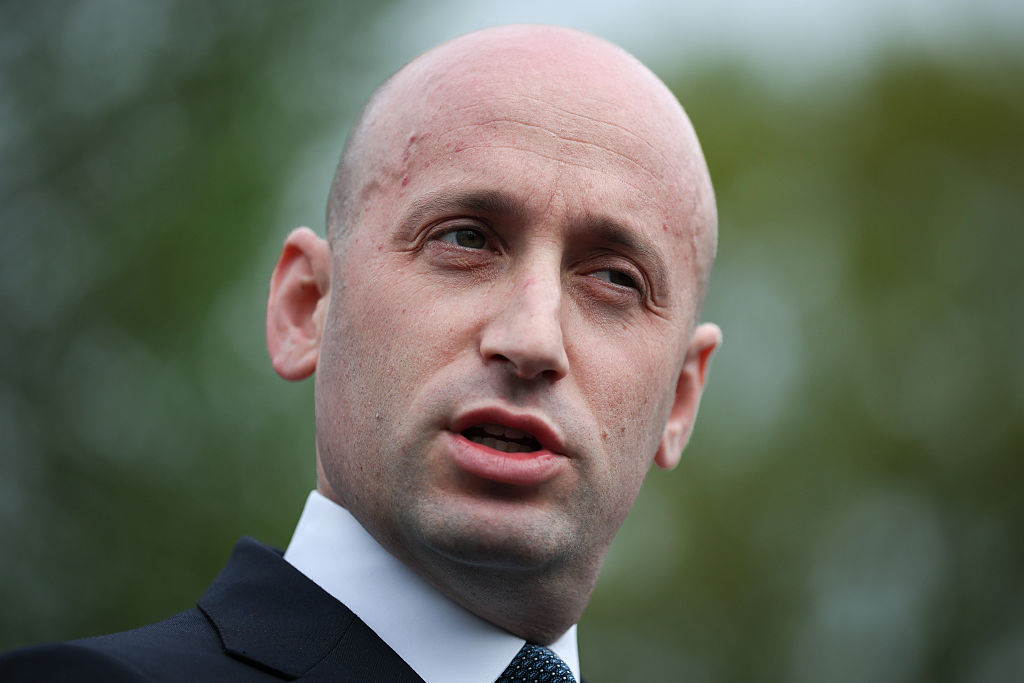
The New Right is no longer just papering over America’s genocidal imperial past. It’s celebrating it. (Win McNamee / Getty Images)
Over the past decade, conservatives have railed incessantly against “woke” educators for indoctrinating young people into believing that the United States was forged through conquest, racial domination, and imperial violence, all of which is historically uncontroversial. In red states, legislators have introduced and passed bills to restrict what can be taught in the classroom about the country’s history, barring discussion of concepts related to race, ethnicity, color, or any topics that promote a “negative account or representation” of the country’s history. Just last March, President Donald Trump issued an executive order that denounced all historical perspectives casting US history in a “negative light,” declaring that historical education should instead focus on the country’s “unparalleled legacy of advancing liberty, individual rights, and human happiness.”
Yet a noticeable shift has taken place in the year since then. Where conservatives once sought to obscure or soften America’s shameful history of conquest and subjugation, many now appear eager to reclaim it instead. Indeed, a growing faction on the Right now celebrates these historical realities openly while recasting empire not as a moral failure but as a legacy worth resurrecting.
This process has accelerated amid the Trump administration’s open embrace of what Matt Huber calls “gangster imperialism,” which many on the Right appear to have taken as permission to openly celebrate the country’s violent imperial past. Consider recent comments from right-wing pundit Matt Walsh during a recent podcast discussing the possible annexation of Greenland with fellow conservatives Ben Shapiro and Michael Knowles. It was amusing, Walsh observed, that people would get so upset by the United States attempting to “grow the empire . . . by force.” After all, the country as it is “currently constituted” became what it is
through purchasing land [and] in some cases going to war, taking it by force, displacing people, kicking them out and taking the land ourself. That’s how this country came to be. We conquered this land . . . because we knew the American empire should reign.
This open acknowledgment of America’s imperial past reflects a new candor about the aims of US foreign policy, which President Trump and his team made clear after the kidnapping of Venezuelan president Nicolás Maduro. Unlike nearly every previous administration, the Trump administration has made little effort to cloak its interventionist agenda in the language of democracy or human rights. Instead, it has openly embraced the language and logic of empire, asserting an imperial right to intervene in the affairs of sovereign nations and to simply take their natural wealth.
Since this unapologetic embrace of empire at the top, MAGA ideologues like Walsh, who had previously posed as an “anti-interventionist,” have explicitly framed Trump’s neo-imperialism as a return to America’s great expansionist tradition. “Expansion is the American way,” Walsh told his four million followers on X. “If Americans in the 1800s were as timid and weak as some of the naysayers today . . . we never would have even reached the Pacific.” Former Trump adviser Steve Bannon put it more succinctly: “How can you get more ‘America First’ than Manifest Destiny 2.0?”
The Revival of the Subjugation Mentality
Beyond invoking nineteenth-century slogans such as Manifest Destiny and the Monroe Doctrine, the neo-imperialist right has also adopted the legal and moral theories once used to legitimize the era’s colonial and expansionist policies.
At the bottom of the “Donroe Doctrine” is the basic idea that raw power is all that matters in world affairs, as Trump’s chief ideologue, Stephen Miller, explained shortly after the Maduro abduction: “We live in a world, in the real world . . . that is governed by strength, that is governed by force, that is governed by power. These are the iron laws of the world since the beginning of time.” Dismissing concepts like national sovereignty and self-determination as “international niceties,” Miller effectively argued that the United States has a right to territory (or resources) as long as it has the strength and ability to take them.
As others have pointed out, this vision amounts to a complete repudiation of the United Nations Charter and the international order that was established after the carnage of World War II. Rejecting principles like sovereign equality and the right of self-determination, the Trump adviser instead seems to favor older concepts like the right of conquest, a doctrine widely accepted under nineteenth-century international law.
Miller has appealed to other concepts and principles common to the age of colonialism, stating that “to control a territory you have to be able to defend a territory, improve a territory, inhabit a territory,” according to “every understanding of law that has existed about territorial control for 500 years.” A Danish politician responded to this by remarking that Miller had the “mentality of a rapist,” but what he was really identifying was the worldview of a nineteenth-century colonizer: an outlook historically bound up with domination, coercion, and violence. By alluding to “improvement,” Miller was also drawing straight from the moral theories long used to rationalize the dispossession of Native Americans deemed by white Europeans to have inadequately developed the land or made productive use of its resources.
Today’s would-be colonizers have nodded to the same archaic rationales when discussing potential new colonies, such as Greenland, which has 56,000 inhabitants. “Only like twelve people live [in Greenland] anyway, [and] they’re not making use of [its resources],” argued Walsh, who went on to fantasize in jest about “going in and conquering Greenland and making them our slaves.”
Silicon Valley’s Dark Imperial Fantasies
There has been intense speculation about President Trump’s fixation on Greenland since he renewed his push to acquire the Arctic island in early January, with many rightly pointing to its natural resources and vast reserves of rare-earth minerals. But the push to acquire the world’s largest island appears to be motivated by more than just its wealth of natural resources and geographic importance.
As reported by Casey Michel in the New Republic and expanded on by Abe Asher in Jacobin, there is a broad network of oligarchs and ideologues who see Greenland as the next frontier and a potential site for political and economic experimentation. Billionaire Trump allies like Peter Thiel and Marc Andreessen have been attached to a project calling for the establishment of a “freedom city” on the Arctic landmass, described by Reuters as a “libertarian utopia with minimal corporate regulation.” There reactionary futurists imagine a “hub for artificial intelligence, autonomous vehicles, space launches, micro nuclear reactors and high-speed rail.” The idea has reportedly been taken seriously by the ambassador to Denmark, Ken Howery, while one Trump donor has envisioned “the dawn of a new Manifest Destiny” on the world’s largest island.
These dystopian fantasies make clear that the pursuit of Greenland is about more than just military bases and mining operations. It is, as Michel explains, “about the opening salvos in a world in which any restrictions on American oligarchy — any oversight, any democratic checks, any hurdles whatsoever — are removed, and a golden, pro-oligarchic age reigns, centered on, but by no means limited to, Greenland.”
In this sense, today’s expansionists are driven by similar impulses as the nineteenth-century expansionists they now venerate. In the same way that Silicon Valley billionaires and reactionary ideologues see themselves as avatars of freedom, earlier expansionists framed their westward advance as part of the righteous cause to enlarge the “area of freedom,” even as they carried out their brutal and genocidal campaigns of conquest. “Freedom,” of course, was generally understood by those on the ground to mean the freedom of wealthy Anglo-American men to do as they pleased without restraint.
“During the first half of the nineteenth century,” historian Greg Grandin recounts, the Jacksonian coalition was united by “slavers and settlers under a banner of freedom defined as freedom from restraint — freedom from restraints on slaving, freedom from restraints on dispossessing, freedom from restraints on moving west.” While the country’s most celebrated Indian killer and slave trader, Andrew Jackson, embodied this idea of hegemonic liberty more than anyone else, it found its most extreme expression in the new Republic of Texas. There self-styled freedom fighters fought against Mexican “tyrants” who sought to take away their god-given right to enslave and exploit other human beings. “Texas must be a slave country,” declared the slave-owning leader of the “War for Liberty Against Mexico,” Stephen F. Austin.
In his acclaimed history of the Jacksonian era, historian Daniel Walker Howe notes that the “ideology of American expansion” legitimized “the assertion of force by the strong and the destruction or expropriation of those who resisted.” Today that ideology is making a comeback, this time under the auspices of billionaire oligarchs and right-wing ideologues who envision a twenty-first century where their freedom to dominate others, plunder resources, and indulge their darkest fantasies is virtually without limit.
Though Trump has since backed off his maximalist demands and threat to seize Greenland by force — no doubt in response to the collapsing stock and bonds markets — the Right’s newfound embrace of expansionism appears to be only just beginning.