The 1873 Colfax Massacre Was a Racist Attack on Black People’s Democratic Rights
The worst episode of Reconstruction Era violence occurred 150 years ago today in northern Louisiana. The 1873 Colfax Massacre saw white supremacists slaughter 150 African Americans, brutally thwarting their hopes for autonomy and self-governance.
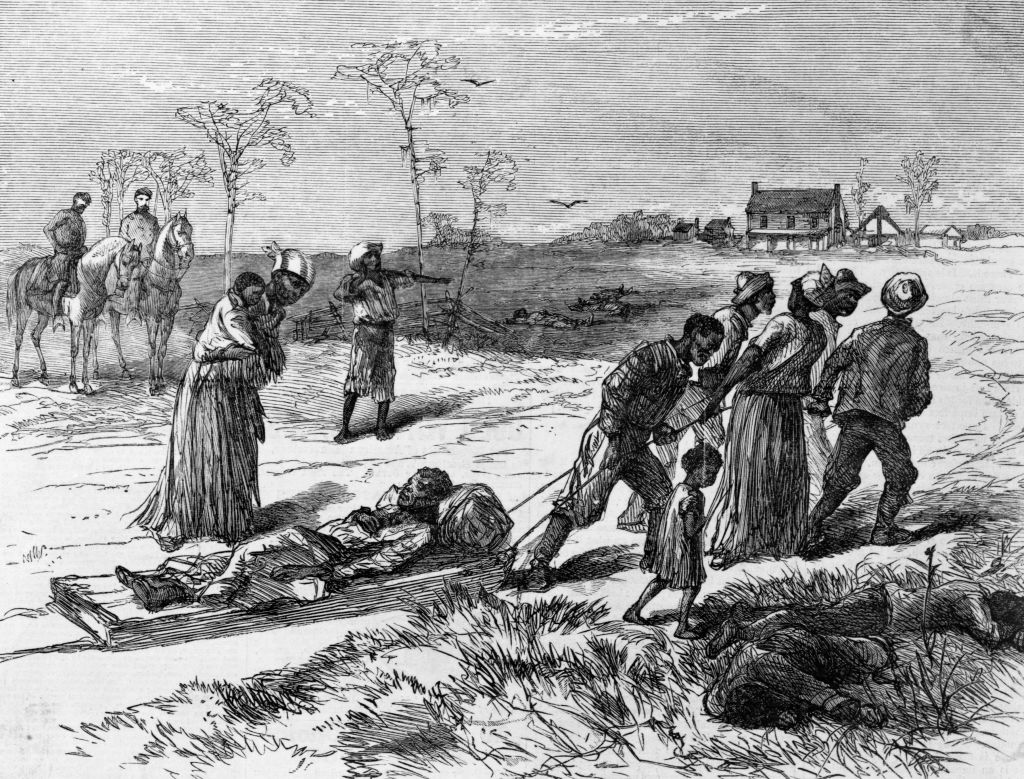
Depiction of African Americans gathering the dead and wounded from the Colfax Massacre in Louisiana, on April 13, 1873, originally published in Harper’s Weekly. (MPI / Getty Images)
The Civil War did not end in the Deep South in 1865. The proslavery, pro-Confederate legacies powerfully persisted, shaping the telling of our history and knowledge about people, places, and events: our perception of reality.
This is precisely why many Americans have never heard of one of the most important episodes of mass murder in US history: the racist, bloody Colfax Massacre of April 13, 1873 — exactly one hundred fifty years ago today — when white supremacists slaughtered over one hundred fifty black men in the northwest corner of Louisiana.
Colfax
Located in the heart of the Red River Valley, Colfax was a highly prosperous area in the global cotton economy prior to the Civil War. But flush times for planters ended abruptly after secession. New Orleans fell to the US Army early, in April 1862. After Abraham Lincoln’s Emancipation Proclamation freed those enslaved in Confederate-occupied territory in 1863, the US Army conducted a ten-day raid up the Red River to Alexandria, where the Confederate governor of Louisiana, Thomas Moore, owned a large plantation.