The Shady Contractors Training ICE Agents
A variety of shadowy private security and weapons firms have been tapped to provide firearms and combat training to ICE agents. They are among the many private entities lining up for their cut of the Trump administration’s deportation spending blitz.
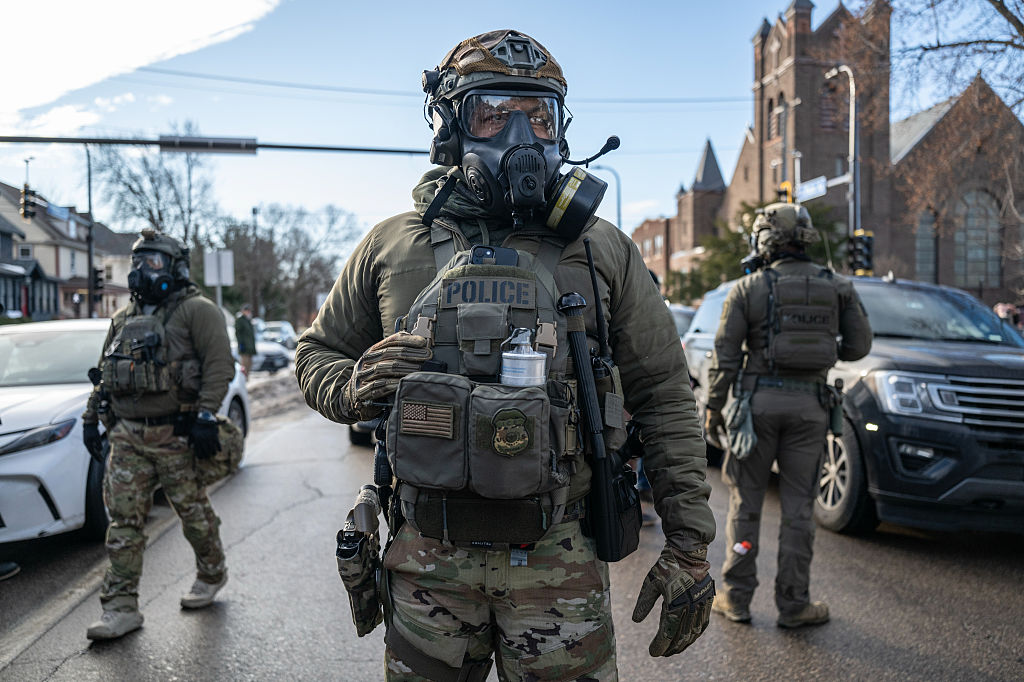
To train its sniper teams and special response groups, ICE has inked deals with military contractors and obscure security firms. (Victor J. Blue / Bloomberg via Getty Images
Over the past six months, per federal procurement records reviewed by the Lever, a variety of shadowy private security and weapons firms have been tapped to provide firearms and combat training to Immigration and Customs Enforcement’s (ICE) snipers and special response teams — several of which had never before received any federal contracts.
Jonathan Ross, the ICE agent who killed thirty-seven-year-old legal observer Renee Good in Minnesota last week, was a ten-year veteran of an ICE special response team, the agency’s equivalent of a SWAT team. Good’s killing has sparked nationwide unrest and scrutiny of ICE’s increasingly violent tactics.
The firms that have won valuable contracts under the Trump administration to train officers like Ross include a Texas armed security company, a politically connected sniper firm in Florida, and a shadowy tactical training company in Virginia. One, Target Down Group, is owned by the brother of Rep. Nick LaLota (R-NY), as Wired reported in September.
These firms are among the many private entities, alongside private prison companies and social media surveillance firms, lining up for their cut of the Trump administration’s deportation spending blitz, which nearly tripled ICE’s annual budget with the enactment of the GOP’s One Big Beautiful Bill in July.
ICE’s workforce has ballooned by 120 percent since President Donald Trump’s inauguration amid an unprecedented hiring frenzy. The agency has slashed its training requirements and loosened hiring standards to hire as many new recruits as possible.
The new contracts with little-known companies that advertise training in “advanced techniques once exclusive to military protection units,” are another window into the ongoing militarization of ICE, a subagency of the Department of Homeland Security.
ICE has long deployed tanks and specialized tactical units in the course of immigration enforcement. But the agency is now spending more than ever before on munitions and military equipment to outfit its officers. The consequences of this spending spree, in the view of many people who have taken to the streets in Minneapolis and around the country, were seen in the killing of Good and, a day later, the shooting of two people during a traffic stop by ICE.
A Bloomberg report last month found that ICE spent nearly $140 million on weapons and ammunition in the final weeks of the 2025 fiscal year, buying from some vendors that had previously worked primarily with the Pentagon. (A single vendor, LionHeart Alliance, received a $49 million contract last month to provide tactical gear like ballistic helmets to ICE.)
Most new ICE recruits go through several weeks of routine training at the Federal Law Enforcement Training Center in Brunswick, Georgia. Five hours away at the Fort Benning US Army base, near Columbus, ICE conducts more specialized tactical training for its elite units. As ICE’s special response teams have expanded, so has its programming at the military base.
ICE also rents firing ranges around the country for its agents; ICE spends the second-highest amount of money on gun-range contracts in Minnesota, behind Texas.
ICE’s training methods at Fort Benning have come under scrutiny before. In 2019, under the first Trump administration, the agency inked a contract with military contractor Strategic Operations, Inc., to build out its “tactical operations complex” at the military base, including a “hyper realistic” replica of a home in Arizona and an apartment complex in Chicago in order to train its agents for supposed “urban warfare.”
Strategic Operations received a subsequent $975,000 contract from ICE in 2024 for another “modular training structure” at Fort Benning, procurement records show.
Already, since September 1, 2025, ICE has spent nearly $8 million on new equipment — including simulation rounds, junk cars, sniper training gear, and a model building — for various training courses, including for its tactical training at Fort Benning, per the Lever’s review of contracting records.
To train its sniper teams and special response groups, ICE has also inked deals with military contractors and obscure security firms.
In July, ICE awarded a first-time, $23,000 contract to Reticence Group LLC, a Texas-based armed security firm, for “specialized law enforcement pistol and rifle” training. The company, led by two SWAT officers in Texas, advertises that it offers “covert and confidential armed security contractors” for the private sector, as well as “firearms training that pushes limits.”
Another sole source contract in July for $35,000 was awarded to Path Consulting LLC, a Virginia Beach–based firm that, according to a contract notice, provides “[close-quarter combat] live fire training” and would help an ICE special response team “develop new standard operating procedures.”
Although the contract notice indicated that Path Consulting LLC had worked with ICE in the past, no other online procurement records mention its name. A call to a phone number linked to the company went unanswered.
In September, ICE issued a no-bid contract to Target Down Group, a company owned by Dan LaLota, the brother of Nick LaLota, who has served as the Republican US Representative for New York’s first congressional district since 2023. (Dan denied his brother had any role in the award when asked by Wired in September.) Most of Target Down Group’s leadership are veterans of the US Special Forces; the company’s president, Dan LaLota, is a former US Marine.
The company’s website advertises “elite firearms instruction,” drawing from “years of experience as veterans from U.S. Military Special Operations.” In the Department of Homeland Security’s September justification for the no-bid contract, officials wrote that ICE had an “immediate requirement to procure precision fires and specialized observation capabilities for the national Special Response Team (SRT) sniper program.”
“The law enforcement officers of ICE have a very challenging job to conduct,” LaLota wrote in response to the Lever’s request for comment. “Target Down Group is honored to have provided training to them in order to assist them [sic] perform their duties.”
The other ICE training contractors mentioned in this story did not respond to inquiries, nor did ICE.