Rojava Is Fighting for Its Survival
- Oscar Davies
Syria’s interim government, backed by Islamist mercenaries, has launched large-scale attacks on the autonomous Rojava region. While Western states endorse Syrian president Ahmed al-Sharaa, domestically his government relies on violent repression.
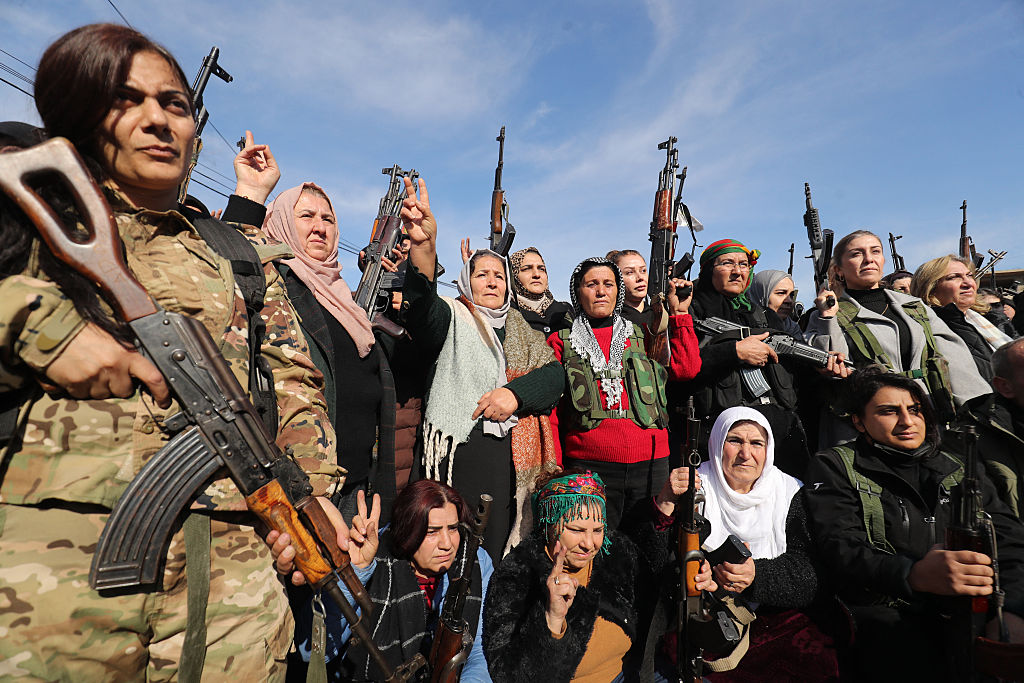
Kurdish civilians gather with their weapons in the city of Qamişlo on January 20, 2026 as the Kurdish-led Syrian Democratic Forces called for “young Kurds, men and women,” both within and outside Syria, to “join the ranks of the resistance.” (Delil Souleiman / AFP via Getty Images)
For days now, the Syrian interim government, together with Islamist mercenaries, has been carrying out attacks on Rojava, a de facto autonomous region in northeastern Syria. Not only is a humanitarian catastrophe imminent, but also the end of the Kurdish self-government.
Emel is about sixty years old and wears thick glasses and a white, traditional Kurdish headscarf. In her apartment in Qamishli (in Kurdish, Qamişlo), she offers fruit to guests. Her relatives are currently in the northern Syrian city of Aleppo, in the predominantly Kurdish districts of Sheikh Maqsoud and Ashrafiyah. Some have been missing for almost two weeks. Whether they are injured, have fled, or have been killed is unknown. Over two weeks ago, an attack was launched in Aleppo against supporters of Rojava — also known as the Democratic Autonomous Administration of North and East Syria (DAANES). Last week, the assault widened: The Syrian interim government and other jihadist groups supported by Turkey are attacking Rojava on three fronts.
But Emel remains determined. Her confidence as a woman in the resistance shines through in accounts of previous attacks, where she defended herself along with many other women. As a sign of community, songs are exchanged. After the anti-fascist song “Bella Ciao,” Emel responds by singing the Kurdish resistance song “Dil Dixwaze Here Cengê” (“The Heart Wants to Fight”). It’s not so much an abstract romanticization of revolution as it is a portrayal of the political reality in which many Kurds have lived for decades.