Kurds Resist Syrian Government Attack on Rojava
The Kurdish-led Syrian Democratic Forces played a key role in defeating ISIS. Now they are again forced to fight for their survival, as former jihadist Ahmed al-Sharaa’s transitional government seeks to crush Syria’s minorities.
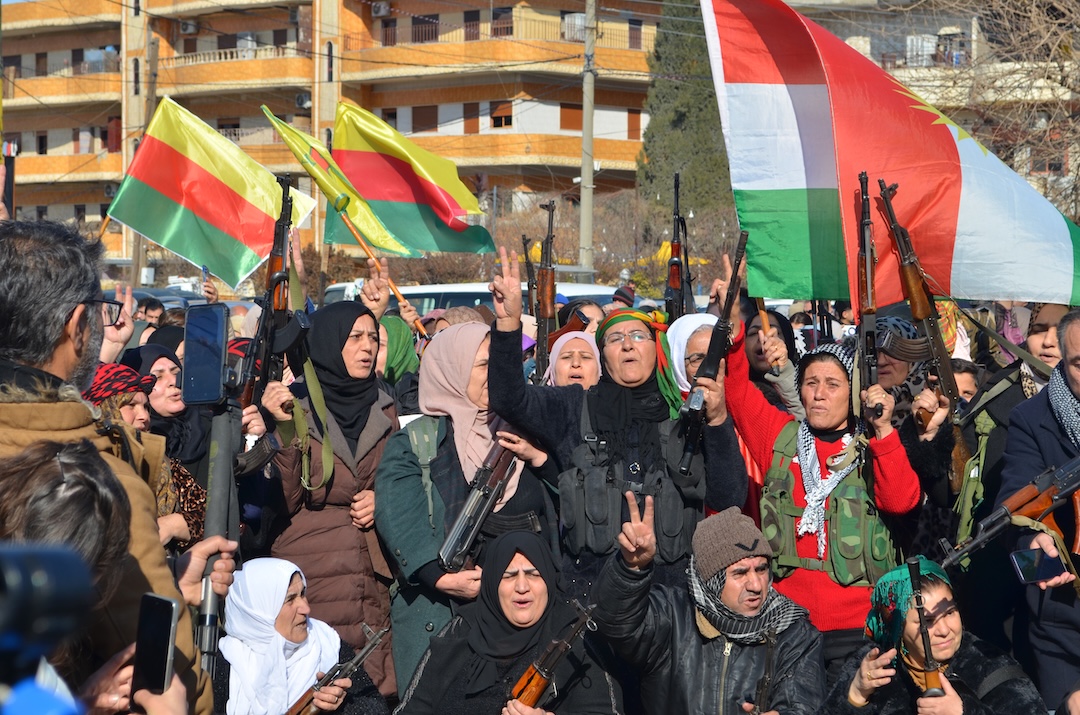
Western leaders used to consider Ahmed al-Sharaa a jihadist terrorist but now paint his Syrian transitional government as a moderate ally. Emboldened by this support, al-Sharaa is now trying to crush Kurdish autonomy by force. (Rojava Information Center)
It’s not often a whole city comes out to celebrate something, and still less to cheer the start of a military confrontation. Yet on Monday night, this was exactly why the Northeast Syrian city of Qamishli (in Kurdish, Qamişlo) came alive. “It’s crazy; they’re celebrating going to war,” remarked a friend in amazement as we headed into the city streets. Yet this isn’t just a war. It’s also about defending a revolution that many, including myself, had considered finished, only the day previously. “Resistance is life,” goes a popular Kurdish saying, and on Monday night Qamişlo showed that spirit in full.
In early January, Syrian transitional government (STG) forces under President Ahmed al-Sharaa attacked the Kurdish enclave of Sheikh Maqsoud and Ashrafiyeh in northern Aleppo. The people resisted but were overwhelmed by the STG. For two weeks now, the Kurdish-led Syrian Democratic Forces (SDF) have been in retreat, first losing the land west of the Euphrates and then east when they withdrew from the Arab regions of Raqqa and Deir ez-Zor. Thousands of Arab fighters defected from the SDF; tribes with whom the SDF had enjoyed good relations for years turned their backs and joined President al-Sharaa’s side. The government advance drove deep into the SDF’s territory known as Rojava. Then came the announcement that SDF commander general Mazloum Abdi had signed a ceasefire deal that, if implemented, would have been a complete capitulation returning all the gains the revolution made in the last fourteen years.
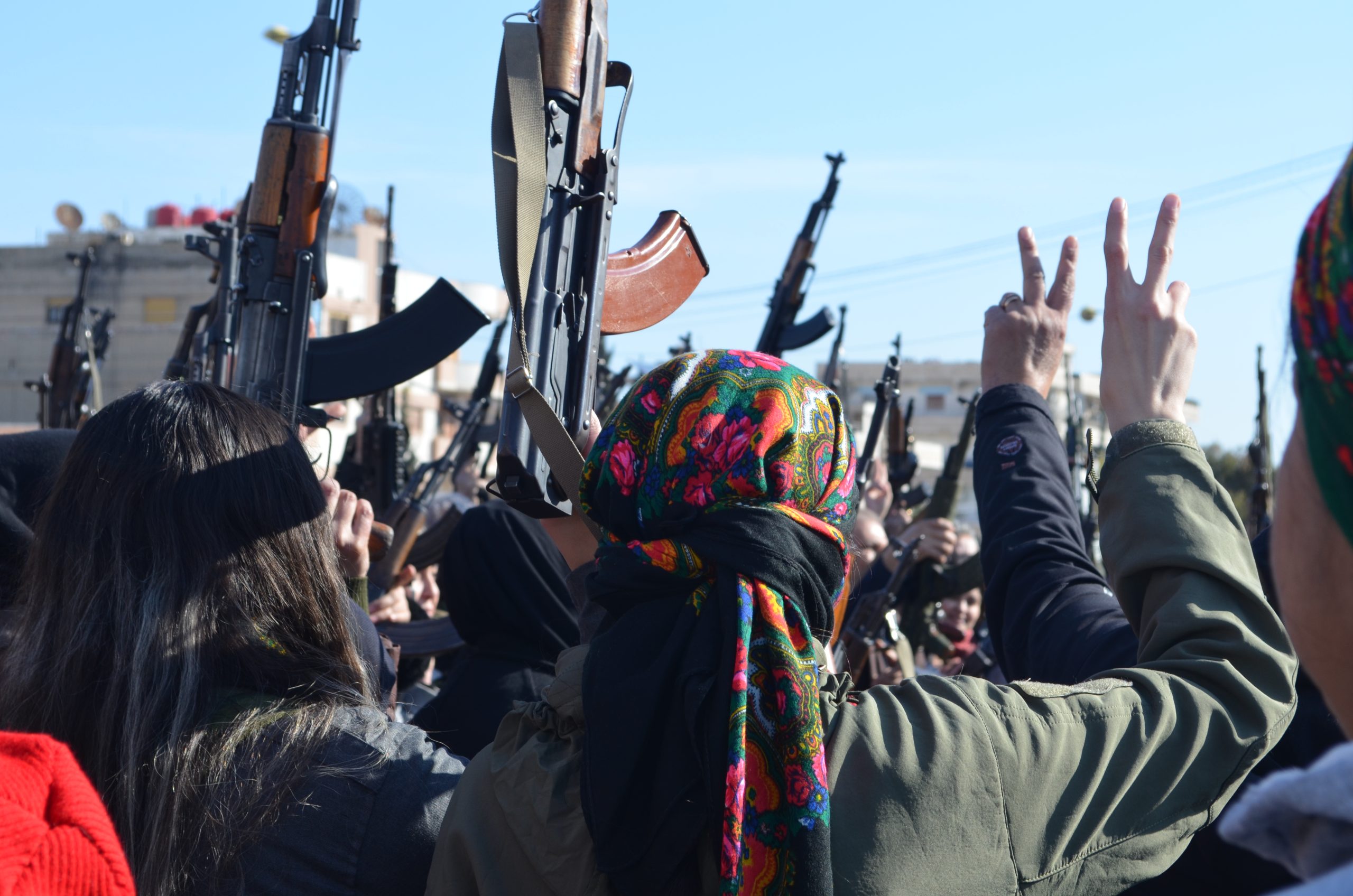
But it seems this agreement was only made to stall the STG advance. In the Kurdish heartlands in the very northeast corner of Syria, there has been a call to arms and popular mobilization in recent days. People across society from grandmothers to their granddaughters have responded by arming themselves. A Yazidi friend told me how his elderly father, unable to walk, is sitting in bed with his rifle, waiting for the transitional government’s soldiers to show up.
Sleeper cells supporting the STG have been activated in the city of Qamişlo on the Turkish border. The Civil Defense Units (HPC) have been keeping watch in the streets each night and have already arrested some of these undercover agents. Meanwhile, on Tuesday night, Turkish drones struck a Kurdish Red Crescent hospital and an Internal Security Forces checkpoint.
I met one of the many women to join HPC, Hevin Hassan, at a demonstration in Qamişlo where the municipality announced the popular mobilization. “As the people, the young, the old, the elderly, we’re all protecting our streets, until the early morning. We don’t sleep! Today isn’t the time for sleep. It’s time for resistance. We’re protecting our truth and our conscience,” Hevin explained.
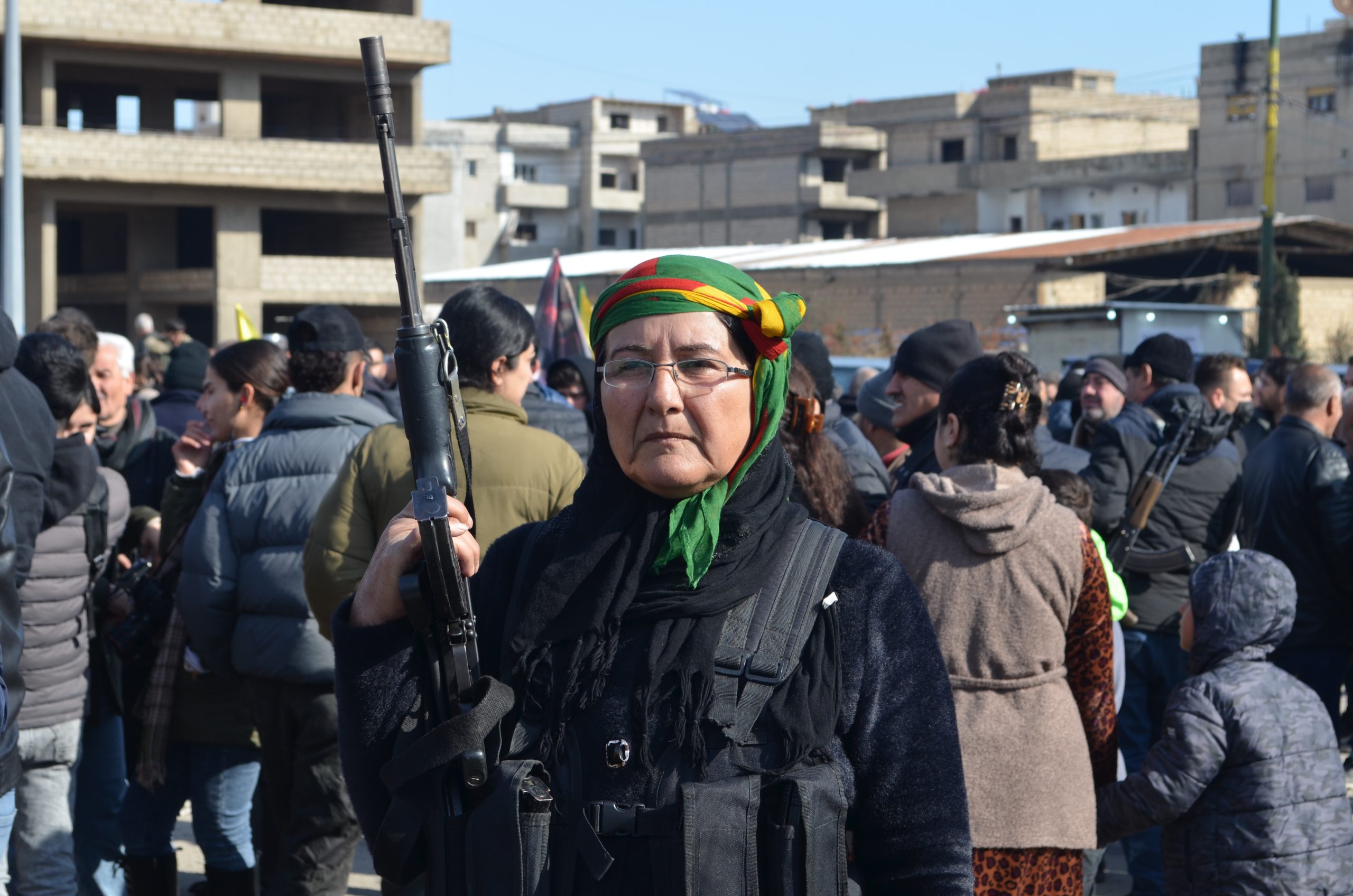
“As Kurdish women, we’ve come out to protect ourselves, protect our homeland, protect our land and our honor,” she told me. “Today in front of our people, we’ve taken up our weapons, and we’re going to support our soldiers and struggle to the last drop.”
Last year, after al-Sharaa swept to power, his military carried out massacres against the Druze people in the southern governorate of Suwayda and against Alawites in the western coastal region. It is understandable, then, why Kurds and minorities in the north are so determined not to give up: giving up could very likely lead to a massacre against them in the future.
A chant often heard at protests here is “There is no life without the leader” (a reference to imprisoned Kurdistan Workers’ Party leader Abdullah Öcalan). I heard this subtly changed to “There is no life without the war.” Videos and pictures showing the STG forces’ war crimes during their two-week advance have been circulating online. Kurds, Armenians, Christians, and the many other minorities that have found a home in northeastern Syria understand that this is a fight for the existence of their peoples and the way of life they built up here when they forced out the Islamic State (ISIS) and former president Bashar al-Assad’s Ba’athist state. There really is no life for them without this war.
“We aren’t scared of the fascist [Turkish president Recep Tayyip] Erdoğan, or his gangs, or Jolani [al-Sharaa]. We got the better of them before. Our 14,000 [martyrs] defeated their ISIS, defeated them in Kobane, and we will defeat them here too,” Hevin told me determinedly.
Over the past year, al-Sharaa and his Western backers worked hard to rehabilitate his image, turning him from jihadist militant to moderate liberal statesman. Now that the Kurds have played their role in fighting ISIS, the Western powers that spent years maligning him as a terrorist have switched allegiances. “The greatest opportunity for the Kurds in Syria currently lies under the new government led by President Ahmad al-Sharaa,” said the US ambassador to Turkey and envoy to Syria, Tom Barrack, yesterday.
Kurds don’t see it this way. Al-Sharaa isn’t reformed, they say, but a jihadist in a suit. “We gave so much in the fight against ISIS, and this is how they repay us?” one woman told me. “Don’t they realize that the new government has the same mentality as ISIS?”
Other people have responded to the mobilization by taking in refugees. Homes and schools have been opened to families fleeing the government advance. They are mostly Kurds and Yazidis from Afrin, Syria’s predominantly Kurdish northwest corner that was invaded by Turkey in 2018. Since then, many Afrinis have found themselves become refugees several times, first in 2018, then again in 2024 as Turkish mercenaries, the Syrian National Army (SNA), swept across the north during the offensive that toppled Bashar al-Assad. Some settled in Sheikh Maqsoud but fled their homes again at the start of the year.
At one school I visited, the teachers told me how they had given up their school and jobs to look after the people fleeing war. Every room was full with refugees, yet they didn’t have enough blankets, food, drinking water, or fuel to keep hunger and the freezing January air at bay.
In one of these schools, I met an elderly woman, rubbing her ankles in pain, who described how she had to walk for five hours in the pouring rain to leave Tabqa. Next to her sat Ahin, a mother of three who gave birth to her last child two months ago. She fled from Afrin in 2018 to a refugee camp in Shahba and then again to Tabqa when the Turkish-backed SNA attacked in 2024. This is the third time she has had to flee war, and when she arrived here the locals helped her settle in. “I thank the people here a lot. . . . They brought clothes for children. They brought blankets and carpets, water, food, and milk [for the babies]. No, really, we’re grateful.”
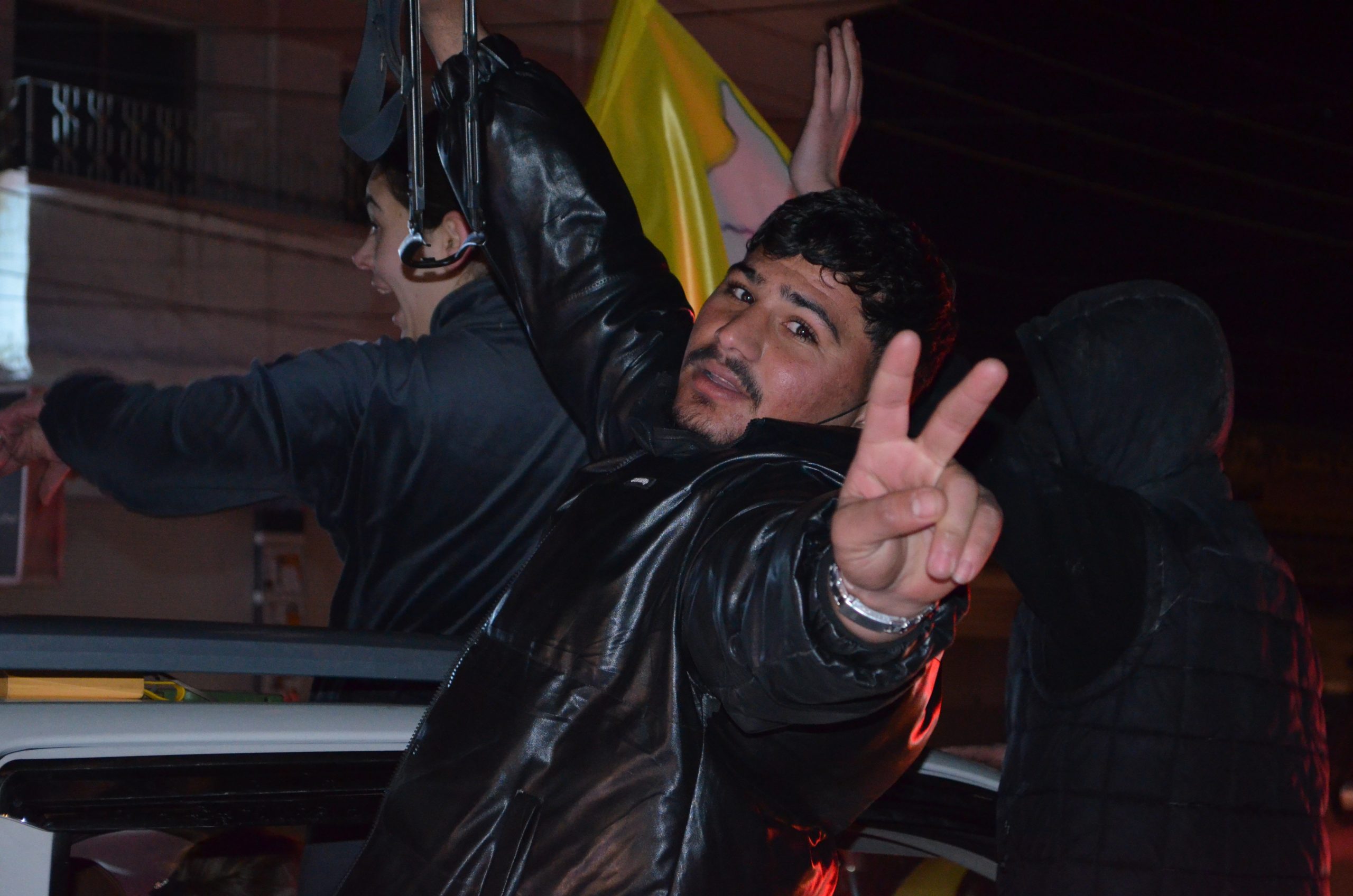
As I walked the street the other night — fires and dancing on every street corner, convoys of cars miles long waving the People’s Defense Units (YPG) and Women’s Protection Units (YPJ) flags — even the mosques joined in. Dance music and chants of “Long Live YPG/YPJ” blasted from the minarets. Young men roamed the street hanging out of cars, flags and guns in hand. “I can’t hear you, Qamişlo,” yelled one as they urged the few neighbors still asleep in bed to join them. Car horns blared across the city until sunrise.
The revolution in Rojava is still in a very precarious position. Kobane is close to being encircled as it was by ISIS in 2014. Sleeper cells are operating across the Jazira Canton in the northeast, and Turkish airpower is a constant threat. Despite a four-day agreement to halt fighting, clashes continue as STG forces continue their tradition of breaking ceasefires. But after weeks of retreat, the revolution has stopped running and turned around to fight al-Shaara. As Kobane is again encircled, many have begun comparisons to the heroic stand Kurds took against ISIS, which marked the beginning of the caliphate’s downfall and the expansion of the women’s revolution. Maybe that comparison isn’t too far off. Time will tell if this is the end of a revolution, or if the resistance has only just begun.