Rojava Is Fighting for Its Survival
- Oscar Davies
Syria’s interim government, backed by Islamist mercenaries, has launched large-scale attacks on the autonomous Rojava region. While Western states endorse Syrian president Ahmed al-Sharaa, domestically his government relies on violent repression.
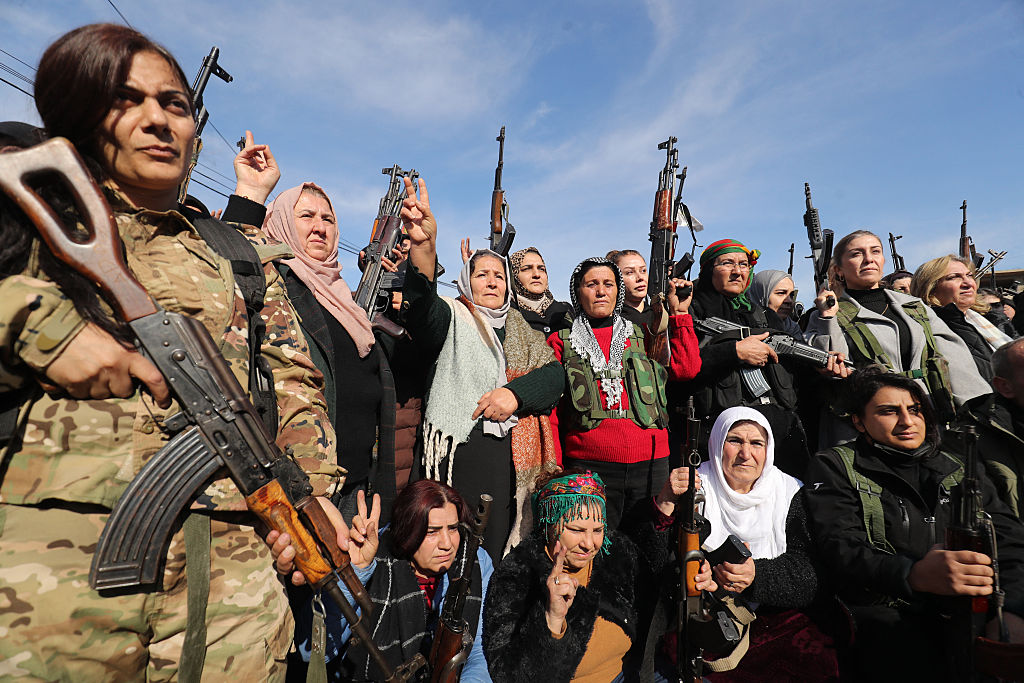
Kurdish civilians gather with their weapons in the city of Qamişlo on January 20, 2026 as the Kurdish-led Syrian Democratic Forces called for "young Kurds, men and women," both within and outside Syria, to "join the ranks of the resistance." (Delil Souleiman / AFP via Getty Images)
For days now, the Syrian interim government, together with Islamist mercenaries, has been carrying out attacks on Rojava, a de facto autonomous region in northeastern Syria. Not only is a humanitarian catastrophe imminent, but also the end of the Kurdish self-government.
Emel is about sixty years old and wears thick glasses and a white, traditional Kurdish headscarf. In her apartment in Qamishli (in Kurdish, Qamişlo), she offers fruit to guests. Her relatives are currently in the northern Syrian city of Aleppo, in the predominantly Kurdish districts of Sheikh Maqsoud and Ashrafiyah. Some have been missing for almost two weeks. Whether they are injured, have fled, or have been killed is unknown. Over two weeks ago, an attack was launched in Aleppo against supporters of Rojava — also known as the Democratic Autonomous Administration of North and East Syria (DAANES). Last week, the assault widened: The Syrian interim government and other jihadist groups supported by Turkey are attacking Rojava on three fronts.
But Emel remains determined. Her confidence as a woman in the resistance shines through in accounts of previous attacks, where she defended herself along with many other women. As a sign of community, songs are exchanged. After the anti-fascist song “Bella Ciao,” Emel responds by singing the Kurdish resistance song “Dil Dixwaze Here Cengê” (“The Heart Wants to Fight”). It’s not so much an abstract romanticization of revolution as it is a portrayal of the political reality in which many Kurds have lived for decades.
Soon after the singing, Emel’s son Agit and her six-year-old grandson Memo arrive from Aleppo. The family reunion is marked by both relief and sadness. Agit recounts being driven from her home and fleeing to the hospital in Sheikh Maqsoud, which at times has had to care for more than a hundred wounded. On the second day of fighting, two doctors were killed there by Syrian army soldiers. “We fled to the hospital with many other families, but then the Turkish state started bombing us there,” Agit says. He shows a video of one of the attacks, in which the young Memo shouts the slogan “Berxwedan jiyan e” (“Resistance is life”).
Agit’s wife and daughters are still in the center of Aleppo. Whether they will manage to escape to the Democratic Autonomous Administration of North and East Syria is uncertain. Even more questionable, however, is whether they would actually find safety there. In the time they’ve been attempting to flee, two more cities in DAANES have been occupied by jihadist forces.
Resistance in Aleppo
Since January 6, Aleppo has become the scene of a brutal chapter in the Syrian war, concentrated in the predominantly Kurdish districts of Sheikh Maqsoud and Ashrafiyah. Turkish-backed jihadist militias and forces of the so-called Syrian Transitional Government are deliberately targeting civilian infrastructure. Kidnappings, torture, and executions have been documented, particularly around the Xalid Fecir Hospital. And the hospital itself was bombed, turning an already precarious health care situation into an acute humanitarian crisis. Residential buildings, schools, mosques, and public facilities have also been shelled. Thousands of people have been displaced, while the estimated death toll rises by dozens each day.
The response to the attacks, however, was not surrender. On January 7, the community council in Sheikh Maqsoud declared, “the aim of these attacks is to massacre our population. Our people and our internal security forces are putting up fierce resistance against these attacks.” A form of community self-defense sprung up: Approximately three hundred members of the self-organized internal security forces faced up to attacks by some forty-two thousand jihadists.
After a few days, the Syrian Democratic Forces (SDF), the self-defense units of the DAANES, also began supporting the population. In addition, people from all over the DAANES territory traveled to Aleppo to provide assistance through civilian initiatives. Among other things, they attempted to establish a humanitarian corridor from the DAANES-controlled areas to Aleppo — a distance of nearly a hundred kilometers through territory controlled by Islamists — to evacuate the wounded. To prevent further escalation and evacuate the wounded, community councils in the districts and the SDF finally agreed to a ceasefire and the withdrawal of their units on January 11. The majority of the population fled the city: more than three hundred thousand people. Many of them have lost loved ones and are seeking refuge in DAANES-controlled areas.
This protection cannot be fully guaranteed, however, as attacks on eastern Rojava are expanding and massacres are being carried out with professional military equipment. The cantons of Raqqa, Deir ez-Zor, and Hasakah, as well as the Tishrin Dam, are now being targeted by jihadists. Prisons holding large numbers of jihadist fighters are located in Raqqa, Shedade (on the road to Deir ez-Zor), and Hasakah.
These areas are also predominantly Arab, and have not yet established a level of self-governance comparable to the Kurdish regions. Some Arab villages have sided with the jihadists during the wave of attacks.
The Background to the Attacks
The attacks on Rojava should not be viewed in isolation, but rather as part of the current power shift in Syria. After the fall of Bashar al-Assad’s regime in December 2024, the Islamist militia Hayat Tahrir al-Sham (HTS), under Ahmed al-Sharaa, seized control of large parts of the region. As a historic al-Qaeda affiliate, HTS lacks both viable administrative structures and broad societal legitimacy.
Nevertheless, Western states, especially the United States, have signaled an early strategic interest in the militia’s political rise. For the United States, the UK, and the EU, al-Sharaa appears as a weak actor that does not control large parts of the country and can thus be easily co-opted into long-term geopolitical interests in the Middle East. Since seizing power, HTS has presented a diplomatic front to the outside world, while repression and massacres are the rule internally. Alawites in Latakia, Druze in Suweida, and now Kurds have been targeted.
Despite this, DAANES, which advocates for a democratic, decentralized Syria, has sought negotiation. An agreement signed on March 10 last year envisioned a ceasefire and the integration of the SDF into autonomous units within the Syrian army. However, every time progress has been made in the negotiations to implement the agreement, Turkey has intervened. On one occasion, for example, Turkish foreign minister Hakan Fidan met with the HTS transitional government, and the latter subsequently withdrew the earlier-offered concessions. This ultimately led to HTS, in cooperation with other Turkish-backed Islamist mercenaries, launching a massacre against the DAANES enclave of Aleppo in noncontiguous regions –— the most difficult-to-defend areas of the self-governing administration.
Turkey’s Role
The attacks bear clear hallmarks of the Turkish state, which does not operate in the background — rather, it has substantial control over the relationship between DAANES and Damascus. Turkey’s political order historically is built on the violent suppression of minorities, particularly the Kurdish population, whose existence Ankara has systematically denied for over a century. Accordingly, the attacks aim not only at military control but, in the case of Aleppo, for example, at a demographic reorganization of the city to erase Kurdish identity and weaken a decidedly socialist liberation movement.
At the same time, Turkey is under geopolitical pressure. In the face of escalating wars in the Middle East — from Palestine to Iran — Ankara is losing strategic weight. New economic projects, such as the India–Middle East–Europe Economic Corridor, deliberately bypass Turkey and instead pass through Israel, which the United States intends to establish as the sole hegemonic power in the region. This shift, which has triggered a political and economic crisis in Turkey, was seized upon by the Kurdish movement as an opportunity to initiate new peace negotiations — based on the assumption that the Turkish state would be eager to avoid another military front.
Turkey’s behavior, however, casts doubt on whether it has any real interest in peace with the Kurds: The Turkish state continues to equate the Kurdistan Workers’ Party with the SDF and has declared that there will be no peace process without the SDF’s complete disarmament — a pretext for legitimizing further attacks. The fact that the SDF cannot unilaterally disarm due to the threat posed by jihadist actors such as ISIS or HTS is ignored. The latest developments underscore this: HTS has already carried out operations against IS prisons, resulting in the release of prisoners.
Meanwhile, the population of northern and eastern Syria is tired of war after fifteen years. Lava, a young woman displaced from the city of Afrin by the Turkish invasion in 2018, summed up the situation: “We don’t love war, we want peace. Turkey says we are all terrorists. But we are simply defending ourselves against being massacred.”
The People Defend Themselves
While HTS and Turkey continue their attacks on civilian targets west of the Euphrates River, the United States is pushing for de-escalation to consolidate its control in Syria. According to a strategy paper, the United States is banking on a weakened, fragmented Syria that will remain controllable — not a consolidated HTS dictatorship under Turkish protection. Ankara, on the other hand, is seeking to secure its regional hegemony militarily.
For the people in the area, this means a further escalation of the war. The future of self-governance in its current form is at stake. “If the international community doesn’t act, they will massacre all the people of Rojava,” warns Lava from Afrin. When asked how she manages to stay strong, she replies: “The Kurds have experienced many massacres. But they have always risen up again. We want peace and democracy. Therefore, we cannot and will not back down.”
Lava’s words embody the attitude of the people in Rojava, where the determination to resist continues. All sectors of society are preparing for an active defense following the methods of a revolutionary people’s struggle. Associations, institutions, and universities are in a strategic state of emergency, intended to ensure that a strong local self-defense force can be built.
People in the community are doing what they can — providing support for medical care, supplying food, caring for children, or performing military tasks. HTS’s plan is to separate Kobanê from DAANES, capture the Tishrin Dam, and thus gradually gain control over all of Syria. There is resistance to this throughout Rojava, in all parts of Kurdistan, and in the diaspora.
When six-year-old Memo shouts “resistance is life” in the bombed-out hospital of Sheikh Maqsoud, or when his sixty-year-old grandmother Emel sings “The Heart Wants to Fight,” these are more than just emotional gestures. They point to a comprehensive demand for a different order based on peace and democracy.