Why Labor Unions Can’t Ignore ICE
From agriculture to meatpacking to service work, immigration enforcement functions as labor discipline. Minnesota’s mass strike against ICE points toward a reckoning with the agency that the labor movement can’t avoid.
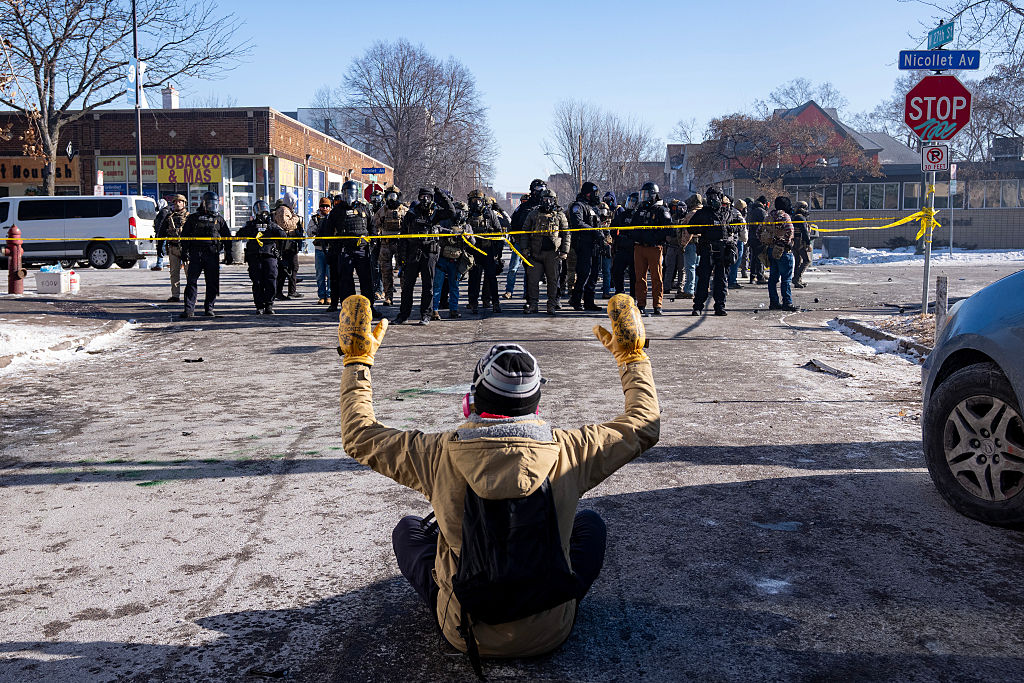
The labor movement has no choice but to take on ICE. (Richard Tsong-Taatarii / Minnesota Star Tribune)
On January 23 in Minneapolis, more than seven hundred businesses closed their doors, and thousands of workers joined Minnesotans of every variety to demand that Immigration and Customs Enforcement (ICE) leave the state. Nearly a century after the city erupted in a general strike, Minneapolis has again become a center of resistance — this time against federal immigration forces who have now killed two people and have turned the city into what many residents describe as a war zone.
Unions endorsed the January 23 action in a way we rarely see in the United States, where labor leaders often stay tightly within the bounds of “bread-and-butter” issues. The Minnesota AFL-CIO, backing the strike, warned that ICE’s operations were leaving people afraid to do the most basic things: going to work, shopping for groceries, sending their kids to school. That fear, its president Bernie Burnham said, was already harming working people across the state.
National labor leaders echoed the point. After the killing of Alex Pretti, an intensive care unit nurse and member of the American Federation of Government Employees, AFL-CIO president Liz Shuler called for ICE to leave Minnesota “before anyone else is hurt or killed,” explicitly linking immigration enforcement to danger for workers.
It’s about time organized labor took a clear stand against ICE. Rather than being adjacent to work, immigration enforcement is one of the key ways work is governed, and not in a way that benefits working-class people, US-born or otherwise. ICE is not simply a border agency that occasionally intrudes into the economy. It is a labor-market institution: an apparatus that disciplines workers, structures whole industries, and makes organizing riskier.
Economists have measured what happens when immigration enforcement expands. It reduces employment for likely undocumented workers — no surprise there — but it also lowers employment and wages for US-born workers. In a flagship study of Secure Communities, the federal program that turbocharged deportations by linking local policing to ICE, labor economist Chloe East and her coauthors find employment declines among likely undocumented immigrants alongside negative spillovers for US-born workers’ employment and hourly wages.
A Brookings Institution review of the post-2010 research landscape puts the point plainly: the weight of rigorous evidence does not show deportations “freeing up” good jobs for US-born workers. Instead, deportations tend to damage local labor markets and worsen outcomes for natives as well.
That alone should be enough to puncture the belief that this form of immigration enforcement “helps American workers.” But the more consequential effect — especially for anyone who has tried to organize a workplace — is not captured by wage averages. Enforcement doesn’t have to culminate in deportation to function as discipline. The mechanism is fear, distributed unevenly across a workforce so that solidarity becomes harder and retaliation easier.
ICE doesn’t just remove people; it changes behavior among those who remain. When immigration enforcement intensifies, workers become significantly less likely to report safety violations, even as injury rates rise in workplaces with large immigrant workforces. The right to complain — to be visible, to put your name to something — is one of the basic building blocks of worker power. When the cost of visibility rises, organizing erodes. ICE is producing a labor market with a built-in underclass.
There are plenty of recent examples of what that looks like in practice. In June 2025, ICE raided Glenn Valley Foods in Omaha, Nebraska. Reporting described the plant losing roughly half its workforce, with output dropping to a fraction of normal — an operational shock that did not raise wages so much as reduce production and ricochet through the supply chain.
Even the business press has acknowledged the dilemma: aggressive deportation and workplace enforcement disrupt meatpacking, agriculture, construction, and hospitality — sectors structurally dependent on immigrant labor — creating shortages, delays, and price pressures rather than some newly empowered native workforce.
Agriculture makes the logic impossible to ignore. As enforcement intensifies, workers don’t show up, farms can’t harvest, and companies scramble. Wages do not magically leap. Wisconsin Public Radio has reported farmers’ fears that surging deportations will worsen already severe labor shortages.
The labor movement has had language for this for a long time: an injury to one is an injury to all. The Industrial Workers of the World slogan was never just a moral appeal. It was also a diagnosis of how employers and the state undermine working-class power. They always try to segment the working class — by skill, by race, by nationality, by legal status — so that harm inflicted on the most vulnerable can be treated as isolated or deserved, all while undermining the standards of all workers.
History bears that out. Immigration enforcement has repeatedly been used to fracture workplaces and derail organizing drives. Labor Notes’ reporting on a 2008 raid documents how a single enforcement action shattered an organizing effort at an Iowa meatpacking plant, removing workers central to the union campaign and terrorizing those who remained. Mass immigrant boycotts and “days without immigrants,” most notably in 2006, made visible the same truth from another angle: entire sectors of the economy depend on labor that the state tries to render disposable.
Immigration enforcement is a working condition. It determines whether you can file a complaint, talk to a reporter, sign a union card, testify in a wage-theft case, or simply insist that a job is unsafe. When the state creates a category of workers whose continued presence is conditional, it hands every employer an extra lever of power over their workforce. Even bosses who never touch that lever benefit from its existence.
US labor law tries to draw a bright line here. You are permitted, in narrow ways, to fight your boss. You are not supposed to fight the state. When workers violate that demarcation — when they treat deportability, detention, or raids as union business — it is a recognition that the world beyond their workplace structures the jobsite itself.
Minneapolis’s working class is refusing to keep pretending that immigration enforcement sits outside the world of work. But ICE operates everywhere. The lesson is not that every city must replicate Minnesota’s exact tactics. It is that workers elsewhere face the same underlying choice: whether to accept a system that weakens organizing by design, or to name that system as a labor issue and act accordingly. If an injury to one is an injury to all still describes anything real, then the response cannot remain local to Minnesota.