Arming Ourselves Isn’t the Answer to Rising Authoritarianism

Expanding gun ownership in response to ICE’s horrific violence is not a path toward safety or liberation, argues epidemiologist Rachel Hoopsick. It is a path to more death, more political weakness, and deeper entrenchment of the very forces the Left opposes.
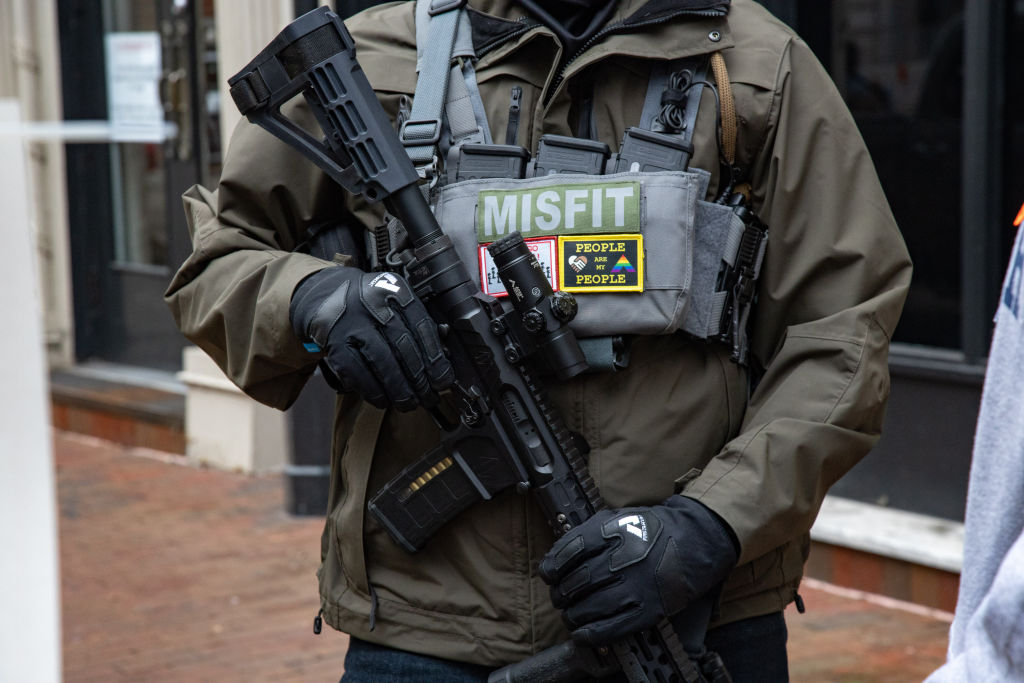
The most effective resistance to repression has come not from armed civilians confronting the state directly but from coordinated disruption of economic and political systems. (Bryan Dozier / Anadolu Agency via Getty Images)

Escalating political violence in this country — including the recent killings of Alex Pretti, Renee Good, and Keith Porter by federal immigration agents from Immigration and Customs Enforcement (ICE) and the US Border Patrol — has raised the question: In the face of an increasingly authoritarian state, should people on the Left arm themselves?

Although registered Republicans are more than twice as likely to own at least one gun compared to registered Democrats (45 percent versus 18 percent, respectively), gun ownership on the Left is on the rise. For many, in the face of such state violence, guns may offer a last line of self-defense against government violence.

This argument is not new, and it is not frivolous. It is rooted in real fear, real grief, and real anger at a state that has repeatedly demonstrated its willingness to use violence against anyone who stands in its way. But it is also deeply mistaken.

From a public health perspective, and from the standpoint of how power actually operates in capitalist societies, expanding civilian gun ownership is not a path toward safety or liberation. It is a path toward more death, more political weakness, and deeper entrenchment of the very forces the Left opposes.

As a public health researcher, I approach this debate through outcomes. What happens when guns proliferate, who is harmed, and who benefits — and which strategies have actually constrained authoritarian power in the past — are empirically answerable questions.

The answers point away from firearms and toward collective action as the only credible counterweight to rising authoritarianism.

The United States Is Already Overarmed

Any serious discussion of arming civilians must begin with a basic empirical reality: the United States already has more guns than people. According to estimates from the Bureau of Alcohol, Tobacco, Firearms and Explosives, there are likely 400 to 500 million firearms in civilian possession, which is a level of saturation unmatched by any other country in the world. This is not a baseline from which more weapons can be added without consequence.

In 2023, nearly 47,000 people in the United States died from firearm injuries — that’s an average of more than five deaths per hour, every hour, every single day. But what often gets left out of the headlines — and public perception  — is the fact that nearly six in ten gun deaths are suicides.

A study published in 2022 from researchers at the University of Washington Center for Firearm Injury Prevention found that adults in gun-owning households believed accidental shootings were more likely than firearm suicide or assault, despite mounting evidence to the contrary.

The relationship between gun access and suicide is particularly well established. Firearms do not increase suicidal ideation, but they dramatically increase the likelihood that a suicide attempt will result in death.

Unlike other means of death, suicide attempts with a firearm are rarely survivable. Research shows that more than 90 percent of suicide attempts made with a firearm result in death. In moments of acute psychological distress, which are often brief and transient, easy access to a firearm turns crisis into fatality.

This is why gun ownership is consistently associated with higher suicide risk, even after accounting for other factors. This is why states with higher gun ownership rates have higher firearm suicide rates. And it is also why claims that guns provide “security” collapse under scrutiny when viewed through a population-level lens.

Firearms have been the leading cause of death among US children and adolescents since 2020, when it surpassed every other cause of death. In a study of violent deaths across twenty-nine high-income countries, more than 98 percent of all children killed by firearms — by homicide, suicide, and accident — were in the United States. These are not marginal effects. They are all central features of an overarmed society.

From a public health perspective, firearms function like any other highly lethal consumer product: their increasing availability increases injury and death. This is not a statement about individual intent or morality. It is about exposure and risk.

The Second Amendment Argument

To be sure, many people contend that this is exactly the kind of moment the Second Amendment was written for. When the state becomes unaccountable and law enforcement and federal agencies act with impunity, armed resistance is framed as both a constitutional safeguard and a moral necessity.

It is important to acknowledge this argument honestly rather than dismiss it reflexively. The concern it reflects — that the state cannot be relied on to protect its vulnerable communities — is justified. But acknowledging that historical rationale does not resolve the question at hand. The relevant issue is not what the Second Amendment imagined in the abstract but what actually happens in a society already flooded with firearms.

In contemporary America, expanding civilian gun ownership does not meaningfully constrain state violence. It has not deterred militarized policing or federal enforcement in practice. Instead, it has the potential to escalate encounters, increase threat perception, and justify further militarization. When civilians are armed, the state does not retreat; it responds with heavier weaponry, broader surveillance, and more aggressive tactics.

At the same time, the harms of increased gun prevalence are borne overwhelmingly by civilians — particularly working-class people, those experiencing mental health crises, and communities of color that are already subject to over-policing. In practice, arming civilians does not shift power away from the state or capital. It shifts risk onto individuals — into homes, moments of crisis, and everyday interactions — where it predictably produces injury and death without altering the structures that generate repression in the first place.

Guns Privatize Risk, They Do Not Build Power

One of the central failures of the “arm the left” argument is that it conflates individual capacity with collective power. A firearm is a private good. Its risks and consequences are individualized, even when its symbolism is collective. It lives in homes, cars, and pockets — not in institutions capable of confronting state authority.

When guns enter communities, they do not remain reserved for moments of political confrontation. They are present during arguments, depressive episodes, domestic conflicts, and accidents. Public health data show that these everyday contexts, not organized resistance, account for the vast majority of firearm deaths. In this way, arming civilians turns structural violence into individualized tragedy. It replaces solidarity with exposure and collective protection with private danger.

This is precisely why mass movements that have successfully constrained authoritarian power have relied on different tools. Historically, the most effective resistance to repression has come not from armed civilians confronting the state directly but from coordinated disruption of economic and political systems: strikes, boycotts, mass noncompliance, and collective withdrawal of labor.

From the US labor uprisings of the 1930s to the civil rights movement’s use of boycotts and mass refusal mid-twentieth century to  Solidarność’s strike campaigns in Poland in 1980 and the anti-apartheid movement’s economic disruptions in South Africa from the 1950s to the 1990s, power was won by making repression economically and politically untenable rather than attempting to match the state’s coercive force directly.

What Engels Got Right — and Why It Still Matters

Friedrich Engels understood this distinction clearly. Writing about nineteenth-century England, he described class struggle as a form of “social war,” but he was explicit about where working-class power was actually forged.

Strikes, Engels argued, functioned as a school of war not because they were symbolic acts of defiance, but because they forced workers to act collectively in the face of real deprivation. By enduring hunger, retaliation, and uncertainty together, workers developed the discipline, coordination, and solidarity necessary for sustained struggle. They were material interventions that imposed real costs on capital.

Just as importantly, Engels was skeptical of radical posturing that bypassed this process. He consistently emphasized that working-class power could not be willed into existence through militant language or isolated acts but had to be built through collective action rooted in material conditions. Struggle divorced from mass participation, he argued, was politically empty — incapable of altering the balance of power between labor and capital.

The relevance of this insight today should be obvious. Firearms may feel like instruments of resistance, but they do not create the collective capacity required to confront either state or corporate power. They concentrate force at the individual level while leaving the structures that organize repression fundamentally unchanged. Organized labor, by contrast, operates at the level Engels identified as decisive.

General strikes, mass walkouts, and coordinated labor actions attack the foundations of authoritarian governance itself: economic productivity, political legitimacy, and administrative capacity. They make repression costly rather than cathartic. And they expose the state’s dependence on the very people it seeks to discipline and control.

The Political Economy of Guns

There is another dimension of this debate that is often ignored: guns are not just tools. They are commodities embedded in a powerful political economy.

Industry trade association data estimate that the firearm and ammunition industry was responsible for more than $91 billion in economic activity in just 2025. Every firearm purchased contributes to an industry and lobbying apparatus that has spent vast sums shaping US politics through elections, judicial appointments, and legislative battles.

Over the last two decades, the National Rifle Association has spent more than $58 million in federal lobbying alone. The organization has successfully blocked even modest gun safety measures, despite overwhelming public support. According to data from the Pew Research Center, the majority of Americans think it is too easy to legally obtain a gun (61 percent) and favor stricter gun laws (58 percent).

This history matters. Gun purchases do not exist outside of politics. They materially strengthen the forces that have normalized mass gun violence, obstructed accountability, and undermined democratic governance. When the Left encourages gun ownership — even for ostensibly oppositional reasons — it funnels money, legitimacy, and cultural power into the same machinery.

This is not an abstract concern. It is a measurable one. The gun lobby’s influence has shaped policy outcomes for decades, often in direct opposition to public health evidence and popular will. The gun lobby’s influence has even shaped what we know about gun violence. Federal funding for firearm injury research was effectively curtailed for decades after the 1990 Dickey Amendment, which barred the Centers for Disease Control and Prevention from using funds “to advocate or promote gun control.” This climate of political constraint has left public health researchers with limited data and delayed critical inquiry into the patterns, causes, and prevention of gun deaths. Any strategy that reinforces this power structure should be viewed with deep skepticism.

A Public Health Framework for Anti-Fascism

From a public health perspective, the question is not whether violence exists — it absolutely does — but how harm is distributed and mitigated. Strategies that increase exposure to lethal means reliably increase death. Strategies that build collective capacity, social cohesion, and economic security reliably reduce it.

This is why labor action matters not only politically but epidemiologically. Economic insecurity and unemployment are associated with worse mental health outcomes and higher suicide risk, while research shows that economic exploitation itself is linked to elevated psychological distress. Stable employment, collective bargaining, and worker protections are not only sources of political power — they are health-protective. Solidarity is protective. Precarity is deadly.

Although some scholars and historians avoid equating current events in the United States with historically fascist regimes, many see nontrivial risks and troubling parallels. Contemporary American fascism is advancing, and it will not be stopped by turning homes into arsenals. It will be stopped by organized, collective refusal to cooperate with authoritarian systems. That refusal takes courage of a different kind: the courage to risk income, stability, and comfort in pursuit of collective survival.

The Left faces a real choice. It can embrace a politics of fear, privatized defense, and escalating risk — a path that history and public health both suggest will lead to more death and less power. Or it can invest in the slow, difficult work of building collective institutions capable of confronting authoritarianism at its roots.

More guns will not save this country. They will only deepen the crisis — lining the pockets of gun manufacturers and lobbyists with more wealth and political leverage while lining our streets, homes, and communities with more bodies of working-class people.

Collective action — strikes, boycotts, mass noncompliance, withdrawal of labor — is the only force that has historically constrained authoritarian power. Fascism will not be stopped at the gun counter.