The Triumph and Tragedy of Poland’s Solidarity Movement
Poland’s Solidarity trade union was one of the most impressive workers’ movements in postwar Europe. It rocked the foundations of an autocratic regime, but it took a wrong turn as the Eastern Bloc started to crumble.
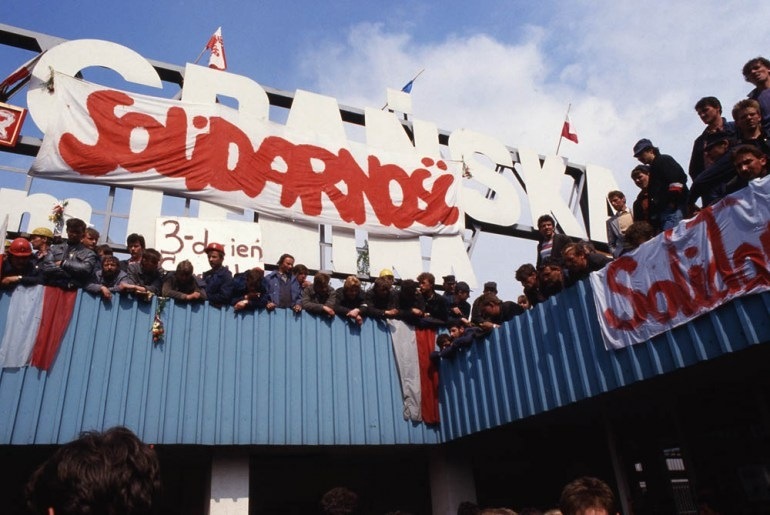
Strikes at the Gdańsk Lenin Shipyard in 1988. (Jerzy Kosnik)
Poland’s Solidarność (“Solidarity”) movement emerged in August 1980 as a left-wing workers’ movement against the putatively left-wing workers’ state governing the country. It was a time of militant strikes, mass participation, and nascent workers’ control of enterprises, with workers and intellectuals jointly challenging bureaucratic state socialism and posing demands for greater democracy, but not for the restoration of capitalism.
Today, what remains of Solidarity is a trade union closely associated with the right-wing Law and Justice party government of Jarosław Kaczyński. This has led many, even in Poland, to reject the movement and discard its legacy. That is unfortunate. The Solidarity uprising was one of the great left-democratic social movements to have occurred since World War II. The contemporary left can still learn a great deal from its experiences and from its evolution.
Wildcat Movement
The movement began as a wildcat strike at the powerful Lenin Shipyards in Gdańsk, a plant with over twenty thousand workers and a tradition of labor protests for workers’ rights. Strikes were illegal in state-socialist society, and unions largely worked in cahoots with management. However, a small circle of opposition labor and intellectual activists convinced key production units to lay down their tools, in the middle of a summer of unrest sparked by the imposition of higher food prices.