Ohio Train Derailment Victims Are Still Waiting for Justice
Three years after the toxic train derailment in East Palestine, Ohio, the railroad, lawyers, and myriad companies involved in a $600 million class action settlement have all been paid — while many residents have yet to receive anything.
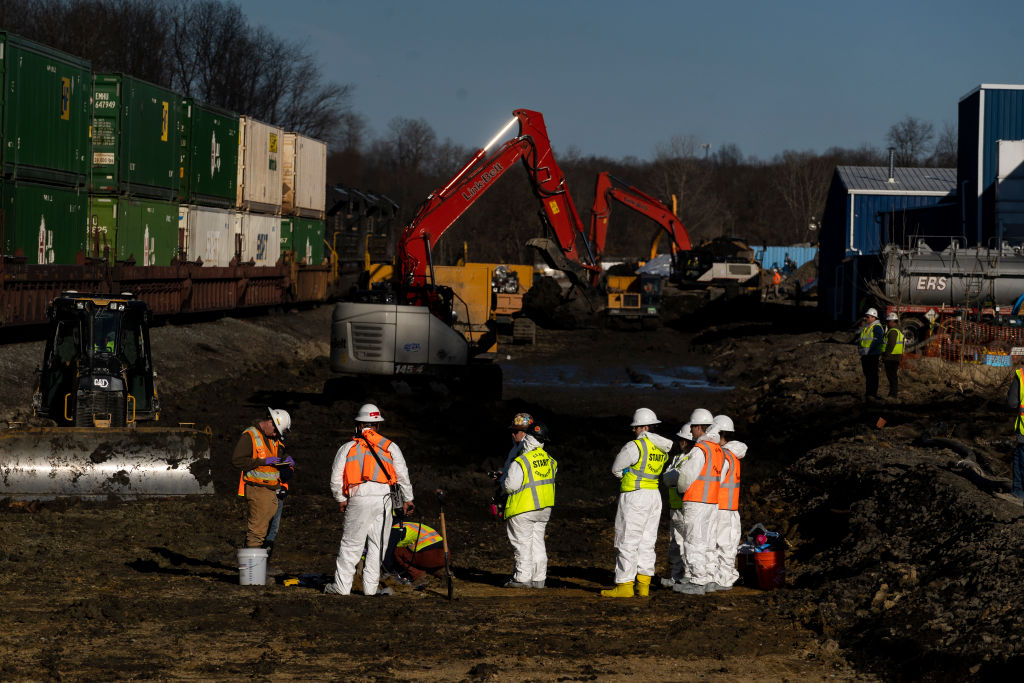
Ohio EPA and EPA contractors collect soil and air samples from the derailment site on March 9, 2023, in East Palestine, Ohio. (Michael Swensen / Getty Images)
On a balmy evening last September, Michael Fowler stumbled out to the south rail line in East Palestine, Ohio, and sat down in the middle of the tracks. His dog, a white Chihuahua, was beside him. The sun was setting. He waited perilously for the next oncoming train.
He wouldn’t have to wait long. Dozens of times a day, freight trains blare through East Palestine, cleaving the small Ohio town in two. The stretch of tracks on which Fowler sat was just a few hundred yards west of the site where two and a half years earlier, a Norfolk Southern train carrying tank cars full of toxic chemicals derailed and burned. The accident sent dark plumes of smoke over the town, leached toxins into local creeks and soil, and ignited a national reckoning around rail safety, one that has since delivered few reforms.
Fowler, fifty-four, was upset with Norfolk Southern, an East Palestine police officer later reported in a sworn affidavit. He had not received the money he was promised from the $85 billion rail company — his cut of the $600 million settlement that Norfolk Southern had agreed to pay to resolve residents’ class action lawsuit over the derailment. Eighteen months after the settlement’s announcement, still no check had arrived.
That September night, Fowler had decided to take matters into his own hands. He hoped to “cost the railroad money,” the police officer wrote, by putting himself in the path of the trains, which ran so close to his home that he could see the tracks from his front lawn.
Fowler was not the only East Palestine resident waiting on restitution from the settlement, which was touted as “historic” by the deep-pocketed lawyers who negotiated it. Nearing the three-year anniversary of the derailment, the railroad, lawyers, and myriad companies involved in the settlement have all been paid — while many residents have yet to receive anything.
The settlement has been mired by delays and scandal. Many checks first promised in 2024 have yet to arrive. The class action lawyers, who have already collected their $180 million cut of the total, face allegations in court that they misled clients into accepting paltry sums. The private-equity-backed company responsible for doling out cash to residents has allegedly misallocated over $17 million and wrongly denied thousands of claims, all while carving out millions in fees from the settlement.
As a result, payouts have been delayed for months, leaving residents in the dark about when — or if — they will see any kind of justice for a disaster that upended their lives and whose long-term impacts on the town and their health remain unknown.
As the Trump administration axes regulations meant to prevent chemical and climate disasters, and companies like Norfolk Southern face reduced scrutiny for corporate negligence, civil cases like this take on an ever more central role in whatever process remains for accountability. But, at least in East Palestine, that system is leaving residents behind.
Around 8 p.m. that night, an East Palestine police dispatcher placed an urgent call to Norfolk Southern. A caller had reported that a man was threatening suicide by train. All rail traffic through the town should be halted, the dispatcher said.
Officers soon found Fowler sitting on the railroad tracks in the fading light, very drunk. They escorted him off the rails, brought him to a hospital, and then charged him with criminal trespass. (The Lever could not reach Fowler, though an Ohio lawyer representing him said he was arranging a plea agreement with county prosecutors.)
A few minutes later, Norfolk Southern’s freight trains resumed running, all through the night.

“Is It Safe to Live in Our House?”
Many of the Norfolk Southern trains that pass through East Palestine carry petrochemicals, the noxious lifeblood of the plastics industry. The train that derailed on February 3, 2023, was carrying thousands of gallons of vinyl chloride, a dangerous chemical used in plastics manufacturing, from the Gulf Coast to a resin factory on the Delaware River.
An hour before the train derailed, a wheel bearing began to catch fire on car twenty-three. Surveillance cameras twenty miles east in Salem, Ohio, captured the first flames, unbeknownst to the crew. As the train reached the west side of East Palestine, the bearing failed entirely. Thirty-eight railcars careened from the tracks, erupting into flames.
On February 6, Norfolk Southern, contrary to expert advice it received, detonated holes in the five railcars that contained vinyl chloride, drained their contents into a ditch, and set the toxins on fire. A massive chemical plume filled the sky over East Palestine and surrounding towns for days, so vast and dark it looked like a thundercloud rolling in.
This course of action released over a million pounds of vinyl chloride and its byproducts into the town’s air and waterways, but it also had the convenient effect of quickly clearing the train tracks. Just two days later, on February 8, 2023, Norfolk Southern’s trains began running again through East Palestine.
The fires, the billowing chemical plume, the fine gray soot that covered homes in East Palestine, a north Appalachian town already in postindustrial decline — images of the derailment gripped the national consciousness. As the Lever helped expose, the story behind the derailment was inextricably linked to corporate greed: Norfolk Southern, enabled by a feckless Department of Transportation, had for years pushed to kill train safety rules that could have helped prevent such a catastrophe. It also, in the name of profits, operated ever longer and riskier trains — like the one that derailed in Ohio.
It was the kind of story that would play well in court.
The train cars were still burning when the first lawyers arrived in East Palestine. Soon, the town was crawling with class action attorneys, recruiting locals in droves to sue Norfolk Southern. Posters and flyers plastered about town advertising the various law firms promised justice alongside the grinning, floating heads of men in suits.
“It was almost like they had those flyers printed out before they got here,” recalled Carly Tunno, an activist and mother who lives seven miles from the derailment site, just over the Pennsylvania border. “And we’re still figuring out, is it safe to live in our house?”
By mid-March, eighteen lawsuits had been filed on behalf of residents. The cases would ultimately be consolidated into a single class action suit. A judge appointed three lawyers, all from out of state, to preside over the litigation.
The attorneys had impressive resumes in complex cases: Jayne Conroy, a New York lawyer who has led litigation against Big Pharma over the opioid epidemic; Elizabeth Graham, who battled big-name auto manufacturers over faulty parts; and Seth Katz, part of the legal team that sued Columbia Gas over a massive natural gas explosion in Massachusetts in 2018.
All had made millions in the business of class actions and mass torts, both critical avenues for people to get justice for corporate wrongdoing. But the flourishing industry also has its own con men and speculators.
Now they were turning to East Palestine.

“Losing Everything”
On a Friday afternoon in May 2023, three months after the derailment, Will Schaffer was driving down Market Street in East Palestine when his Jeep spun off the road, crumpling against a telephone pole.
A local cop who witnessed the accident assumed Schaffer was drunk. But when the officer got to the car, he realized Schaffer was having a seizure.
Schaffer, 59, worked at a manufacturing plant in East Palestine, a half mile from what’s become known as “ground zero,” the site of the derailment. Despite the dayslong evacuation order, the machines at Schaffer’s employer had to keep running. So while the Norfolk Southern train still smoldered a few hundred yards away, the chemical plume wafting overhead, Schaffer remained at his post.
The symptoms soon began for Schaffer: headaches, strange rashes. (Some 60 percent of people in the vicinity of the derailment, in one survey, reported “persistent headaches,” alongside eye and nasal irritation.) The more serious warning signs came later: Mild brain fog, an occasional slip in his memory.
Now, behind the wheel, he’d lost all control.
Schaffer broke his back in two places. A concussion brought lingering cognitive issues. He’s been unable to work ever since, unable even to take the desk job offered by his former employer.
Without income, Schaffer lost his lot at a local mobile home park. To help with his care, his daughter quit her job as a cancer nurse. Now he spends his days in a small, spare apartment in Bessemer, Pennsylvania, waiting by the window for his five-year-old grandson, Knox, to get home from school.
“We couldn’t get help with nothing,” said Michele Gasper, his ex-wife. “And this man, who had worked constantly, all his life, is sitting there, and he’s losing everything.”
Schaffer had no history of epilepsy; his family blames the incident on the derailment. Seizures and other neurological issues have been documented as side effects of exposure to vinyl chloride and other chemicals known to have been present in the air after the crash. But data on the matter is limited, so it’s difficult to connect the accident to Schaffer’s condition with certainty — or assign blame.

Help seemed to arrive in April 2024. That month, the class action lawyers announced that Norfolk Southern had agreed to a $600 million settlement over the derailment. It was an unusually fast timeline for such a complex and high-profile case; the settlement was reached just over a year after the first lawsuits were filed.
The attorneys justified the quick turnaround by saying many residents in East Palestine could not afford to wait for a check. “The relief that the community needed was immediate,” Graham, one of the three lead lawyers on the case, later said. For the Schaffers and many other residents, there was truth to this.
But a prompt settlement also meant the lawyers got paid more quickly. Attorneys in these cases typically get their paycheck when the deal is signed, before the settlement is allocated. That creates an incentive for quick deals, but it also reduces lawyers’ investment in making sure everyone else gets their due.
All people living and working within 20 miles of the derailment site — an area that encompasses not just East Palestine but several of the surrounding towns in Ohio and Pennsylvania — were eligible to submit claims. Awards, based on residents’ proximity to ground zero, would range from a few hundred dollars to tens of thousands. All told, the $600 million, minus the attorneys’ $180 million cut, could be divided among a class of hundreds of thousands of people.
For those within 10 miles of the derailment, however, there was another pot of money, some $129 million. The class action attorneys called it the “personal injury program,” and, in pamphlets they distributed around town, promised an additional $25,000 per person for East Palestine residents who submitted claims.
To receive this additional money, there was a catch. Residents had to sign a release form waiving their right to sue Norfolk Southern for any future “personal injury” — that is, any health issues, including cancer or other serious illness, that arose in the future related to the derailment.
Schaffer’s family filled out the paperwork, glossing over the fine print. The payments meant that Schaffer could “get back on his feet,” his daughter, Vinci Schaffer, said. And they had no money for a lawyer. By May 2025, a letter had arrived in the mail confirming that Schaffer was eligible for a $25,897 payout, scheduled to arrive imminently.
Weeks went by, and then months. No check arrived. Although Vinci and her boyfriend lived within 20 miles of the derailment, making them eligible for a cut of the settlement, their own claims were denied.
The family says the payout confirmation letter remains the only communication they have ever received from the attorneys.
“We don’t even know who they are,” said Vinci.

“We Were Gullible”
In the first days after the derailment, Beth Kosar Vivo, a mother in nearby Boardman, Ohio, got a job with Perfected Claims, a legal company that swiftly set up shop in East Palestine. At first, the operation was staged in the basement of an abandoned building on Main Street, a former inn with boarded-up windows, not far from the burning train.
Perfected Claims is not a law firm, as the company’s fine print makes clear. The company is just one player among the peripheral cottage industries that have cropped up around valuable, complex cases like the lawsuit against Norfolk Southern. The operation consults with law firms preparing to sue in the wake of disaster, helping them prospect for clients.
It dispatched representatives to Maui after the devastating fires in 2023 and to farmlands in Maine poisoned by forever chemicals. In East Palestine, working with one of the many law firms jostling for a role in the settlement, Perfected Claims hired Kosar Vivo as a community liaison. She became a point of contact for residents with questions about the deal.
On Kosar Vivo’s first day of work, Perfected Claims called in Erin Brockovich, the environmental advocate who inspired the eponymous film about a rural California town suing over groundwater poisoning. Brockovich, who now works as a kind of celebrity consultant for law firms, roamed town in aviators and a leather moto jacket, encouraging residents to join the litigation. At the time, the sight helped assure Kosar Vivo that her work for Perfected Claims was important and just.
After the settlement announcement, Kosar Vivo’s work intensified. She realized her employer was particularly concerned about the low number of people signing up for the personal injury payout — the $129 million set aside for residents like Schaffer, who were willing to sign away future claims against Norfolk Southern.
“We would get emails like, ‘Get these people to sign up for it,’” Kosar Vivo told me. “Not too many were.”
Perfected Claims referred questions about their work on the case to the law firm they partnered with in East Palestine, which did not respond to the Lever’s queries.

The lawyers had reason to be concerned. A clause in the settlement agreement ensured that if not enough people signed away their rights to sue Norfolk Southern down the line, the entire deal would collapse. It was a tactic by Norfolk Southern to “insulate itself from more lawsuits,” as attorneys wrote in one filing — like the tens of thousands of lawsuits Johnson & Johnson faced over its talc-based baby powder, which plaintiffs alleged caused cancer.
Though not uncommon, such a structure creates “a very heavy incentive for class counsel to strong-arm class members into accepting a settlement agreement,” explained Elizabeth Chamblee Burch, a University of Georgia School of Law professor focused on class actions and complex litigation. “Because if the defendant walks away, then nobody gets paid anything — including class counsel.”
The Lever contacted all three lead attorneys on the case multiple times; none responded to a list of detailed questions about their work on the deal.
In a statement to the Lever, Norfolk Southern noted that the “administration, investment and distribution of the Settlement Fund is the sole responsibility of the Settlement Administrator and Class Counsel,” adding that the rail company “has fully complied with all its obligations under the Settlement, including the timely contribution of all required payments to the Settlement Fund to date.”
For East Palestine residents, whether or not to opt in to the personal injury payout was an agonizing decision. If they — or their children — developed serious health conditions down the line as a result of the chemical exposure, were they willing to give up their right to compensation?
“I thought, this is ridiculous,” recalled Marie Gordon-Coontz, an East Palestine resident who lives about a mile and a half from the derailment site, and who was a plaintiff in one of the first cases against Norfolk Southern. “I’m not signing away my rights.” She certainly wouldn’t do so for her daughter, who at the time was only six.
By the summer of 2024, the class action attorneys were increasingly concerned that the settlement could fall through because so many residents weren’t submitting personal injury claims. “The low take rate on [personal injury] is putting the settlement in jeopardy,” one of the lead attorneys wrote in a July email later revealed in court documents.
To encourage more residents to sign up, the lawyers launched a public relations blitz, even hiring their own communications firm. Though the attorneys originally told the court they anticipated the average claims payout to be $10,000, they raised the estimate to $25,000 at the end of July, promising residents in pamphlets circulated around town that “a greater per person Personal Injury Payment will be available.”
The lawyers reiterated the $25,000 figure at a virtual town hall meeting that August. They then introduced a video of Arch Carson, an associate professor at the University of Texas School of Public Health, whom they called an “experienced doctor.” Carson informed residents watching the meeting that “based on my best judgment, there will not be any long-term health impact of the chemical exposure from the derailment to community members of East Palestine.”
He added, “I would personally not expect one person to develop a cancer as a result of this exposure.”
Soon claims began to soar. From the last week of July 2024 onward, the number of claims submitted for personal injury rose by over 300 percent.
This was a mistake, said Kosar Vivo. Looking back, she says she was wrong to believe her employer, to encourage people to agree to the settlement.
“We were gullible,” she said.

“This Is War”
“There ain’t enough money.” Mindy Bish paused, letting the words sink in. Then she said it again, more slowly: “There ain’t enough money. What they promised to you when you signed was a lie, and there ain’t enough money.”
Bish, a trial lawyer, stood in the low-ceilinged basement of a Best Western in Columbiana, Ohio, a few miles outside of East Palestine. She was flanked by a small band of attorneys. Before her sat a hundred or so people, residents of East Palestine and surrounding towns.
Bish, sixty-five, is a partner at an Atlanta firm that has pioneered an aggressive approach to plaintiffs’ litigation. She arrived in East Palestine in December 2024, long after the ink had dried on the settlement deal, and started talking to residents.
“What they started to talk about was this class action settlement, and how much money it entitled them to,” Bish told me. “And some of them were very sick. And I thought, how? How does this happen?”
Bish has since intervened in the case on behalf of residents who want to be released from the settlement. In what she admits is a “long shot,” she’s accusing the class action lawyers of “fraud and misrepresentation,” of concealing “critical expert findings about health risks to the Court and to the class claimants,” and “inducing class members to sign personal injury releases in exchange for inadequate personal injury payments.”
The promised $25,000 payments were wildly low, Bish and her team alleged in court records, particularly given that some residents had doctors prepared to testify that they were suffering serious health consequences from exposure.
Bish also represents hundreds of plaintiffs — clients who were not part of the original class action — in a new and unconventional lawsuit against Norfolk Southern and a long list of additional defendants, including the massive investment firms BlackRock and Vanguard, a railroad trade association, and even the local school district, for complicity in the derailment.
For many residents who felt equally betrayed by Norfolk Southern, local authorities, and the class action lawyers, Bish has become a new source of hope. “She’s honest,” a man beside me at the meeting remarked as she spoke.
Tonight that honesty was painful. Because so many residents ultimately submitted personal injury claims, Bish explained that it was essentially impossible for everyone to receive even the $25,000 they’d been promised from the fixed pool of money.

To claw that money back, Bish told the room, she was going after the class action lawyers.
“They’re running like rats trying to abandon the ship,” she said.
Bish remained long after the meeting, holding court in a folding chair for a line of residents eager to consult with her. “This is war,” she told me the next morning, over breakfast in the hotel lobby. “This is really war. And you have to provide.”
Motivated by what she’s seen in East Palestine, she’s delayed her planned retirement. Now she’s replicating her strategy in other communities beset by disasters, like Conyers, Georgia, where a chemical plant fire engulfed the town ina cloud of chlorine gas, and Roseland, Louisiana, where oily black rain fell on homes after a lubricant facility exploded.
But would she be any different from the lawyers that came before her, who had collected their own windfall and left town?
“What she’s filling is a very real void,” Alexandra Lahav, a law professor at Cornell University, told me when I asked her about Bish’s up-close-and-personal approach. A “black hole of communication” is a “real problem” in class action suits, Lahav said. “But is she leading them down the primrose path?” Lahav mused. “That’s the question. And I don’t know the answer to that.”
In this part of the country, people are used to real help never arriving.
One resident I spoke to, who was diagnosed with cancer in 2024, recalled the checks that his father and uncle received in the mail, every so often, as compensation for the asbestos exposure they experienced working in Ohio steel mills. (The resident asked to remain anonymous to not jeopardize future legal action he might take against Norfolk Southern.)
“My whole life, we got mailbox money,” he told me. “But it was never anything you could take to the bank.”

“Staggering” Errors
The full extent of the mishandling of the class action settlement became clear last spring. In May 2025, an audit uncovered “significant and pervasive” problems with Kroll Settlement Administration, the private company charged with disbursing checks to residents.
According to investigators, Kroll hadn’t just been slow to process claims and cut checks — its process was riddled with errors. The company had allegedly denied hundreds of claims incorrectly and routinely miscalculated payouts. Subsequent court documents revealed that the company was outsourcing its claim review process to workers in India.
In total, it had allegedly overpaid claims by upward of $17 million, a “staggeringly high” error rate, the class action lawyers wrote in a court pleading, and one that left far too little left to properly compensate everyone.
All the while, Kroll was siphoning cash from the settlement fund to pay for its work.
“While Class Members have grown increasingly frustrated, Kroll has pocketed over $9.5 million from the Settlement Fund for its own fees,” attorneys wrote in an October court filing. (Kroll, in a December 22 agreement with class action attorneys, agreed to pay $17 million back to the settlement fund, a figure that would cover most of the alleged overpayments but not the millions in fees it charged to the settlement.)
Kroll did not respond to multiple inquiries from the Lever about its work on the East Palestine settlement.
Kroll is a major player in the niche but lucrative business of settlement administration. It’s also backed by private equity, an industry known for aggressively slashing costs and milking profits from its acquisitions. In 2018, Kroll was acquired by Duff & Phelps, an investment firm; two years later, Duff & Phelps was acquired by several global investors, including the private equity firm Stone Point Capital.
Since the acquisition, concerns have emerged about Kroll’s involvement in other settlements. In its work distributing settlement checks related to a 2018 lawsuit over a university’s false advertising practices, the company allegedly made $16.5 million in incorrect payments before being pulled off the case, causing delays and confusion.
The story was the same in East Palestine, where nearly everyone I spoke to was still waiting on a check, frustrated by the litany of systems that had failed them.
“It’s not about the money,” people said — but when money was all the restitution had been promised, it was inevitably about the money.
“I’ll donate it to charity, but I want it because of what they did,” said Ben Terwilliger, fifty-four, whose home lies just a few hundred feet from the derailment site.
“They thought, ‘They’re hillbillies, throw them a couple bucks and be done with it,’” he added.
“Catastrophic Failure”
In the first days after the derailment, chemicals glistened like “vegetable oil” on the surface of Sulphur Run, a small creek that runs along the railroad in East Palestine, flowing into the Ohio River, a tributary of the Mississippi. Since then, Norfolk Southern has aerated the creek and dredged out the soil as part of its remediation efforts.
But on a cold morning this past November, traces of a rainbow sheen shimmered on the surface of the murky creek as a freight train roared by. Was it typical industrial muck? Or remnants from the derailment?
To find out, scientists from Three Rivers Waterkeeper, a Pittsburgh-based environmental group, were wading through the water alongside a local creek ranger, taking photographs and collecting soil samples. They’ve been testing the water for two years, trying to answer the question that residents have been asking since the train first went off the tracks: Are they safe?

Five days after the derailment, state and federal officials declared that East Palestine residents could “return safely home” — a conclusion for which there was “not a strong scientific basis,” as one epidemiologist put it, given the many unknowns about the accident. Still, the claim was repeated by Norfolk Southern, local authorities, and the Biden administration.
The vacillating, disorganized response to the derailment by both the Environmental Protection Agency (EPA) and local officials has been roundly criticized. Andrew Whelton, a professor of civil, environmental, and ecological engineering at Purdue University, described it to me as a “catastrophic failure of science, engineering, and practice.”
As part of the court battle, the class action lawyers in East Palestine brought in their own experts to evaluate the health impacts of the derailment. Their experts, too, tested the town’s air and soil. But the results of those tests — and the experts’ conclusions about the dangers for East Palestine residents — are sealed in court documents.
The August 2024 video of Carson, the University of Texas professor dismissive of long-term health concerns, remains one of the few pieces of testimony the lawyers have shared with residents.
Carson, a medical toxicologist, told me that he was unaware of the controversy his video had caused. “All I did was look at the documentary evidence that was available to me,” he said. After surveying EPA testing, among other materials, he concluded that the chemical exposure experienced by residents was negligible. He said he was not paid for his work on the case and that he regularly provides expert testimony for both plaintiffs and defendants in similar litigation.
Still, Carson said he was under no illusions about the potential issues with the litigation. “Soon after the accident, hundreds of attorneys swooped in, promising all kinds of huge settlement deals for the community,” he said. “My assumption, when I was making the recording, was that [the class action attorneys] were attempting to calm the fervor and back out of some of the promises they had made.”
Faced with claims from Bish and some residents that Carson’s video amounted to fraud, one of the class action lawyers told a judge in September 2024 that “we have never proffered any information to suggest that there is zero risk to this community.” (She noted that the professor was a “friend of one of the attorneys” and that the video, created by a public relations company the class action attorneys hired, “was meant as nothing more than an attempt to quell some of the fearmongering.”)
This matter, however, is far from settled. Timothy Ciesielski, a research scientist at Case Western Reserve University’s Swetland Center for Environmental Health, who is part of a consortium of researchers from universities across the country studying the impact of the derailment in East Palestine, said he disagreed with Carson’s assertion that there would be “not be any long-term health impact” to residents.
Within the scientific working group he belongs to, he said, there was “a noncontroversial, universal consensus that we would not know that. That you could not say that,” Ciesielski said.
Rather, he said, the full scope of the environmental impact of derailment remains unknown.
Ciesielski recalled the early days of his work in the town, where he spoke with residents desperate to know more about the risks. “We were talking to people that needed to decide, ‘Do I get out of here? Do I leave my home?’” he said of his time in East Palestine. “And we really could not tell them.”

This is a central conundrum in environmental disaster cases: How can you judge what fair compensation might look like when the long-term health impacts are so difficult to divine?
“In these kinds of cases where you have toxins involved, sometimes it’s years before you know,” said Alexandra Lahav, the Cornell law professor. For example, the public health consequences of the 2010 Deepwater Horizon oil spill are an ongoing subject of research, while struggling Gulf Coast residents say they were cheated out of fair compensation in the subsequent legal fight.
If there is any winner from the class action settlement in East Palestine, it’s Norfolk Southern, which is now largely off the hook if future costs emerge.
The railroad’s defense lawyers, from the major law firm WilmerHale, were lauded for their performance in the litigation. Norfolk Southern’s insurance policy — which covered more than $1 billion in liability for the disaster — essentially zeroed out the cost of the settlement. (The railroad says it has paid $2 billion in total over the derailment, when you include other lawsuits and remediation efforts.) In the meantime, the railroad has been pursuing an $85 billion megamerger to expand its reach across the country.
Meanwhile, the company’s trains are still running, some forty-six times a day, through East Palestine, as residents wait for their checks to arrive. That includes Fowler, now ensnared in a legal quagmire after putting himself in the path of the trains, and Schaffer, whose life went off the rails three years ago — and has never really gotten back on track.
“After he pays his bills, he has like $50, you know,” said Vinci, Schaffer’s daughter.
“And what if he wants to go buy a scratch-off ticket?” she adds. “Because he might be more lucky with that than he was with the derailment.”