How One Black Labor Union Changed American History
A century ago, the Brotherhood of Sleeping Car Porters launched a union drive against a railroad giant, changing the course of the twentieth century and forever entwining the causes of labor and black civil rights.
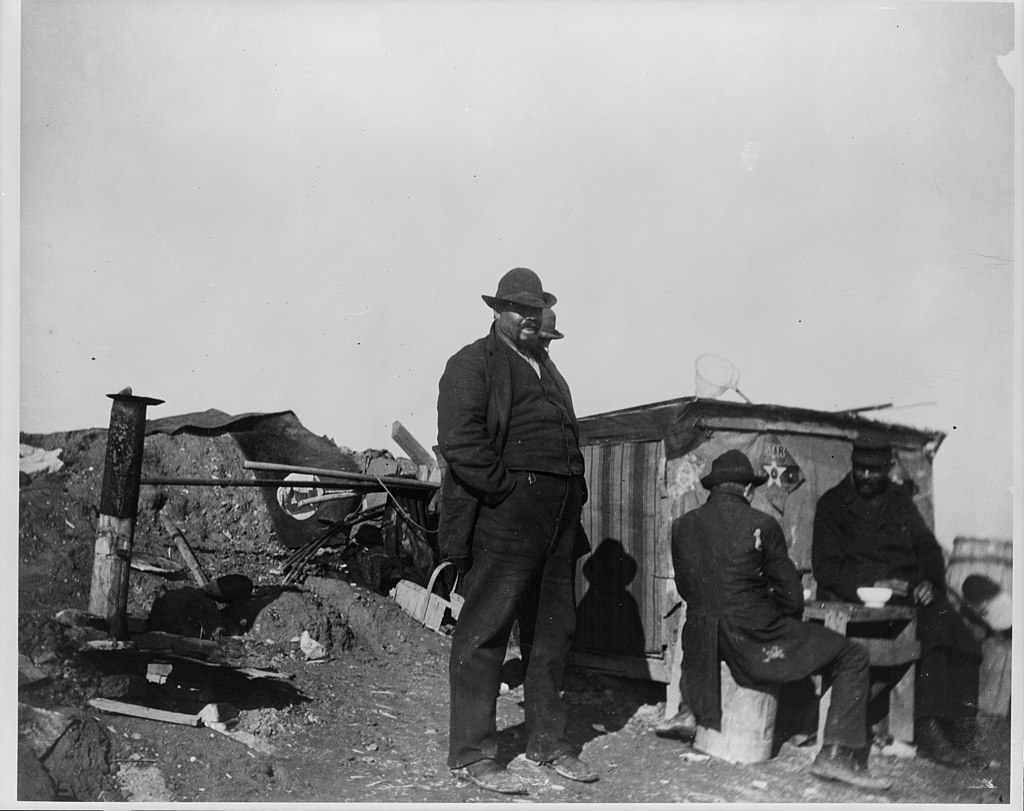
“Living conditions among the poor during depression & pullman strike, Chicago” (Library of Congress Prints and Photographs Division)
The fact that the meeting was even happening was enough to produce an air of subversive excitement. On August 25, 1925, a century ago this year, black sleeping car porters hoping to form a union at the Pullman Company packed the room at the Elks Hall in Harlem. Though we’ll never know how many, Pullman company spies were undoubtedly among the audience.
In fact, to combat the presence of these spies, no porters even spoke during the meeting. Instead, A. Philip Randolph, then an eccentric soapbox socialist with a string of failed unionization attempts behind him, led the meeting. He argued that a union was the only way to confront the company, address the porters’ grievances, and reclaim their manhood. And that he should be the man to lead them.
Common wisdom and past precedent suggested this campaign would go like so many before it: a flurry of enthusiasm followed by dashed hopes and a sober return to reality. But instead, this gathering initiated a twelve-year struggle to form the Brotherhood of Sleeping Car Porters and win a first contract against a corporate giant.
The significance of the Brotherhood of Sleeping Car Porters (BSCP) went far beyond one union and its members. “The Brotherhood,” as many members affectionately called it, would become a vessel through which to educate black communities about labor unions and challenge paternalistic corporate relationships. It acted as a critical institutional anchor through which broader fights for civil rights were waged and activist pressure tactics were developed.
The story of the BSCP illuminates the deep historical connection between the labor movement and civil rights. Through patient institution building and dogged determination, the union was able to shift the consciousness and balance of power within black communities to support unionization. This coalition was the backbone of the historic progress made toward civil rights during the mid-twentieth century. Rather than leave it in the past, this same coalition can provide the basis for fighting racial inequality today.
“Trained as a Race”
Black Pullman porters occupied a complicated class position within black communities. Associated simultaneously with dignity and servility, the porter represented a contradictory symbol of black advancement. Their emergence can be traced quite literally back to chattel slavery.
In the late nineteenth century, industrialist George Pullman designed luxury train cars to transport passengers across the country. The genius was in making this service available to the middle classes, not just the wealthy elite. The idea took off, and by 1895 Pullman had 2,556 sleeping cars that traveled over 126,660 miles of track. At the company’s peak, the sleeping cars hosted one hundred thousand passengers a night, more than all of the country’s major hotels combined.
The key to this luxury was that it wasn’t just a bed to lay your head on and some food to eat. Passengers would have their own personal servants at their beck and call: the Pullman porter. Cynically, Pullman reserved these jobs for Southern black men, preferably the formerly enslaved.

Pullman felt this was a perfect match, explaining how black former slaves were “trained as a race by years of personal service in various capacities, and by nature adapted faithfully to perform their duties under circumstances which necessitate unfailing good nature, solicitude, and faithfulness.” In a further insult to their dignity, most porters were referred to as “George,” harkening back to the days of slaves being named after their masters.
The expectation of complete subservience was reinforced by the fact that porters mainly relied on tips for their wages. The surest path to a fat tip was catering to the customers’ every need and enduring each humiliation with a smile. Shining shoes, running a bath, mailing letters, lugging baggage, and looking the other way at indiscretions were all in a day’s work. Former NAACP president Roy Wilkins, who worked as a Pullman porter as a young man, said they “worked like house slaves on roller skates.”
The hours were brutal. On average, a porter had to work almost 350 hours per month. Especially in the early years, they would have a hard time getting more than three hours of sleep at night while on a trip. Porters would have to pay out of their meager wages for a work uniform and supplies like shoe polish.
But despite these conditions, a sleeping car porter was viewed as a prestigious job within black communities. With their crisp Pullman uniforms, porters had an air of distinction. Their work was not “dirty,” unlike so many jobs black workers were relegated to. The pay wasn’t great, but still much better than most other jobs working-class blacks could hope to find. A Pullman porter was seen as a proud representative of a small but growing black middle class. In Chicago, for example, home ownership among porters was at a high 57 percent in 1927.

Samuel Turner worked forty-one years on the railroad, mostly on dining cars. He said to Rising from the Rails author Larry Tye that he “always wanted to be a sleeping car porter. They had those pretty uniforms on, they made tips, and they had those high-class people riding those sleeping cars, people who had money. All those porters had nice houses, beautiful homes. You were almost considered a doctor.”
Many porters used the job to pay for their college education. From Thurgood Marshall to Malcolm X, a list of former porters can read like a who’s who of black history. Beyond economic stability, a porter represented well-traveled cosmopolitanism and sophistication. E. D. Nixon, a porter and BSCP leader in Alabama, said that when a porter spoke “everybody listened because they knowed the porter been everywhere and they never been anywhere themselves.”
Pullman porters became an important conduit for spreading information and new ideas to black communities. The editor of the Chicago Defender, one of the largest and most important black newspapers, used porters to distribute the paper all across the South in barbershops, churches, and other social settings. It was likely thanks to porters that by 1920 the paper had a circulation of 230,000, two-thirds from outside Chicago.
There had been previous efforts by porters to organize, but they never lasted long. In 1890, a group of porters known as the Charles Sumner Association threatened to strike but backed down when Pullman threatened to replace them with white workers. In 1901, a group of porters even got their demands published in the St. Louis Post-Dispatch.
Such initiatives were snuffed out through brute intimidation and then eventually clever co-optation by the Employee Representation Plan (ERP), a company union set up in 1920. In response to worker rumblings, the ERP instituted a paltry 8 percent wage increase.
One of the officers of the ERP was a respected porter named Ashley Totten who read the Messenger, A. Philip Randolph’s socialist magazine, and listened to some of his soapbox speeches. He and some other reps were fed up with the ERP’s ineffectiveness and thought Randolph could be the perfect outsider to agitate porters without fear of retaliation from the company.
While Randolph was indeed outspoken, his record in unionization efforts wasn’t exactly inspiring. Though his agitation against World War I earned him the title of “most dangerous Negro in America” from the State Department, he struggled to make his socialist ideas have an impact on the real world. His attempt to organize black elevator operators and waiters ended in disaster. As most unions within the American Federation of Labor (AFL) banned black workers, his quest to promote unionism within black communities seemed delusional and out of touch.

During the 1910s and early 1920s, Marcus Garvey’s ideology of self-help, black nationalism, and international racial glory captured the imaginations of the black masses. Randolph would later acknowledge, “Socialism and trade unionism called for rigorous social struggle — hard work and programs — and few people wanted to think about that. Against the emotional power of Garveyism, what I was preaching didn’t stand a chance.”
But Randolph saw in the porters’ struggle a symbol for the strivings of all black working people. Believing that they were “made to order to carry the gospel of unionism in the colored world,” he threw himself into his newfound leadership role.
Initially, the campaign gained momentum. At the first mass meeting at the Elks Hall, Randolph raised the major demands of a wage of $150 per month, a limit of 240 hours of work per week, and an end to the demeaning practice of tipping. The next day, two hundred New York porters streamed into the Messenger office, which now also served as union headquarters. The Amsterdam News described the occasion as “the greatest mass meeting ever held of, for and by Negro working men.”
Breaking Pullman’s Web of Paternalism
To go up against Pullman and win, the union could not limit itself to persuading the workers. The BSCP had to wage a crusade for the hearts and minds of the communities where workers lived and shift the balance of power within important black institutions. Over the course of decades, Pullman had perfected a web of paternalism to ensure the loyalty of key black constituencies.
Beth Tomkins Bates’s Pullman Porters and the Rise of Protest Politics in Black America offers an excellent account of the paternalist network that bonded Chicago’s black community to the Pullman company, and how over time the BSCP was able to break it.
The company was already seen as benevolent for being such a consistent employer of black workers in the first place. This image was reinforced by substantial financial support of black institutions like churches, the Urban League, and the Wabash Avenue YMCA. Without Pullman funding, Provident Hospital, the first large-scale civil project in Chicago’s black community, would not have been possible. Ida B. Wells and Frederick Douglass even took part in its opening ceremony in 1893.
Pullman courted and won over a phalanx of prominent black figures. Chicago Defender editor Julius Nelthropp Avendorph was hired as an assistant and kept Pullman abreast of developments in the black community. Claude Barnett, founder of the Associated Negro Press, was given funding to publish Heebie Jeebies as an anti-union propaganda outlet.
Control of black churches ensured that anti-union propaganda could also be spread at the pulpit on Sundays. One of the most important relationships cultivated by Pullman was with the Quinn Chapel AME Church under Reverend Archibald James Carey. The church ran an employment service funneling workers to Pullman, and Carey refused to allow Randolph or any other pro-union figures to speak there. His blunt explanation was consistent with the view of many black religious institutions at the time: “The interest of my people lies with the wealth of the nation and with the class of white people who control it.”
Just as importantly, Pullman gave workers various social outlets in the form of company-sponsored baseball games, concerts, and barbecues. Its annual picnic in Jersey City was described by the New York Times as the “Newport of the colored social world.” Randolph and other BSCP leaders understood that any success would depend on their ability to make the union a defining presence in black social life, too.
Slowly but surely, the BSCP began to make inroads. Early on, women’s political clubs were instrumental in connecting Brotherhood activists to a broader political network. Ida B. Wells was active in this scene and organized the Wells Club and Negro Fellowship League, where discussions were held on Pullman unionization. After Randolph spoke at the Chicago and Northern District Federation of Women’s Clubs in December 1925, Wells invited him into her home and endorsed the union effort.
The BSCP Women’s Auxiliary, consisting mostly of the wives of Pullman porters, gave vital support as well. Often women went to meetings to prevent retaliation against male workers. BSCP organizer Benjamin McLaurin explained, “We had to function through the women at that time because they could attend meetings, they could pick up the literature.” Auxiliary chapters organized study groups and fundraisers for the union’s cause.
While Chicago’s black faith community began as largely united in opposition to the union, activists took advantage of some early cracks. Dr William D. Cook from Metropolitan Community Church was the only invited speaker to show up at the BSCP’s first meeting in October 1925. Known as an “outlaw preacher,” Ida B. Wells and her club friends were some of his church’s first members. Cook opened up his church to Randolph two months later to speak on “The Negro and Industrial Emancipation.”
Dr Junius C. Austin came from Pittsburgh to Chicago in 1926 and pastored Pilgrim Baptist Church. In Pittsburgh, he was a vocal supporter of Marcus Garvey’s United Negro Improvement Association (UNIA) but was more open to supporting the BSCP in Chicago because he wasn’t enmeshed in the local Pullman patronage machine. He allowed the BSCP to use his church for meeting space.
Though the ideologies of the UNIA and BSCP were almost diametrically opposed, it wasn’t entirely rare for people like Austin to support both organizations in different contexts. This speaks to the ability of the union to reframe and redirect working-class black militancy and desires for self-organization. Civil rights–minded activists like Austin wanted direct action to advance the interests of the race and were willing to align with whomever took the initiative.
Milton Webster, the hard-nosed, politically connected head of the Brotherhood’s Chicago division, put together a Citizens Committee as a venue to build public support for the union in the city’s black community. The people that formed the original core of the Committee were varied in their class and associational background, which made it all the more powerful.
Irene Gaines, an experienced activist through women’s political clubs and as industrial secretary of the Young Women’s Christian Association (YWCA), was an early recruit to the Committee. Perhaps one of the most unlikely members, George Cleveland Hall was a prominent businessman and personal friend to the anti-union Booker T. Washington. But as an advocate for black self-organization, this all-black upstart union captured his imagination.
The Citizens’ Committee organized regular “labor conferences” that brought Brotherhood allies together and stimulated deeper thinking about the role of black communities in the economy. Described by the Chicago Defender as a “movement to stir interest in serious economic problems and to educate the Race in channels of thought where there hadn’t been much before,” these labor conferences served both an organizational and ideological role within Chicago’s black community. By 1929, nearly two thousand people attended these gatherings.
The union very consciously portrayed its fight as a continuation of black people’s long-standing quest for civil rights and equality. Quotes from Frederick Douglass, especially his “power concedes nothing without a demand,” can be found throughout Brotherhood literature. One union bulletin read, “Douglass fought for the abolition of chattel slavery, and today we fight for economic freedom. The time has passed when a grown-up black man should beg a grown-up white man for anything.”
These appeals were all the more poignant because much of the Brotherhood membership had a direct connection to chattel slavery. In the pages of the Messenger, the unofficial organ of the union, the story of Silas M. Taylor was published. Taylor was born enslaved and went to work in a tobacco factory in Virginia after emancipation. Finding conditions too similar to slavery, he unsuccessfully attempted to lead a strike. He became a porter, where he served for forty years and became the head of the Boston chapter of the Brotherhood.
Taylor was fired without a pension for his militancy, to which he said in response: “They can withhold my pension . . . I am not old. I was born when the BSCP was born.” Taylor’s story embodied the lives of so many other porters and the symbolic importance of the union’s quest for economic freedom.
It became hard to disentangle the fate of the union from that of black civic life more broadly. One pro-union cartoon in the Messenger showed a porter voting for the union with the caption “I am voting for myself, my children and my race this time.” Being supportive of or opposed to the Brotherhood became a lightning rod issue that animated fierce battles among different sections of black civil society. Black labor historians Sterling D. Spero and Abram L. Harris said it was “impossible for a leader to remain neutral toward the union,” with one’s position becoming a “fundamental test” of racial militancy.
Black press outlets were put on the spot and forced to wrestle with the issue. The Chicago Defender received ad revenues from the Pullman Company and initially opposed the unionization effort. Never afraid to go to battle against anti-union forces within the black community, Randolph launched a boycott against the paper at a 1927 mass meeting held by the union in Chicago. By the end of the year, calculating that its reputation among black people was of more value than ad revenues, the Defender came out in support of the Brotherhood.
Battle With the Courts and the Company
At the same time that public sympathy was mobilized, Brotherhood leaders had to continue building and maintaining membership while a lengthy court battle unfolded. By June 1927, the Railway Labor Act mediation board recognized the union as representing a majority of Pullman porters. But they still lacked the power or leverage to force the company to the table to negotiate a contract.
Randolph felt that if they presented a credible strike threat and created a national crisis, the president could be called on to step in and force the company to bargain. The union threw itself into strike preparation, and by the spring of 1928 claimed that over six thousand porters had voted to strike. But Pullman called the bluff, saying they could easily be replaced. The mediation board believed the company and felt that since there was no crisis, the president did not need to be brought in. Randolph, after getting pressure from AFL president William Green, decided to call off the strike.
The union had shown its hand and lost. After years of momentum, the whole project was thrown into doubt. Randolph faced serious questions about his leadership, and it all seemed like a repeat of his past failures. The St. Louis Argus wrote, “The proper thing now for those who have given him money is to demand so much of it back.” The disappointment of the aborted strike combined with the pressures of the Great Depression to create a death spiral for the union.
BSCP membership fell from a peak of 4,632 in 1928 to 1,091 in 1931. These were years of intense personal struggle for the union stalwarts who stayed committed. Randolph conducted union affairs in tattered suits and with holes in his shoes. He often had to pass the hat at the end of meetings in order to get from one place to the next. E. J. Bradley, the director of the St Louis BSCP division, was one of the most powerful symbols of this sacrifice. He lost two homes and a wife due to his involvement and lived out of his car until the debt collectors took that too. But he refused to give up and received the title “noblest Roman of them all.”
Spero and Harris, though great supporters of the union from the beginning, were ready to throw in the towel in 1931 when they wrote, “The hope that this movement would become the center and rallying point for Negro labor as a whole is now dead.” But the union was able to bounce back, and not just due to the faith and persistence of Brotherhood leaders.
The election of Franklin D. Roosevelt as president in 1932 was a lifeline to the Brotherhood. The New Deal is often maligned by progressives today, portrayed as at best irrelevant to black people and at worst an agent of racial discrimination. This conception flies in the face of the actual historical record and lived experience of black working people. William H. Harris, in his account of the BSCP titled Keeping the Faith, argues, “One cannot overemphasize the importance of changes wrought by the Great Depression, particularly the New Deal, to the success of the Brotherhood.”
Progress didn’t come immediately, for porters were not covered by the National Industrial Recovery Act. But in 1934, Roosevelt signed an amendment to the Railway Labor Act which included porters, banned “yellow dog” contracts with company unions like the ERP, and required corporations like Pullman to negotiate with unions that represented the majority of their workers. The change in momentum on the ground was swift. In 1933, BSCP membership had dropped to a paltry 658. By 1934, it shot back up to 2,627.
The long, patient work Randolph and Brotherhood leaders had done building support within the black community and the American Federation of Labor was paying off. Back in 1929, Randolph facilitated the appearance of AFL president William Green at Abyssinian Baptist Church in Harlem to speak to porters and black civic leaders. At the time, this was a rare occurrence and helped a little to break down the justified tensions between black workers and the AFL. While always a reluctant and tentative partner, the AFL giving institutional support to the porters was crucial for the Brotherhood’s eventual success.
Prominent black organizations like the NAACP and Urban League began to focus more on economic issues and embrace trade unions, in no small part due to Randolph’s relentless propaganda. Abram L. Harris chaired the NAACP’s new Committee on Future Plan and Program in 1934, which called for radical economic measures. The Urban League began to set up workers’ councils, which educated black people about the benefits of unions. Both organizations publicly endorsed the Brotherhood, and on July 1, 1935, the union won an official election by the porters, 5,931 to 1,422.
On August 25, 1937 — twelve years to the day after Randolph’s first public meeting with porters in 1925 — the Pullman Company signed a collective bargaining agreement with the Brotherhood of Sleeping Car Porters. It was a fulfillment of many of the union’s initial demands and changed the lives of porters. The working month was reduced from four hundred hours hours to two hundred, the wage package increased salaries by a total of $1.25 million, and a grievance procedure was established. The Chicago Defender described the contract as “the largest single financial transaction any group of the Race has ever negotiated.”
Roy Wilkins, who worked as a porter himself before becoming NAACP president in 1955, said there were three events during the 1930s that made him proud to be black. Two were sporting events: Jesse Owens’s performance during the 1936 Olympics and Joe Louis’s knockout of Max Schmeling that same year. But the third was “the day the Pullman company, after a contract wrangle that had lasted more than a decade, summoned in A. Philip Randolph and the leaders of the BSCP and said, ‘Gentlemen, the Pullman company is ready to sign.'”
Anchor of the Civil Rights Movement
Randolph could never disentangle his role as a union leader from his role as a civil rights crusader. Having established itself as a leading force in black labor, the Brotherhood used its institutional muscle and vast social networks to stimulate political activity against racial inequality. The coming of World War II provided a great opportunity.
The war mobilized industry and signaled the final death knell for the Great Depression. But black workers remained largely locked out of defense industry jobs. The issue hit a raw nerve for black workers and heightened the contradiction of fighting a war for democracy while being excluded from it. For the US government, the problem risked ballooning into a national security crisis. Therein lay Randolph’s point of leverage.
Randolph called for a March on Washington to secure jobs for blacks in the defense industries, along with other demands like desegregation of the armed forces. Today marches on Washington barely merit a mention, but at the time it was an audacious idea, especially when it came to mobilizing working-class blacks to do it. March on Washington Movement (MOWM) chapters were established in cities across the country, and it wasn’t a surprise that they were strongest wherever there were large BSCP locals.
BSCP members were leaders in the effort, with the union offering meeting space and other logistical support. Randolph held large rallies across the country, while porters spread the word on their rides. This movement was not engaged in the polite lobbying of the middle class that characterized most NAACP efforts of that time. MOWM had a more militant edge and lived in the union halls, fraternal chapters, salons, movie theaters, bars, and poolrooms of working-class black America.
Randolph claimed he could bring one hundred thousand black people to descend on the nation’s capital, but no one really knew what the number was. Roosevelt recognized that whatever the specific number, the threat of a large domestic disturbance right as the United States entered the war was a credible one. He blinked and signed Executive Order 8802, banning discrimination in defense industries and establishing the Fair Employment Practices Committee (FEPC). Randolph and the porters had successfully harnessed and mobilized black militancy toward concrete material gains in a way that radical black nationalists hadn’t been able to. MOWM activist Richard Parrish reflected in the 1970s that the march “scared these people like no other thing. Marcus Garvey, Malcolm X, H. Rap Brown, all wrapped together, never had the power, the real power, and threat that the first march had.”
After getting this win, Randolph called off the march but kept the movement in place to enforce the order in localities. Though only lasting for a relatively brief time in the 1940s, the MOWM established the social networks, protest strategies, and political confidence that would fully blossom during the “classical phase” of the Civil Rights Movement in the 1950s and 1960s. Here again, the Brotherhood was instrumental.
St Louis was home to both a very strong MOWM chapter and BSCP local, and porter T. D. McNeal served as its leader. The chapter routinely turned out hundreds of people to pickets at local defense manufacturing plants and held a massive rally against layoffs that drew ten thousand people. In May 1942, they led a silent march of five hundred around the US Cartridge Company complex, which resulted in the raising of black workers’ wages and the hiring of seventy-two black women.
Anticipating this tactic’s widespread use in the 1960s, St Louis MOWM led sit-ins at diners and public utility companies like Southwestern Bell Telephone that won agreements to hire black workers. The FBI, which had taken a worried interest in the MOWM, concluded that “the most active Negro organization in the City of St Louis is the March on Washington Movement.”
The MOWM thrived in other cities like Chicago and New York City, also BSCP strongholds. On June 16, 1942, a MOWM event was staged in Madison Square Garden that the Pittsburgh Courier described as “the greatest race meeting in this city’s history.” It wasn’t just a rally; it was a tour de force of black political and cultural expression. Civil rights–themed skits were staged and militant speeches were made by a who’s who list of black leaders. Adam Clayton Powell Jr, the Abyssinian Baptist Church pastor and city council member, used the event to announce his historic run for Congress.
Historian David Welky described MOWM’s captivating presence in Harlem: “Around eighteen thousand African Americans streamed downtown in their Sunday best. Women wearing festive hats and men in solemn ties jammed buses and subway trains . . . Sixty blocks uptown, Harlem’s street culture fell silent out of respect for Randolph’s audacity.”
As the Congress of Industrial Organizations began to seriously get down to the task of organizing black workers, they relied extensively on black political networks that had developed while supporting the BSCP and MOWM. Halena Wilson, for example, was president of the Chicago Women’s Economic Council and was tapped to help organize the Inland Steel Company in Indiana Harbor. She drew on her BSCP ties to help five thousand black workers sign up for the Steel Workers Organizing Committee in 1937.
This feverish period of BSCP-led activity during the 1930s and 1940s opened up opportunities for black women to exercise leadership in black political activism. While often this was not through formal leadership titles, black women played indispensable roles in organizing direct action and providing the administrative backbone for movement activities.
Randolph was an inspiring and visionary leader, but women like E. Pauline Myers and Anna Arnold Hedgeman mostly staffed the MOWM offices and attended to the day-to-day organizational tasks that made the organization function. While T. D. McNeal was made the face of the sit-in movement for jobs in St Louis, he admitted, “These women really did the work.”
Maida Springer, who became an organizer for the International Ladies’ Garment Workers’ Union (ILGWU), names Randolph as an important early mentor. As a young girl, she remembers going over to a family friend’s house to stuff leaflets for the BSCP union drive. She marched with the union when they won their first contract in 1937 and was part of Randolph’s inner circle during the MOWM of the 1940s.
The BSCP Ladies Auxiliary didn’t just assist their husbands in the fight to form a union; they engaged in consumer activism during the war, too. The higher wages won by Pullman porters allowed many wives of porters to stay at home without work, a rare luxury for most black women at the time. Some auxiliary groups, like in Chicago, formed reading groups about consumer cooperatives and even established their own.
Ladies Auxiliary groups lobbied Congress to pass milk price control legislation and worked to support the Office of Price Administration (OPA) to enforce price controls at the local level. In St Louis, they monitored rent prices. The OPA formally recognized the Denver BSCP Ladies Auxiliary and said, “No women in the city are better informed or more cooperative than these women.”
Given all of this, it should be no surprise that the BSCP played a central role during the catalyzing event of the modern Civil Rights Movement: the Montgomery Bus Boycott. E. D. Nixon, president of the Montgomery BSCP, bailed Rosa Parks out of jail after her arrest. The Montgomery BSCP union hall became the meeting space of the boycott movement, and Nixon’s extensive organizing experience and broad social network were invaluable throughout.
Pullman porters, the itinerant eyes and ears of the civil rights fight, reported lynchings to groups like the NAACP. The union gave money and legal support to higher-skilled black workers like firemen, brakemen, and switchmen fighting to end employment discrimination and keep their jobs. During the March on Washington, the fulfillment of A. Philip Randolph’s original idea, the BSCP gave $50,000.
The Brotherhood was not just a union of black workers. It was a movement: an institution for black economic advancement and social equality. The union embodied the necessity for civil rights to be grounded in an economic outlook and a working-class base. The experience of this movement offers a host of lessons for organizers today on the role of building broad public support, political education, and making a union an institutional anchor for larger political fights.
Transposing experiences from 1925 to 2025 is dangerous and fraught. The BSCP relied on and mobilized a vast civil society network within black communities that amplified and reinforced their aims. We live in a much more atomized society with declining associational life. But still, people engage with sports leagues, churches, PTAs, and other organizations. Black workers are still prominent throughout our economy, from auto plants and warehouses to the postal service and public schools.
In February 2025, Teamsters Local 100 held a Black History Month event at their union hall in Cincinnati, Ohio. Over 150 members packed the hall, many of whom rarely attended union events. This social networking planted the seeds for a for a contract campaign by members at Zenith Logistics, a third-party operator for Kroger where most of the workers are black and Latino. They gathered contract surveys in multiple languages, wore “Will Strike if Provoked” shirts and all clocked in at the same time in front of management. The workers won a contract with the best wage and benefit gains they’d ever seen, along with language protecting members from ICE raids. Some of these members are now becoming shop floor leaders and could be seen proudly at the Teamsters for a Democratic Union convention.
One can’t help but see the spirit of the Brotherhood in them.