The March on Washington Advanced a Radical Vision for Society That Remains Unfulfilled
Sixty years ago today, hundreds of thousands gathered at the Washington Mall, where they heard Martin Luther King Jr’s “I Have a Dream” speech. Since then, we’ve beaten a retreat from the march’s vision of racial and economic justice.
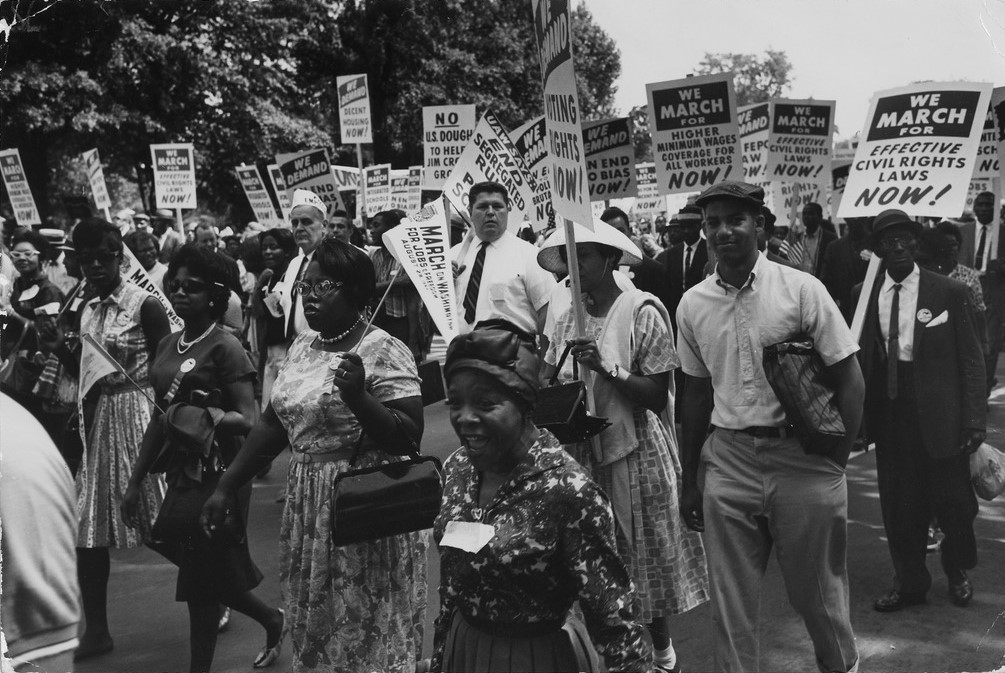
Demonstrators at the March on Washington for Jobs and Freedom, August 28, 1963. (Rowland Scherman / National Archives at College Park via Wikimedia Commons)
By noon on August 28, 1963, the Washington Mall was a sea of people, dabbing sweat from their brows and bobbing picket signs in the air. The official police report counted 250,000, but those who were there said it had to be at least 400,000.
Sign reading “We Demand Voting Rights Now!” and “We March for Integrated Schools Now!” reflected the demands of a civil rights movement that had grown in confidence and had reached a truly explosive character. There was also a strong economic component, reflected in slogans like “Civil Rights Plus Full Employment Equals Freedom,” “We Demand an FEPC Law Now!,” and “We Demand Decent Housing Now!” Many in the crowd were there representing their labor unions, like the United Auto Workers (UAW) and Industrial Union of Electrical Workers.
While it was hundreds of thousands of ordinary people who made the event so significant, many celebrities were featured in the day’s programming or could be spotted in the crowds. Musicians Mahalia Jackson, Joan Baez, and Bob Dylan serenaded the audience; stars like Harry Belafonte and Josephine Baker gave speeches; and Jackie Robinson, Sammy Davis Jr, Paul Newman, and Marlon Brando could be seen hobnobbing.