Once the Party of Business, Republicans Have Gone Rogue

The Republicans have always been enemies of labor. Now, freed from the shackles of their business patrons, Paul Heideman argues in his new book, the GOP may be more dangerous than ever.
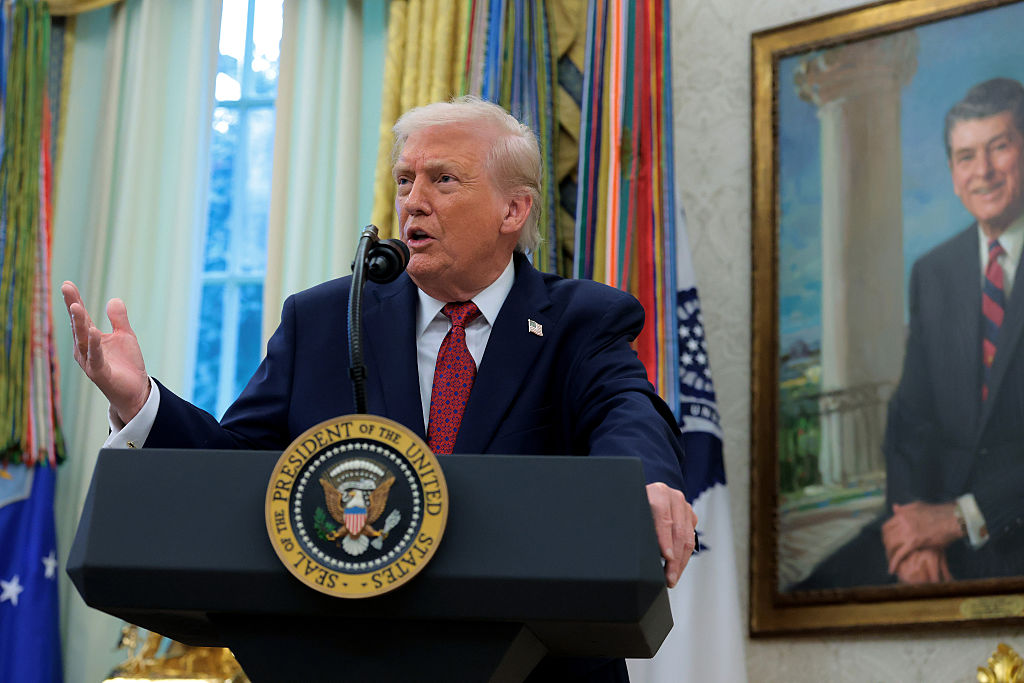
Why did America’s capitalist class fail when it tried to discipline the GOP after January 6? And what does this failure say about the political capacities of US capital? Paul Heideman’s new book, “Rogue Elephant,” attempts to answer these questions. (Anna Moneymaker / Getty Images)

In the days after January 6, 2021, when a mob of Trump supporters stormed the Capitol in an abortive attempt to prevent the certification of the 2020 presidential election, a number of corporate leaders stepped forward to announce that they were temporarily suspending their financial support for the Republican Party. Four years later, an A-list of America’s business elites crowded into the same building to take their front-row seats for Donald Trump’s second inauguration.

Such a portrait in contrasts poses some puzzling questions about Trump’s Republican Party and its relationship to America’s corporate elite. If America’s capitalist class tried to discipline the GOP in the aftermath of January 6, why did it fail? What does such an attempt imply about the nature of the GOP? And what does such a failure imply about the political capacities of US capital?

These questions are at the core of Paul Heideman’s new book, Rogue Elephant: How Republicans Went from the Party of Business to the Party of Chaos. The book provides readers with an accessible account of Republican radicalization and the party’s increasingly strained relationship with America’s bourgeoisie.

Decades before Trump arrived on the political scene, Republican insurgents began displaying an increasing proclivity to pursue aggressive partisan tactics in defiance of the wishes of business as expressed in its own organizations, corporate boardrooms, or editorial boards. This is not to suggest that Republicans have become an anti-business party. On the contrary, as the front row of Trump’s second inauguration displayed, corporate leaders continue to court the party, and the party continues to return the favor. What has changed, Heideman argues, is business’s capacity to cohere its general interests and mobilize as a class to impose those interests on rogue officeholders.

Rogue Elephant bridges two debates that are typically conducted in isolation from each other. On the one hand, while known for their relative weakness compared to parties in other capitalist democracies, America’s two major parties have come under increasing scrutiny for their institutional “hollowness.” Their inability to control their own candidates and platforms has left them open to hostile takeover and results in governance failure. On the other hand, political economists have been underscoring the fragmentation of business elites in the neoliberal era, suggesting that their unparalleled success in beating back the mid-twentieth-century advance of trade unionism and government regulation has eroded their ability to define and pursue their collective class interests. Heideman’s signature achievement is in synthesizing these distinct perspectives into a coherent explanation of how we got to our present moment.

The Argument of Rogue Elephant

His historical account is composed of two independent but parallel processes: the organizational transformation of the parties, and the fragmentation of capitalist class capacities.

First, due to the long-term and cumulative effects of the efforts of policymakers and reformers across the twentieth century, America’s political parties have been hollowed out. Primaries took nominations out of the hands of party officials, information and communications technologies elevated candidates over their parties, and major actions taken by Congress and the courts erected a campaign finance regime that incentivized candidate-centered fundraising independent of their associated party organizations. By the 1980s, Heideman concludes, both parties “were no longer, by and large, in the business of setting policy or choosing candidates.” When it came to elections, such enfeebled parties were demoted to junior partner status, offering mere assistance to candidates who pretty much ran their own operations.

Second, America stands out for lacking strong peak business organizations. In other countries, it is more common to find durable membership organizations of businesses, whether by sector or classwide. Heideman’s explanation for America’s distinctiveness is straightforward: “Capital organizes when labor does.” Late nineteenth- and early twentieth-century labor turmoil spurred the creation of the National Association of Manufacturers (NAM) and the US Chamber of Commerce. However, as Heideman details, their memberships encompassed only a small share of America’s businesses and pursued “far more sectional and self-interested political action” than their Western European counterparts.

The exception that proves the rule, Heideman argues, is the 1970s, when business mobilized politically unlike it had before or has since. In response to a wave of federal regulatory policy, labor militancy, spiraling costs, and global economic instability, American business got its political act together. Mobilized around institutions like the Business Roundtable and a revitalized Chamber of Commerce, business organized to displace the Keynesian policy consensus with previously fringe free-market principles, break the inflationary spiral, and bring unions to heel. These goals were manifested in Federal Reserve chairman Paul Volcker’s interest rate hike and the eventual elevation of Ronald Reagan to the leadership of the Republican Party and the Oval Office.

However, business’s success had unforeseen consequences for its political organization. Counterintuitively perhaps, it was businesses’ strength, organization, and success that conditioned their future weakness and disorganization. Precisely by removing the threats posed by the 1970s, the impetus for continuing class organization fell away. A return to the kinds of sectional and fragmented mobilization typical of US corporate elites was evident in Reagan’s signature tax bill, which initiated such a “feeding frenzy” of carve-outs and loopholes that it exploded the federal budget deficit — an outcome that may have been good for individual businesses but that was certainly not in the interests of business as such. Subsequently, deficit reduction came to be a divisive and frustrating policy debate within America’s business class as individual corporations sought to preserve their particular advantages while simultaneously pushing the fiscal burden onto others.

Heideman brings together these parallel stories of party hollowness and capitalist class fragmentation in the second presidential administration of George W. Bush. While the Clinton impeachment scandal of the late 1990s had been a signal moment foreshadowing a Republican leadership willing to press its partisan advantages to the hilt despite the expressed preferences of business elites, it was Bush’s ill-fated embrace of immigration reform and his response to the 2008 financial crisis that ignited a Republican rupture.

Throughout his presidency, Bush and his political allies cultivated a coalition that united traditional bastions of Republican support in America’s corporate boardrooms with the evangelical churches that were exerting increasing political influence within the GOP since the Reagan era. Indeed, so closely did Bush adhere to a corporate-friendly agenda that his efforts to reform education, Medicare, Social Security, and immigration cost him significantly with the party’s right wing. The latter invited such nativist backlash across the conservative talk radio waves that rank-and-file Republican officeholders openly defied the president’s immigration reform proposal, despite its significant support from America’s business community.

The starkest break between Republicans and the business community manifested with the Wall Street bailout in the midst of the 2008 financial crisis. Protracted negotiations between Bush administration officials in the Treasury, the Federal Reserve, and the key leaders of the failing financial institutions produced a bailout bill that netted only sixty-five Republican votes in the House. In the face of near-unanimous business consensus that massive and decisive federal action was required to avert another Great Depression, Republicans scoffed. While a subsequent vote did pass the bailout program, it attracted only an additional thirty Republican votes.

Subsequently, during the Obama years, additional developments weakened what little hold business as a class still exerted over the Republican Party. Oil and gas titans David and Charles Koch, who had been active in anti-regulatory initiatives for years, assembled a vast network of organizations to press their preferred agenda on state governments across the country. In 2010, the Supreme Court handed down the infamous Citizens United decision, removing campaign spending limitations for individuals, unions, and corporations. The predictable result was a continuing upward spiral of campaign spending by individuals, PACs, and super PACs.

To be sure, the Tea Party insurgency that mobilized in response to Barack Obama’s presidency and that later swept through the Republican Party was backed by Koch money and many other billionaire-backed outfits whose deregulatory agenda overlapped with the at-times libertarian and at-other-times reactionary views of Tea Party candidates and their supporters. But for all their organization and network-building, these billionaires did not represent business as a group. On the contrary, in an age of sky-high income and wealth inequality, billionaires like the Kochs need not compromise their preferences by forging consensus with their fellow capitalist class members. They have the resources and the will to try to impose their vision on all concerned, even if that means spending millions on promoting idiosyncratic candidates in competitive districts or advancing genuinely unpopular public policies.

By the Trump era, these contradictions had manifested into a populist backlash, combining nativist rage with antiestablishment resentment. After cutting through the deep bench of Republican candidates in the primaries, Trump captured the presidency. His tenure in office featured a chaotic management style that saw tightening control over the GOP and ineffective command of the federal bureaucracy, especially during the pandemic.

Beyond Rogue Elephant

As a whole, Rogue Elephant offers a challenging reinterpretation of our present moment and its mainsprings. Readers will learn about the relatively weak patterns of class organization that have characterized the American bourgeoisie over time and how this secular trend has intersected with changes in the party system.

However, readers may also pose several questions that the book does not address, each of which is raised or implied but deserves deeper discussion in its own right.

First, how weak are parties really? Heideman equates contemporary critiques about party hollowness to long-standing debates concerning party weakness. And while he is to be lauded for considering parties in organizational terms, weakness and hollowness are not the same. Parties have several important features, including but exceeding their formal organization. Parties, for instance, have a social or coalitional component, ranging from voters to activists up to allied groups, movements, and donor networks. They also have an ideational dimension: parties are distinctive brands that many political actors are attracted or even devoted to.

This matters because party hollowness has become a term of art to capture the paradox of modern party politics in the United States: parties are not merely weak; they are simultaneously weak while also being socially and ideationally strong. Local, state, and national party committees command less influence than they did in the past. And yet Democrats and Republicans continue to turn out many millions of voters to the polls cycle after cycle, with minor party candidates receiving less voter interest than ever. To be sure, many voters are not content with the two-party system as is and simply turn out to vote against the other party. Nevertheless, on paper, their voting behavior is indistinguishable from that of committed partisans. While they may be organizationally weak, American parties have in other ways never been stronger.

Why? Though it is an ongoing debate, one plausible explanation could be that other institutions are compensating for enfeebled party organizations. This includes not only the durable networks of interest groups, think tanks, and advocacy organizations that orbit the formal organizations but also state institutions, foremost the presidency, which has become the paramount focus of party politics and, with a nearly always deadlocked Congress, the primary driver of partisan policymaking.

Conceived of as institutional orders that span society and state, encompassing voter and group coalitions, formal organizations, and distinct parts of government, parties are driven to seize control of governing institutions in order to wield their power any way they can. Please excuse my functionalism, but in their current configuration, parties don’t need robust formal organizations to achieve their goals. As problematic as the consequences may be, the appellation of “weak” to this institutional order is insufficient to comprehend the paradoxical dynamics of contemporary American party politics.

Second, with regard to Heideman’s argument about the political incapacities of America’s business class, where is the state? The role of the “executive committee” of the whole bourgeoisie in representing capitalists’ class interests is noticeably absent from Rogue Elephant. This may stem in part from the “two logics of collective action” framework first articulated by Claus Offe. While the two logics refer to the distinctive and asymmetrical barriers to collective action faced by working and capitalist classes, the influential framework fails to theorize the active role state institutions can play in spurring, fostering, or even compelling the capitalist class to organize politically.

Indeed, there are empirical reasons for thinking that state institutions do precisely this. In drawing a contrast between America’s relatively weak business organizations and the strong corporatist institutions found in Northern Europe, Heideman underscores that “business organizations play a state-appointed role in collective bargaining and various tripartite (or bipartite) committees” (emphasis mine). Perhaps the reason these countries are host to strong corporatist institutions is due to the fact that the state coerces these organizations into bargaining arrangements?

Parties too may play a facilitating role in organizing the capitalist class into politics. While noted only in passing, Heideman points out that the US Chamber of Commerce and the NAM “were both organized externally, by Republican Party operatives, in order to create closer links between business and the party.” Though they did not develop into the kinds of powerful peak organizations we see in other capitalist democracies, this fact suggests that the assumption that capitalist classes organize themselves autonomously from politics and create their own organizations to act independently on politics and policymaking may be a flawed starting point.

Finally, while presenting a very compelling historical account of our pathway to the present, the book concludes without offering much about what the future may hold and, more important, how we might orient our politics to shape it. Specifically, given the attention dedicated to elite failure in the book, we might creatively imagine how such a narrative might be deployed in the post-Trump era. Should this Trump administration again end in blood, as did the last one, all those titans of industry that (again) distance themselves (temporarily) from the toxic Republican label might be reminded of the front-row seats they clamored for at Trump’s second inauguration.

As in post-WWII Europe, elites could be painted with the disgrace of collaboration — those who, despite having the power and resources to stand up to the enemies of liberal democracy, failed to do so. Like in that earlier era, such a crisis for elite legitimacy may contribute to forging a different balance of class power, one that would strip elites of the responsibilities that come with their wealth and privilege, given that they proved unreliable defenders of society. A durable rebalancing of class power will take more than an effective narrative, but it is a critical component.