The Downfall of Larry Summers Was Long Overdue

Larry Summers has been forced to step back from public life after revelations about his ties to Jeffrey Epstein. His moment of disgrace comes after decades of work promoting economic policies that have had a devastating impact on countless people.
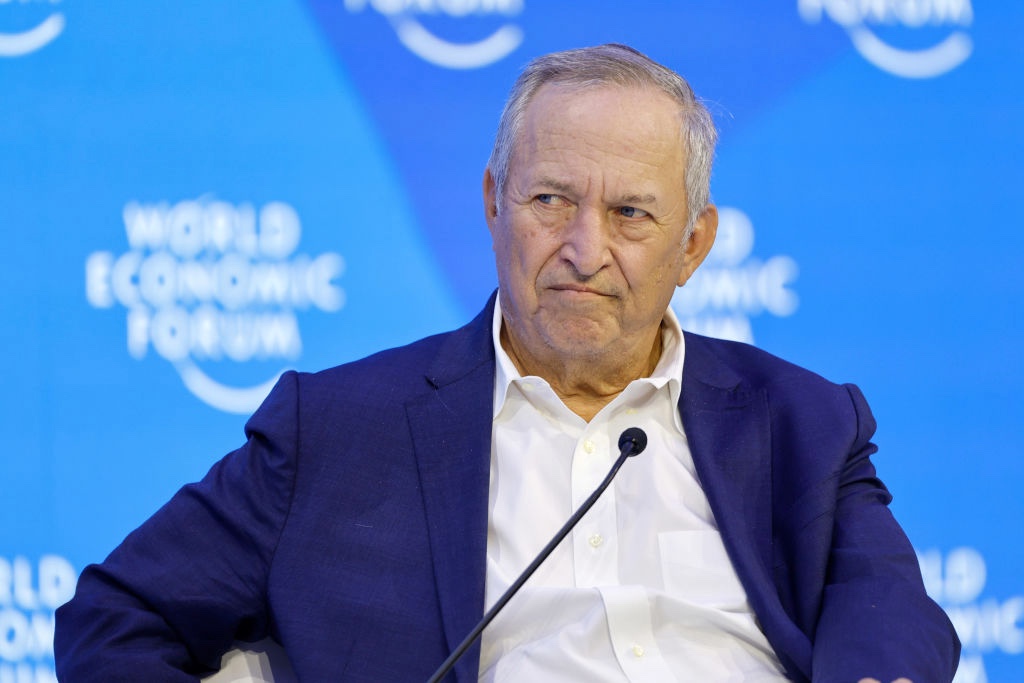
Larry Summers’s fall from grace could serve as a metaphor for our changing times. (Stefan Wermuth / Bloomberg via Getty Images)

Larry Summers, long-time stalwart of Democratic Party economics and academic governance, has been disgraced by the release of emails between himself and Jeffrey Epstein — a correspondence that continued long after Epstein’s conviction for sexual offences with children.

The emails are sleazy and cringe-inducing, with Summers seeking Epstein’s advice on the pursuit of women (one of whom was a student). Summers has been expelled from some roles (including membership of the American Economic Association) and has stepped back from others, including his position as economic advisor at the Center for American Progress, a think tank crafting an agenda for what they hope will be the next Democratic presidency.

The fact that Summers was involved in the center’s work to begin with says a lot. As Jeff Hauser, head of the watchdog Revolving Door Project, puts it: “Larry Summers has an argument for being on the Mt. Rushmore of people responsible for destroying America. Only insane people would seek out the counsel of a man who relies on Jeffrey Epstein for dating advice and Milton Friedman for economic inspiration.”

As Treasury secretary under Bill Clinton, Summers pushed Wall Street deregulation, especially liberalization of trade in derivatives, laying the basis for the crash of 2008. To add injury to injury, as a key economic advisor to Barack Obama, Summers deepened and prolonged the ensuing recession (including a mass foreclosure epidemic) by arguing against the kind of stimulus package that was required, all the while blocking the breakup of the banks responsible for the mess and the holding of their management teams to account.

Thought Experiments

This record makes Summers rightly toxic to the American left. But his toxicity extends well beyond US shores, and his record says much about the links between American power and global governance. Those links are now being challenged by both domestic and overseas forces.

In 1991, Summers was chief economist of the World Bank, where he accepted responsibility for a memorandum issued in his name — he may not have originally written it — that made the case for moving polluting industries to developing countries: “I think the economic logic behind dumping a load of toxic waste in the lowest wage country is impeccable and we should face up to that,” the memo read. “I’ve always thought that underpopulated countries in Africa are vastly underpolluted.”

While Summers would later describe the memo as an ironic “thought experiment,” his commitment to extreme liberalization was real enough. This was very much in keeping with the mood of the times as championed by the World Bank and related institutions.

The World Bank was founded, along with the International Monetary Fund (IMF), at the Bretton Woods conference of 1944. This was where the soon to be victorious Western allies constructed the economic governance architecture of the postwar world.

The IMF developed into a backstop lender of last resort for member countries, to which they could turn — at a price of course — when other borrowing options were foreclosed to them. The World Bank became the world’s largest (so-called) development organization, dispensing loans, grants, and policy advice to the Global South.

Both organizations have long been controversial, but the criticism intensified from the early 1980s onward as a debt crisis engulfed much of the Global South. In order to qualify for limited debt relief as well as access to new lending and aid, countries were obliged, under IMF and World Bank conditionality, to adopt so-called “structural adjustment” policies.

Those policies included higher interest rates and cutbacks in government expenditure as well as the removal of trade barriers that protected domestic industries from foreign competition. Governments also had to lift capital controls, adopt an open-door approach to foreign investment, and carry out privatizations of state enterprises.

Fire Sales

Not surprisingly, the results usually involved austerity for the majority, rising inequality, and deindustrialization as the Global South was incorporated into an increasingly neoliberal and globalized world economy. Summers championed these policies, even though the countries (China especially) that have experienced the most significant economic growth and poverty reduction rates over recent decades have not followed the recommended course. Nor, for that matter, did Western and other economically successful economies stick with the neoliberal template in earlier periods.

Similar policies were imposed upon the countries of the former Soviet bloc at the end of the Cold War, on East Asian states in the wake of a financial crisis in the late 1990s, and on peripheral European countries after the crash of 2008. Summers, who was embedded in the US Treasury during the 1990s, was one of the figures “pushing a fire sale of Russian state assets ultimately bought cheap by corrupt oligarchs,” as Robert Kuttner observes.

He went on to make a decisive intervention in relation to the World Bank during the Asian crisis of 1997–98. While the IMF, urged on by the US Treasury, pushed for deep austerity and the rapid opening up of the East Asian economies to international capital, the World Bank’s chief economist, Joseph Stiglitz, argued for a more cautious and gradual approach. A furious Summers demanded Stiglitz’s resignation. The United States has always had de facto veto power over key World Bank decisions, so he got his way.

Stiglitz would later ask: “Did America — and the IMF — push policies because we, or they, believed the policies would help East Asia, or because we believed they would benefit financial interests in the United States and the advanced industrialist world?” The question goes to the heart of the relationship between US imperial power and institutions like the World Bank.

These institutions were designed to serve the interests of empire and capital (US capital above all others). Such interests were arguably better served by a multilateral, rules-based approach — although the United States always retained the right to exempt itself from the rules — than by a framework where states and corporations could operate in a purely unilateral manner.

As Robert Wade observed, if the United States can persuade elites in other countries to embrace goals like the free movement of capital or openness to foreign investment, “it can achieve its foreign economic policy objectives far more cheaply and effectively than through either [bilateral] negotiations or coercion.” The Bretton Woods institutions have long been successful at persuading national elites to play ball in this way, though coercion has never been entirely absent from the mix.

Trump’s Strategy

This system is now under threat from within, as the Trump administration restores trade barriers and reverts to bilateral negotiations (based on unilateral US demands) and overt coercion. Trump’s team wants to browbeat rival national elites (and even erstwhile allies) into compliance instead of seeking to persuade or co-opt them into multilateral arrangements.

In fact, the recommendations of the Heritage Foundation’s Project 2025 blueprint for a Trump presidency included leaving the IMF and the World Bank altogether. This is in line with a general MAGA preference for unilateral US action and a distaste for multilateral institutions. A review of US membership of the Bretton Woods organizations is ongoing.

For defenders of the Bretton Woods framework, Trump’s threats to the World Bank and IMF smack of self-harm, considering how closely those institutions have aligned themselves with US interests. With good reason, such commentators cite the willingness of the bank to pump money into post-invasion Iraq and Afghanistan as proof of its usefulness to the US imperial project.

Backing up this position, but from a critical perspective, Filipino anti-imperialist Walden Bello documents the World Bank’s long-term support for the US client dictatorship of Ferdinand Marcos in his home country. Michela Wrong has similarly shown how the World Bank helped keep Zaire’s pro-Western tyrant Mobutu in power for decades. There are many other examples of the same pattern.

In response to the threat from Trump, the bank has opted not merely to stand on its record of support for US imperialism but also to engage in further appeasement. The Bretton Woods Project, a critical NGO, sums up the World Bank and IMF management meetings in October 2025 as follows: “Loyalty to Washington and private capital was on full display.” US Treasury secretary Scott Bessent backed this emphasis on policies “that enable the private sector to flourish” and railed against “overregulation.”


Will this appeasement be enough? The Trump administration doesn’t seem interested in creating a stable framework within which US capital in general can thrive. It wants a regime in which Trump family businesses and other designated beneficiaries (not necessarily American ones) can carve out super-profits and sees coercive individual deals as a better means to that end than rules-based multilateralism.

The World Bank could still remain a bulwark of US power projection, as evidenced by its proposed role in financially underwriting Trump’s plan for the occupation of Gaza. Influential actors, many of whom contribute to the insider journal Foreign Affairs, have continued to draw up schemes for the restoration or reinvention of a US-dominated multilateral order on a broader basis, with allies once again treated as allies while US power operates through rather than against global governance.

But the challenges to that old vision come from outside the United States as well as within. China and other so-called BRICs nations do not pose any fundamental anti-capitalist challenge to the Bretton Woods bodies. However, they do want a bigger say in how they operate, and China in particular is prepared to offer alternatives.

One example is its establishment of the Asian Infrastructure Investment Bank (AIIB) as a source of development finance in 2016. One study concludes that the AIIB “could unsettle the political influence the United States has enjoyed over developing countries through its leadership of the World Bank. An important set of countries may be parting ways with the World Bank and looking to a Chinese institution for leadership in the world of development.”

Summers bestrode the interlocking worlds of US and global governance like a colossus for decades, at a time when the United States became the world’s only superpower and its dominance seemed unchallengeable. His own tawdry fall from grace could serve as a metaphor for our changing times.

US imperialism is facing fundamental challenges, not just from the economic rise of China but also from worldwide popular revulsion at the genocide in Gaza in particular. Its ruling class is divided against itself, with the multilateralist wing represented by Summers on the defensive, and new financial storms are brewing. All of this comes against a backdrop of severe global indebtedness, both public and private, and an intensifying climate emergency.

Trump and Summers have much in common, with propensities for arrogance, bullying, sexism, and self-aggrandizement, not to mention a shared friendship with a notorious pedophile. But until recently, they represented different ideas of how best to advance US elite power and wealth. It is probable that neither of their approaches will prove sustainable (in Trump’s case) nor recoverable (in that of Summers) in the context of a crisis-ridden, increasingly multipolar world.