The Borderland Where Fascism Learned to Rule
Italian Fascists honed their ideology in Venezia Giulia, fusing anti-Slavic racism with anti-communist repression.
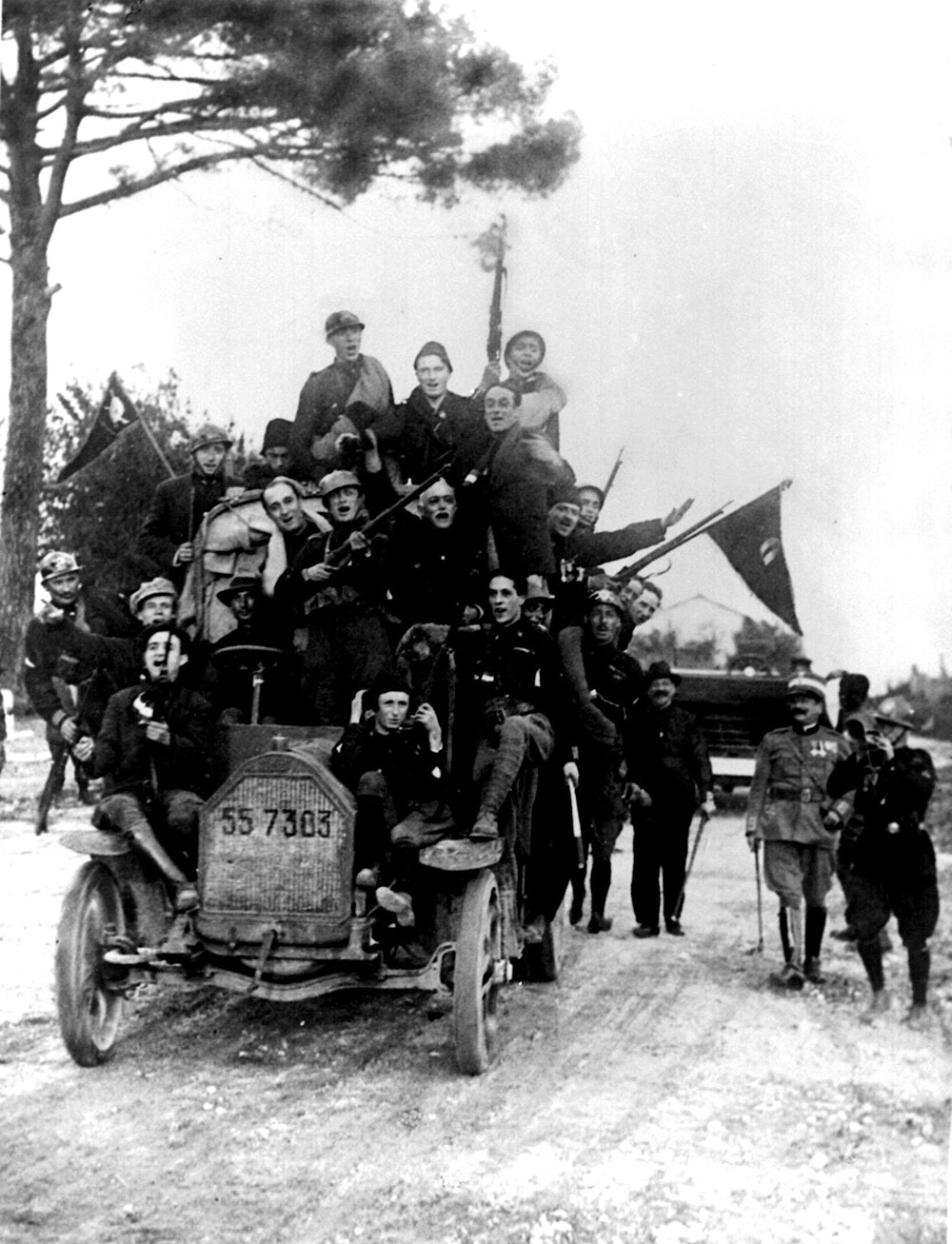
(PA Images / Getty Images)
Jože Srebrnič was a People’s Hero of socialist Yugoslavia, but he’d never been a citizen of that country. He was born in 1884 as a subject of the Austro-Hungarian Empire and headed to the Eastern Front in 1914 under its colors. He soon surrendered to tsarist Russia, though by the time he’d left again it had become a Soviet republic. His hometown of Solkan is now Slovenian, but that state didn’t exist in his day. The region was annexed by Italy after 1918 and occupied by Germany in late 1943, before joining Yugoslavia in 1944, soon after his death. Srebrnič thus spent most of his later life fighting Benito Mussolini’s Fascist regime — even as a Slovene-speaking Communist member of the Italian parliament.
Nineteenth-century Italian nationalists hoping to annex Srebrnič’s home region had given it a new name: Venezia Giulia. They emphasized its connection with Venice, ninety miles to its west; patriotic bards lauded the Port of Trieste as italianissima — Italian to the hilt. The 1910 Austrian census had reported that 46 percent of the regional population generally spoke Italian, though the faster-growing minorities preferred Slovene (31 percent) and Serbo-Croatian (21 percent) alongside German, Hungarian, and Ladino. The demographic trends of recent decades had eroded the Italian majority, even as census results became crucial to defining borders. After World War I, Fascism’s creed of militarized national unity gained traction early here, claiming to defend “Italianness” from the cosmopolitan Bolshevism embodied by Srebrnič.
While Srebrnič had been a member of parliament, and under Fascism was detained alongside leading Communists like Antonio Gramsci and Amadeo Bordiga, he isn’t today a well-known name in Italy. This strip of territory along the Adriatic also isn’t the obvious place to examine the rise of Fascism. It was hardly central to worker insurgency in the Two Red Years of 1919–1920. Yet from Venezia Giulia, militants like Srebrnič saw firsthand how upheavals in the annexed region were speeding the Fascist takeover nationally. The borderland Fascism that took root there did not just react against proletarian movements but fused this with fear of national and ethnic replacement.