How Language Is Weaponized in Wartime Ukraine
Russian-speaking Ukrainians are among the main victims of Vladimir Putin’s invasion, and many have served in the Ukrainian army. The call to “decolonize” Ukraine by banishing Russian ignores this, imposing a vision of narrow cultural homogeneity.
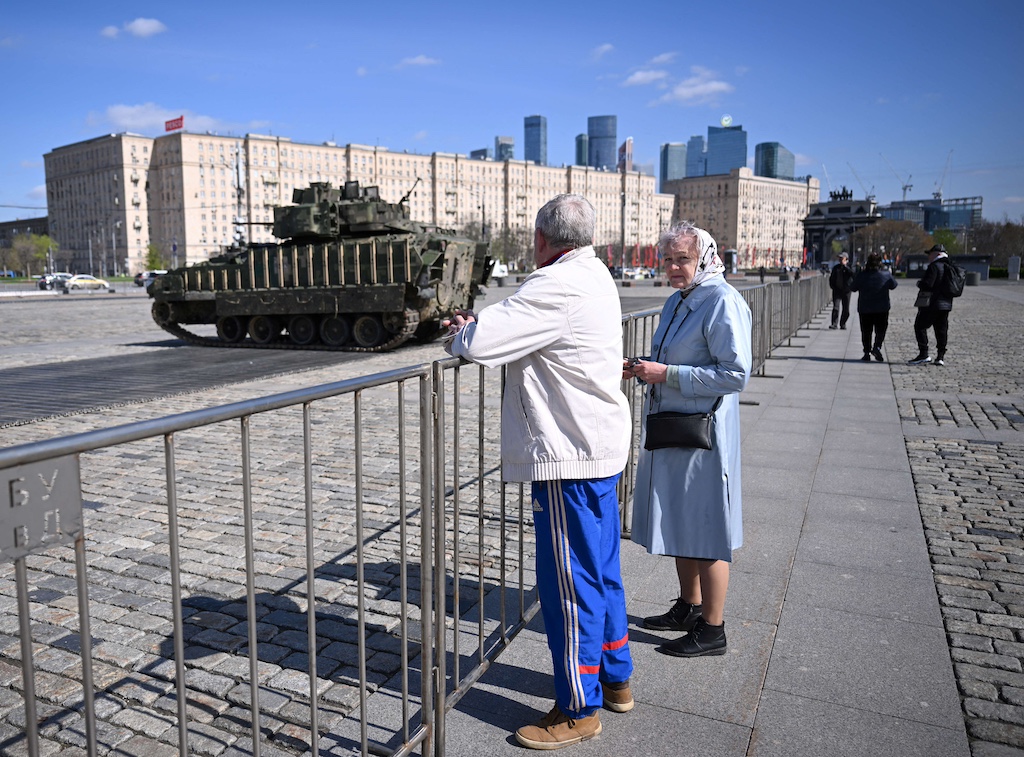
In Ukraine, language has turned from a means of communication into a “security” issue. (Natalia Kolesnikova / AFP via Getty Images)
Russia’s foreign minister, Sergey Lavrov, continues to insist that without full recognition of the rights of Russians and Russian-speakers in Ukraine, no peace is possible. “Our goal was, and remains, to protect the Russian people who have lived on this land for centuries,” he told an interviewer on August 19. Meanwhile, Russia bombs the very cities where most of these Russian-speakers live, laying waste to their homes and scattering their families. It’s protection by annihilation.
Few doubt the imperial nature of Russia’s aggression. Yet some in Ukraine still fall for the occupier’s formal pretexts and provide an inverted version of its script — treating language as a marker of loyalty to Ukraine and policing cultural identity. Take activist Sviatoslav Litynskyi, who argued that the language barrier “corresponds to the front line,” helping to uphold Ukraine’s defenses as much as the army. Or Serhii Prytula, a celebrity volunteer, who said that the Russian spoken on the streets is “a tool of Russia’s expansion,” and that those who use it become tools themselves.
This is the move: turn language from a means of communication into a “security” issue: Russian becomes a weapon, Ukrainian a shield. Once framed that way, everyday differences between ordinary people look like a danger. For a society already exhausted by war, austerity, and decades of institutional neglect, this narrow framing of belonging is a form of self-harm. Instead of building solidarity and bridging divides, political discourse increasingly insists that true unity requires cultural homogeneity.