How Ukraine’s Far Right Pushed Its Myths About World War II
Throughout the Russo-Ukrainian war, each side has cast its enemy as heirs to the Nazis of World War II. In Ukraine, this has fueled comfortable myths about the nationalists of the 1940s, whose role in the Holocaust is routinely ignored.
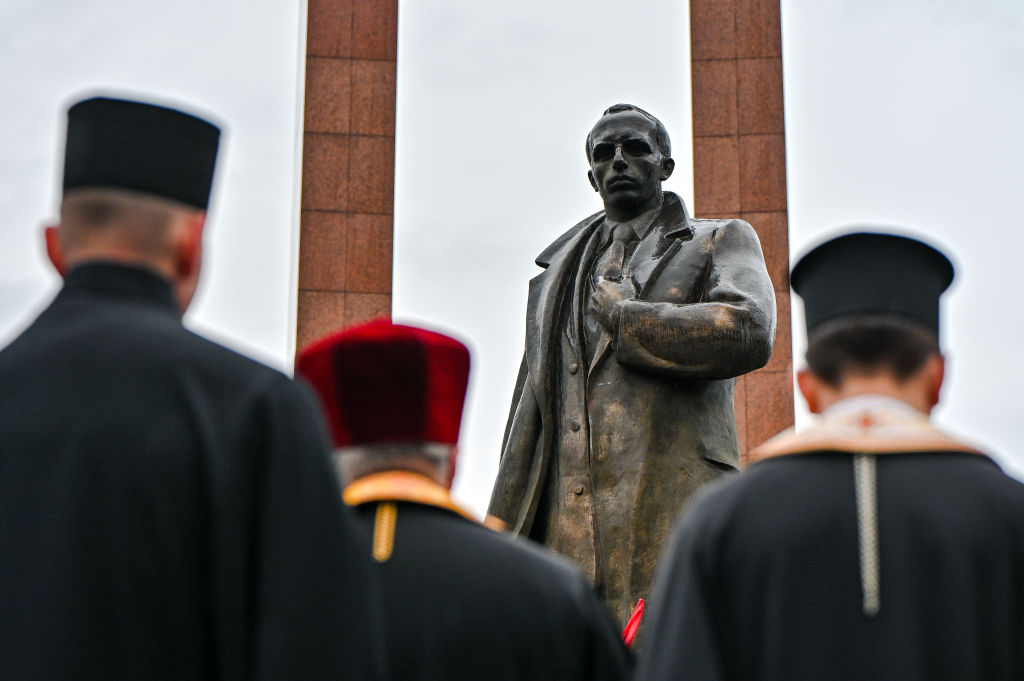
The monument to Stepan Bandera, the leader of the Organization of Ukrainian Nationalists, in Lviv, Ukraine, on January 1, 2024. (Ukrinform / NurPhoto via Getty Images)
During World War II, Ukraine became the epicenter of the most brutal fighting, and also the most extreme murder of Jewish and Slavic populations. Many Ukrainian nationalists sympathized with the Nazis, hoping that they would help them achieve an independent Ukrainian state. But this was far from Nazi Germany’s goal. From the start of its invasion, it tried to keep the main Ukrainian nationalists at bay — or to exploit their desperate situation to keep the genocidal war going.
Many Ukrainian nationalist forces joined in anti-partisan actions and the murder of Jews for various reasons. After World War II, all these circumstances were used by Soviet propaganda to vilify the Ukrainian nationalists, led by Stepan Bandera, whose real importance the Soviets greatly exaggerated. After the fall of the USSR, memory politics went to the opposite extreme — and pro-Nazi nationalists began to be celebrated by parts of Ukrainian society, especially those in exile.
But how far has the memory politics of World War II in Ukraine been dominated by the far right after the Maidan revolt of 2014? And how has this whole situation escalated since Russia’s invasion of Ukraine? Marta Havryshko, a Ukrainian historian and expert on the Holocaust in Ukraine, currently based at Clark University, answered these questions in an interview with Ondřej Bělíček.