We Can Organize Amazon, but Only If We Understand It
Organizing Amazon workers is both an existential challenge and an opportunity for labor. But the company’s cash advantages and operational flexibility mean that traditional union tactics won’t be enough. We need strategies that combine disruption and scale.
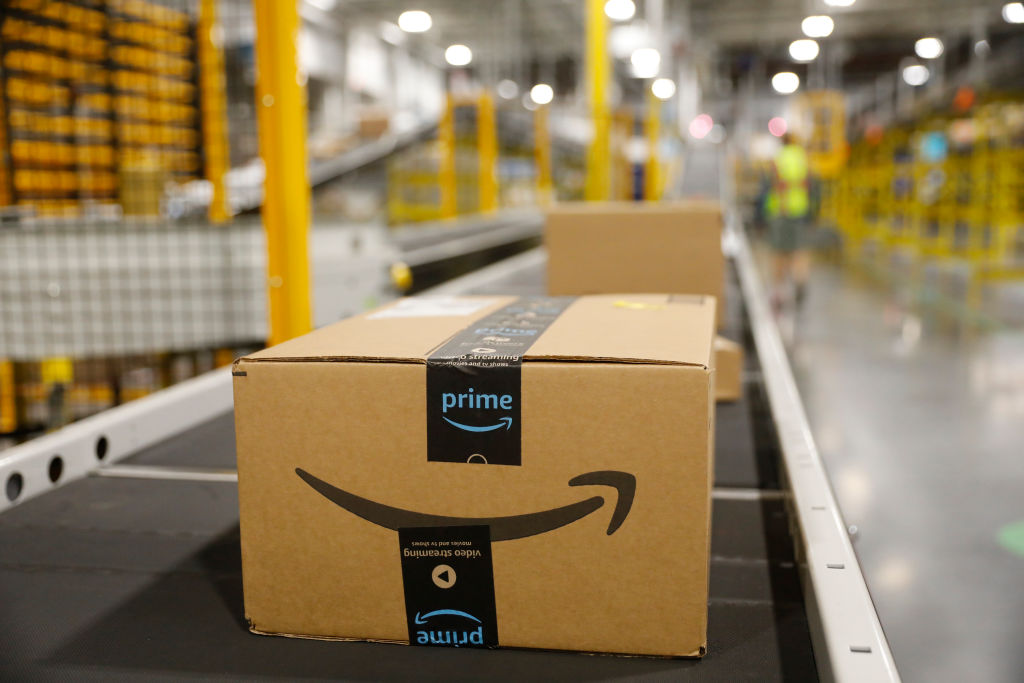
Products are seen on a conveyor belt at an Amazon fulfillment center where they are being sorted and shipped on November 27, 2023, in Tampa, Florida. (Octavio Jones / Getty Images)
If we count Amazon’s roughly 500,000 subcontracted drivers alongside its 1.5 million employees, this modern corporate behemoth is likely the largest employer in the country — edging out Walmart, which has held that designation for three decades. It is second only to Walmart in total revenue (a fact that may well change very soon, too), and it’s got the fourth-largest market cap ($2.47 trillion) after Apple, NVIDIA, and Microsoft.
It’s also a very strange company. It’s a software company, it’s a retail company, it’s a parcel company. It wants to be everything for everyone, and its dynamism continues to amaze. Eleven years ago, it had no outbound transportation capacities. Today, with a gigantic network of sortation centers [SCs] and delivery stations, it’s delivering more packages than UPS.
For strategists seeking to organize this always-changing and ruthless corporation, these facts raise an important question that is quite difficult to answer: What exactly is Amazon? Why has it been so successful? Does it benefit from certain unfair conditions? What is the source of its profitability? Of its dynamism?