Bolivia’s Failed Coup Is the Symptom of a Growing Political Crisis
Details surrounding a recent coup in Bolivia are still murky. But one thing is certain: the botched military takeover is the symptom of a political crisis fueled by a split within the Bolivian left.
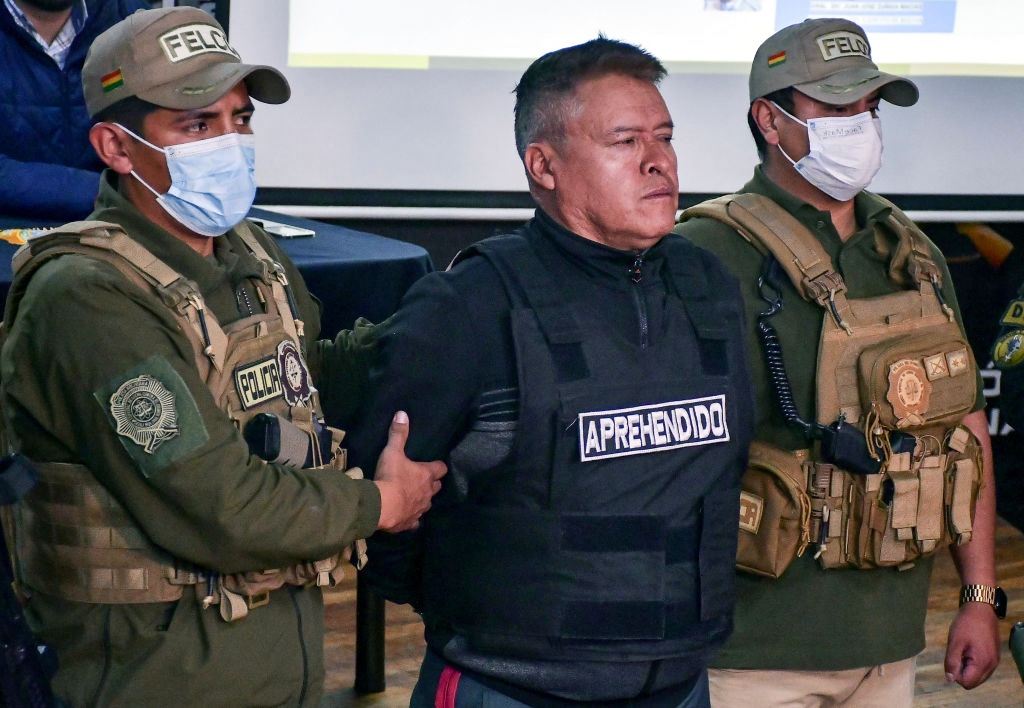
Bolivian now-dismissed army chief General Juan José Zúñiga is escorted by police after his attempted coup in La Paz on June 26, 2024. (Daniel MirandaI / AFP via Getty Images)
Last week, Bolivia experienced yet another coup. During the afternoon of Wednesday, June 26, armed soldiers and tanks massed in La Paz’s Plaza Murillo, with one tank breaching the historic presidential palace. Images of the face-to-face confrontation between army general Juan José Zúñiga and President Luis Arce went viral. For Bolivians, the feeling of dread evoked was all too familiar. Fortunately, it was fleeting, with the putsch petering out within hours. Instead of bloodshed and repression, the failed coup left questions: Why did it occur, and what comes next?
Within Bolivia, there is debate over why the coup took place. The most straightforward answer is that this was the work of a disgruntled and, by all appearances, astonishingly inept and isolated general, furious with the president for his apparent disregard for his loyalty. Zúñiga displayed this “loyalty” on June 24 by publicly declaring that Evo Morales, President Arce’s one-time boss and current political rival, is ineligible to stand for election in 2025. As Pablo Stefanoni notes, in his June 24 interview, Zúñiga stated, “Evo Morales is legally ineligible. The Constitution says that you cannot have more than two terms, and this man was reelected. The mission of the Army and the Armed Forces is to make sure the Constitution is respected and complied with. This man cannot be president of this country once again.”
Zúñiga’s words refer to a December 2023 ruling by Bolivia’s Plurinational Constitutional Tribunal, which held that presidents cannot serve more than two total terms in office. This ruling negated the Tribunal’s controversial 2017 decision that presidents and other officeholders can stand for reelection indefinitely as a human right. That earlier ruling paved the way for Morales’s victorious 2019 presidential campaign, which sparked the last Bolivian coup of November 2019, ushering in a year of military rule under the far-right regime of Jeanine Áñez. By reversing its 2017 decision, the Tribunal has blocked Morales’s ability to run in the 2025 election.