In Italy, an Exploited Punjabi Farmworker Is Left to Die
Last Monday, Punjabi farmworker Satnam Singh suffered critical injuries in an accident on an Italian farm — and then his boss left him to die. The shocking case showed how Italian agriculture treats migrant workers’ lives as the cheapest of commodities.
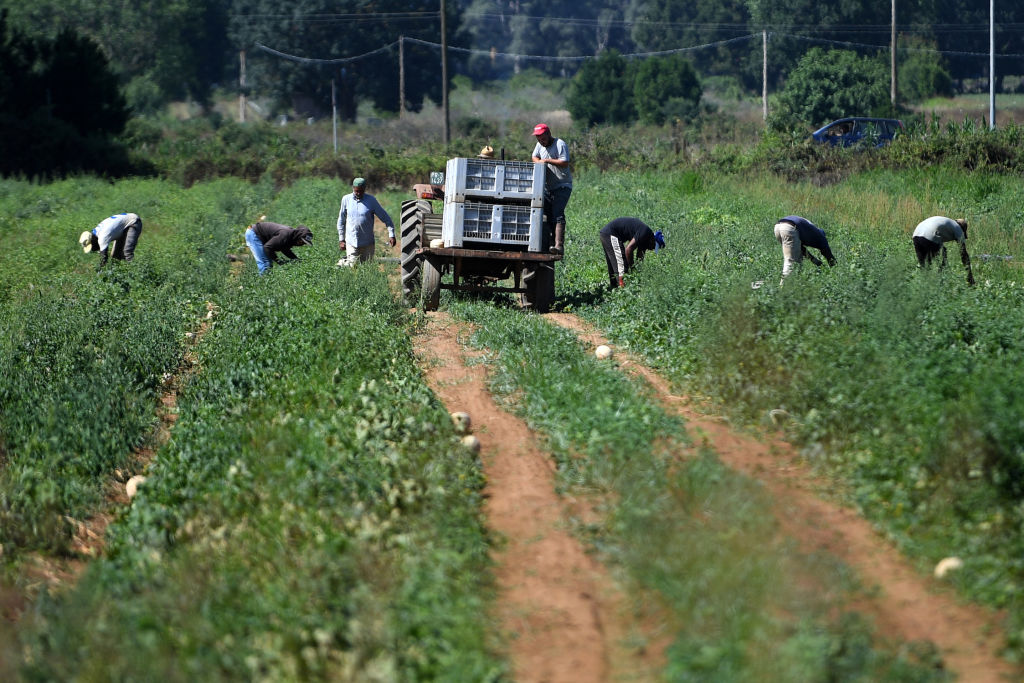
Punjabi migrant laborers work in the village of Bella Farnia, Italy, on July 1, 2021. (Filippo Monteforte / AFP via Getty Images)
June 19 was time for mourning as Italy’s agromafia claimed its latest victim. Thirty-one-year-old migrant Satnam Singh died in a Roman hospital, two days after his arm was cut off and his legs were fractured in a tragic accident. He had been operating an agricultural machine in a farm near Latina, a rural province fifty miles south of Rome where criminal networks systematically exploit the labor of thousands of migrants from Punjab, India. He and his wife Sony had both worked in the area without contract since 2021, planting melons for just €4 per hour. Their boss’s subsequent actions helped ensure that when Satnam was injured, he didn’t get medical attention.
At the time of the accident, Satnam had already been working for twelve hours. When the machine mutilated his body, the Italian padrone (literally “owner,” as employers in the area like to be called, a term reminiscent of feudal dependence) prevented everybody on the farm from calling an ambulance and confiscated their phones. Instead, the boss drove the unconscious Satnam and his desperately crying wife in his van for miles, dumped them in the back of their house along with the pieces of Satnam’s severed arm in a fruit box, and ran away — rather than taking them immediately to the hospital, which could have saved Satnam’s life. Had he brought them to the emergency room, the boss would have had to face up to the legal consequences of employing the workers without a contract and without protections.
The inhumanity of his actions prompted widespread horror. It turned public debate back to the issue of caporalato (gang mastering), a practice that affects almost all migrant workers in Italian agriculture, as has been well-documented for many years by researchers and activists in Latina and beyond. The current discourse focused on “fighting the plague of caporalato,” promoted by politicians of the present and past governments, was reiterated during the strikes organized by the Italian General Confederation of Labor, the Italian Confederation of Trade Unions, and the Italian Labor Union in Latina over the last week in support of Satnam Singh and all exploited workers. The mayor of Latina — a member of Giorgia Meloni’s Fratelli d’Italia party, invited to speak on stage in both demonstrations — insisted that “caporalato is a form of slavery that does not belong to our culture, our city, and our nation: as such, it needs to be eradicated.” She took up a familiar apologetic trope of Italians being brava gente, “good people.”