Why Germany Continues to Fail Its Migrant Workers
Migrant workers have served as the foundation for Germany’s rapid economic growth in the postwar years, but the benefits of that growth have not been evenly distributed. Today, precarious workers are pushing back against Germany’s exclusionary economic system.
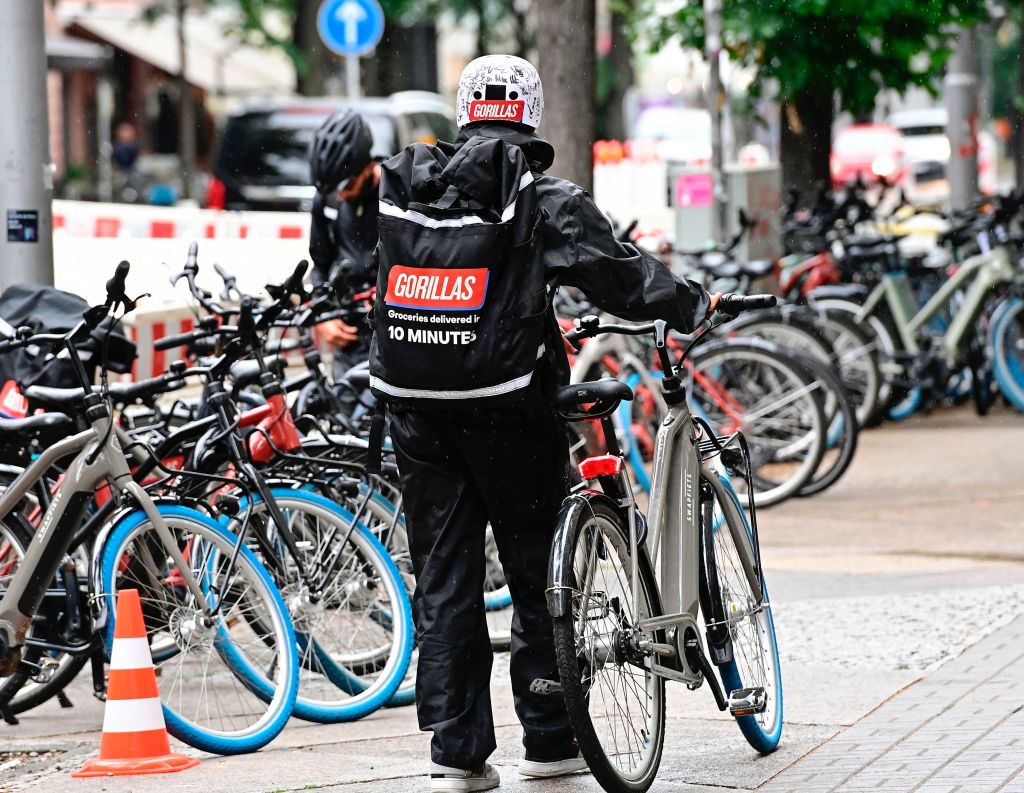
A courier for grocery-delivery company Gorillas in Germany. (Tobias Schwarz / AFP via Getty Images)
For the majority of Germans, between 1950 and 1970, net real wages grew threefold. Industrial workers saw the bulk of these gains, as their salaries increased fivefold over the course of this period. The benefits of what came to be known as the Wirtschaftswunder (economic miracle) were, however, not evenly distributed.
Between 1956 and 1966, the number of foreign workers in West Germany increased from 95,000 to 1.3 million and then, following a depression-induced lull in 1968, increased again to 2.6 million, in 1973. Many of these workers enjoyed little to no employment rights and were not covered by the strong postwar labor laws and collective bargaining agreements usually associated with German social democracy.
Although other European nations developed similar recruitment programs, West Germany’s was one of the most sophisticated and comprehensive. Starting with Italy in 1955, the federal republic would go on to set up agreements with Spain, Greece, Turkey, Morocco, and Yugoslavia to recruit workers to take up positions in the informal sectors of Germany’s economy. The drive was a response to its rapid industrial expansion in the postwar years, which generated a massive demand for unskilled and semiskilled labor.