Germany’s Far Right Is at War With Itself
- Loren Balhorn
The far-right Alternative für Deutschland came second in the European elections but fell short of expectations. Now its leadership is riven by conflicts both internal to the party and among the broader European far-right milieu.
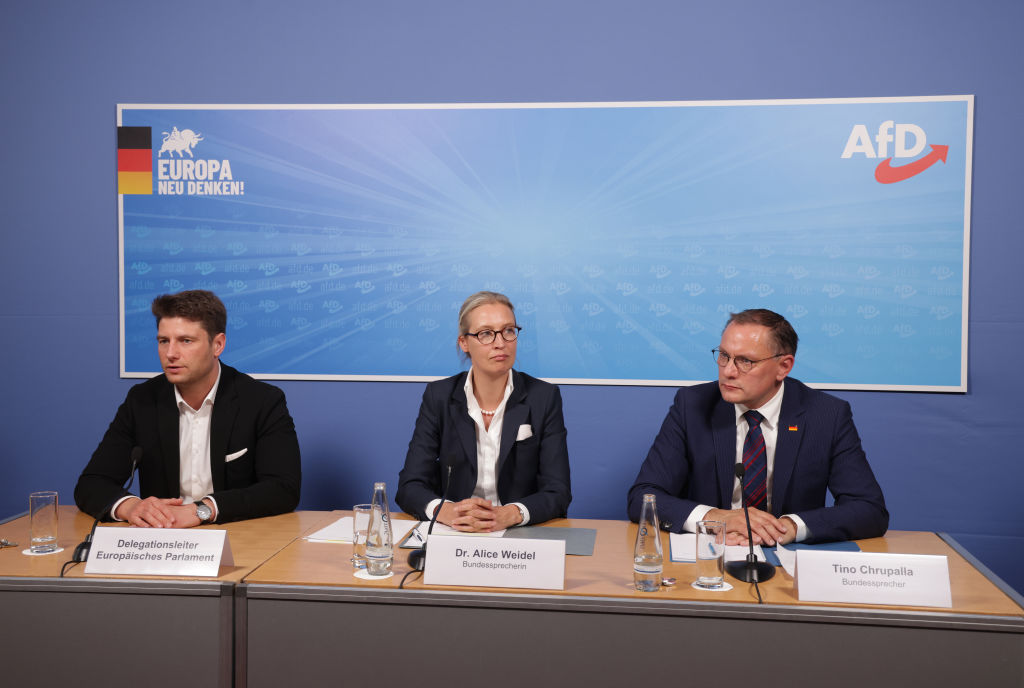
Tino Chrupalla (R) and Alice Weidel, coleaders of the Alternative für Deutschland, and AfD European Parliament candidate René Aust speak to the media the day after European parliamentary elections on June 10, 2024 in Berlin, Germany. (Sean Gallup / Getty Images)
Less than six months ago, the rank and file of Germany’s leading far-right party, the Alternative für Deutschland (AfD), was ecstatic. Founded a little over a decade ago as a Eurosceptic protest party, by early 2024 the AfD was polling at up to 23 percent — and nurtured justified hopes of becoming the strongest party in Germany in June’s vote for the European Union’s parliament.
The AfD’s so-called Spitzenkandidat, or top candidate for the EU elections, Maximilian Krah, emphasized at every opportunity that the AfD was the most exciting right-wing party in Europe. Unlike Giorgia Meloni in Italy or Marine Le Pen in France, he told supporters, the AfD rejected cooperation with the political center. The AfD had instead staked out a clear position on the hard right while still gaining in the polls. The party faithful eagerly anticipated the 2024 “super election year,” including not only the EU elections but three important state elections in Brandenburg, Saxony, and Thuringia, which it was set to dominate.
In the aftermath of the EU vote, however, little is left of that euphoria. The AfD did take 15.9 percent — almost 5 percentage points higher than in the last such elections in 2019 — and became the second-strongest party behind the Christian Democrats (CDU/CSU). But overall, this outcome was disappointing compared to the sky-high expectations of only a few months ago.