Europe’s Center Is Holding — by Integrating the Far Right
This weekend’s European elections saw a swing to the right, including big gains for anti-immigration parties. In most cases, far-right forces have abandoned calls to leave the EU — but they are increasingly able to set the bloc’s own agenda.
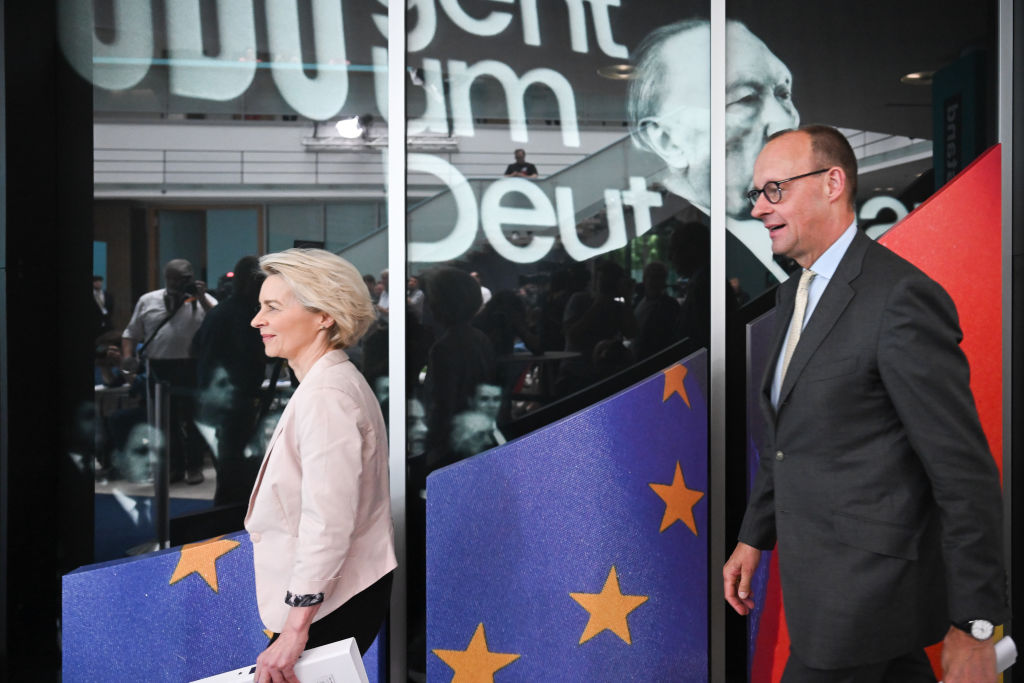
Friedrich Merz, chairman of the Christian Democratic Union (CDU), and Ursula von der Leyen, lead candidate of the CDU for the European elections and president of the European Commission, arrive at a press conference after the CDU Federal Executive Committee meeting in the Konrad Adenauer House, Berlin, Germany, June 10, 2024. (Sebastian Christoph Gollnow / picture alliance via Getty Images)
Would Giorgia Meloni prefer to partner with the “mainstream pro-European” Emmanuel Macron or else the “far-right outsider” Marine Le Pen? Ahead of this weekend’s elections to the European Union’s parliament, much punditry on the EU’s future speculated on the next moves by the Italian prime minister — deemed a potential “kingmaker” in Brussels coalition-building or else a partner in a new nationalist international. Rival far-right candidates accused Meloni of sucking up to the French president (and to the EU’s top official, Ursula von der Leyen); some more proudly Europeanist commentators hoped Macron and Meloni could “join forces to save Europe.” But now, with Macron calling snap elections that could easily vault Le Pen’s party into the national government, perhaps Meloni won’t have to choose one over the other after all.
International media veneration of Meloni as a pragmatic actor in EU politics generally relies on a near-indifference to specific policies, so long as the overall European project holds together. Her party is by this point committed to changing the EU from within, and also relatively stable at home. It scored 29 percent in Sunday’s vote, beating its 2022 general election score and outclassing its often-disruptive coalition partners in the Lega (8 percent). The results also confirm that Italian prominence in EU politics reflects the weakness of the bloc’s usually central French-German pairing and the tailing-off of its postpandemic economic relaunch. In France, Macron’s list scored 15 percent, versus 31.5 percent for Le Pen’s Rassemblement National. In Germany, scandals over Nazi-indulgent views in the Alternative für Deutschland (which rose to 16 percent) did not stop it defeating the ruling Social Democrats (14 percent), whose coalition partners (Greens on 12 percent, Free Democrats on 5 percent) also scored abysmally.
In general, the far right increased its numbers, though the language of insurgent outsiders ill befits what is now an established part of the EU political landscape. In fact, looking at the election as a whole, the change was pretty incremental. Overall seat totals suggest that in the new 720-member parliament, which has grown by fifteen seats since 2019, the center-right European People’s Party gained about nine seats, the Social Democrats lost two, the Left lost one, Greens and Liberals lost about twenty each, and the various strains of the far right added on about thirty or so, mainly in France and Germany. In Italy the far right came first, but this wasn’t new: the fourteen seats gained by Meloni’s Fratelli d’Italia were all at the expense of the Lega. The center left performed well, while Macronesque extreme centrists like Matteo Renzi lost out. In Spain, Meloni’s allies Vox gained two seats, but the mainstream parties’ vote also held up; in Poland, Law and Justice lost out, to the benefit of both the softer right and the harshly nationalist/right-wing-libertarian Konfederacja.