Stop Blackmailing Georgians Over EU Membership
Anti-government protests in Tbilisi have been hailed as a fight over Georgia’s European future — even though the government itself wants to join the EU. Amid the geopolitical posturing, the real issue being ignored is the chronic crisis of Georgian democracy.
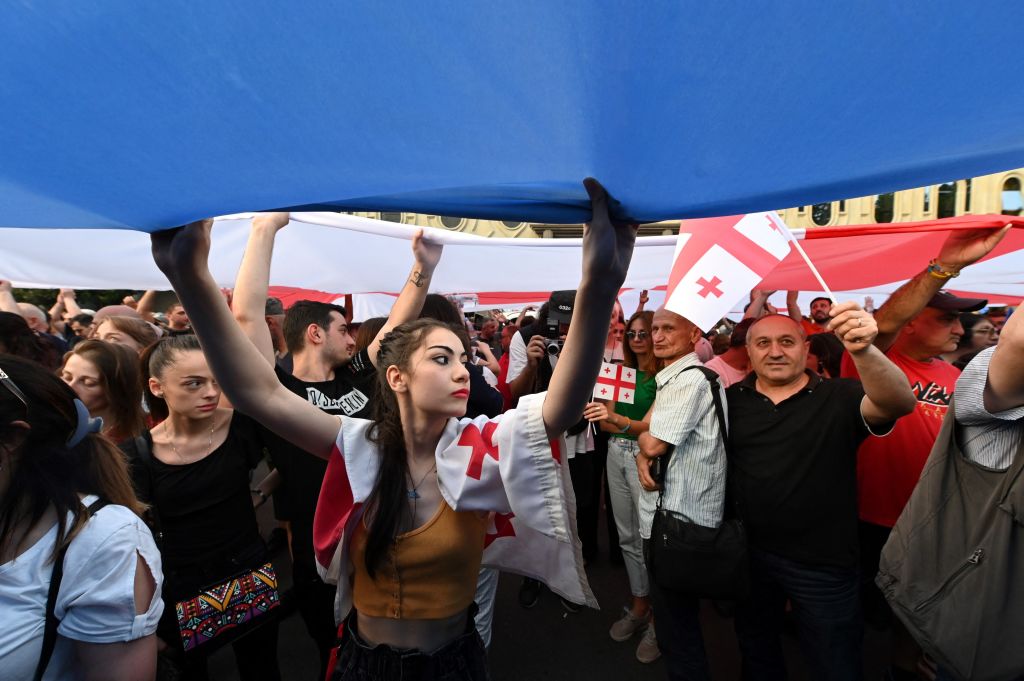
Demonstrators hold a giant European flag as they attend a pro-EU march in support of the country’s membership in the European Union in Tbilisi on June 20, 2022. (Vano Schlamov / AFP via Getty Images)
The outsized role that foreign-funded nongovernmental organizations (NGOs) play in Georgia’s politics, policy-making, and public services has led the country into a chronic democratic crisis.
This is a massive problem — and goes back a quarter of a century, predating the 2003 Rose Revolution. The late president Edvard Shevardnadze had given foreign aid agencies great leeway, so toward the end of his feckless and corrupt rule, NGOs were already a vocal presence in the country’s political discourse and maintained confident relationships with international donors. After years of turmoil and state collapse, Georgians with ideas and convictions seized the moment to shape their society.
It felt fresh and energetic, albeit driven more by “social entrepreneurs” than broad-based grassroots movements. After Shevardnadze’s former justice minister, Mikheil Saakashvili, deposed him in the Rose Revolution, NGO professionals quickly filled senior government posts. The country’s policy space was thrown wide open to any and all foreign-led aid and reform experiments. The calculation was that the geopolitical and material benefits would far outweigh any drawbacks.