Georgia Is Trying to Make It Harder for Workers to Unionize
Labor has been stirring recently. That’s unacceptable for bosses, who never rest in their attacks on unions. Case in point: a new bill in Georgia that seeks to ensure the unionization process is as difficult for workers and favorable to bosses as possible.
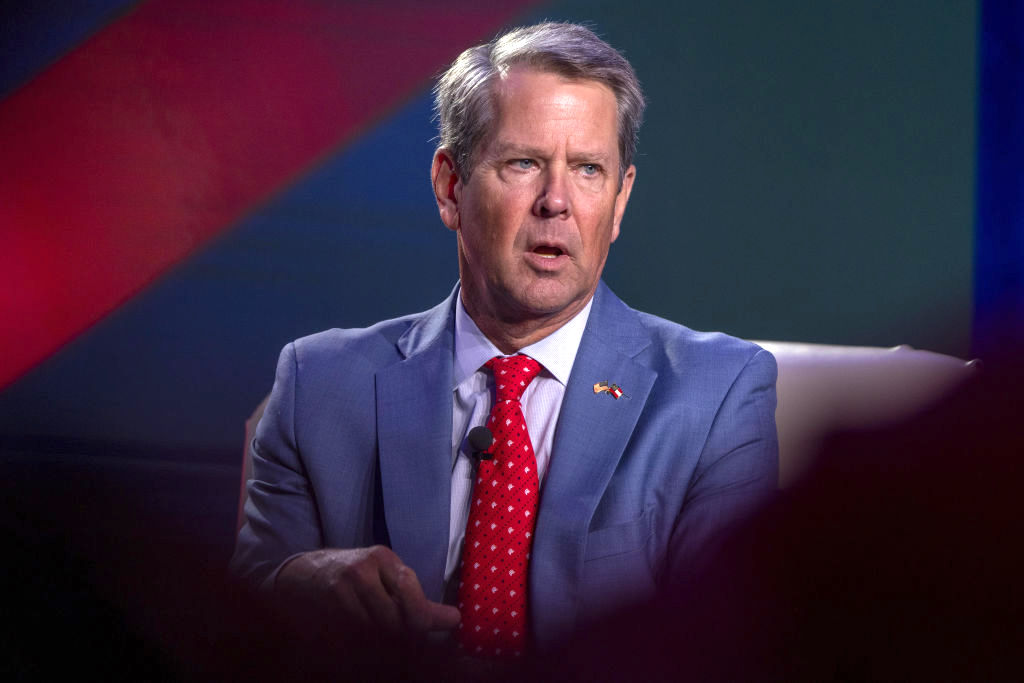
Governor Brian Kemp speaking in Georgia, August 18, 2023. (Alyssa Pointer / Bloomberg via Getty Images)
Last week, Georgia lawmakers passed legislation aimed at making it harder for workers to unionize. SB 362, championed by Republican governor Brian Kemp, bars companies from receiving economic incentives from the state if they voluntarily recognize a union rather than requiring workers to hold a secret-ballot election overseen by the National Labor Relations Board (NLRB). While the bill’s Republican backers characterize the legislation as a means of protecting workers’ right to privacy, its effect would be to protect employers’ right to coerce their workforce during the union-election process; currently, some 42 percent of employers are charged with violating federal labor law during that period.
The National Labor Relations Act (NLRA), the 1935 law that governs private sector collective bargaining, allows for such voluntary recognition. According to the long-standing interpretation of the law, employers can recognize a union and begin bargaining once workers have demonstrated their desire to unionize, often via “card check,” where workers show that a majority have signed union authorization cards. The process has been frequently used by unions in recent years as it offers a faster route to unionization and contract bargaining than the NLRB process, which employers frequently take advantage of to wage a union-busting campaign, hauling workers into captive-audience meetings and otherwise using their unfettered access to workers to sow confusion and fear.
The Georgia legislation passed in the state senate last month 31-23 and in the House on Wednesday 96-78, in votes that fell almost entirely along party lines, with Republicans backing the bill. It’s sure to face legal challenges for violating the NLRA’s protection of workers’ right to voluntary recognition. As American Federation of Labor and Congress of Industrial Organizations (AFL-CIO) president Liz Shuler said of the bill, it “violat[es] long-held precedent established by the NLRA.” Only 4.4 percent of workers in Georgia are unionized, the eighth-lowest union density in the United States. The bill is “a solution in search of a problem,” James Williams of the Georgia AFL-CIO said.