Aligning With Washington Is Bad News for Argentina
Argentina’s biggest trade partners are Brazil and China, but President Javier Milei is making them into enemies. Desperate to suck up to US interests, Milei’s Cold Warrior foreign policy is an ideological relic, out of touch with a multipolar world.
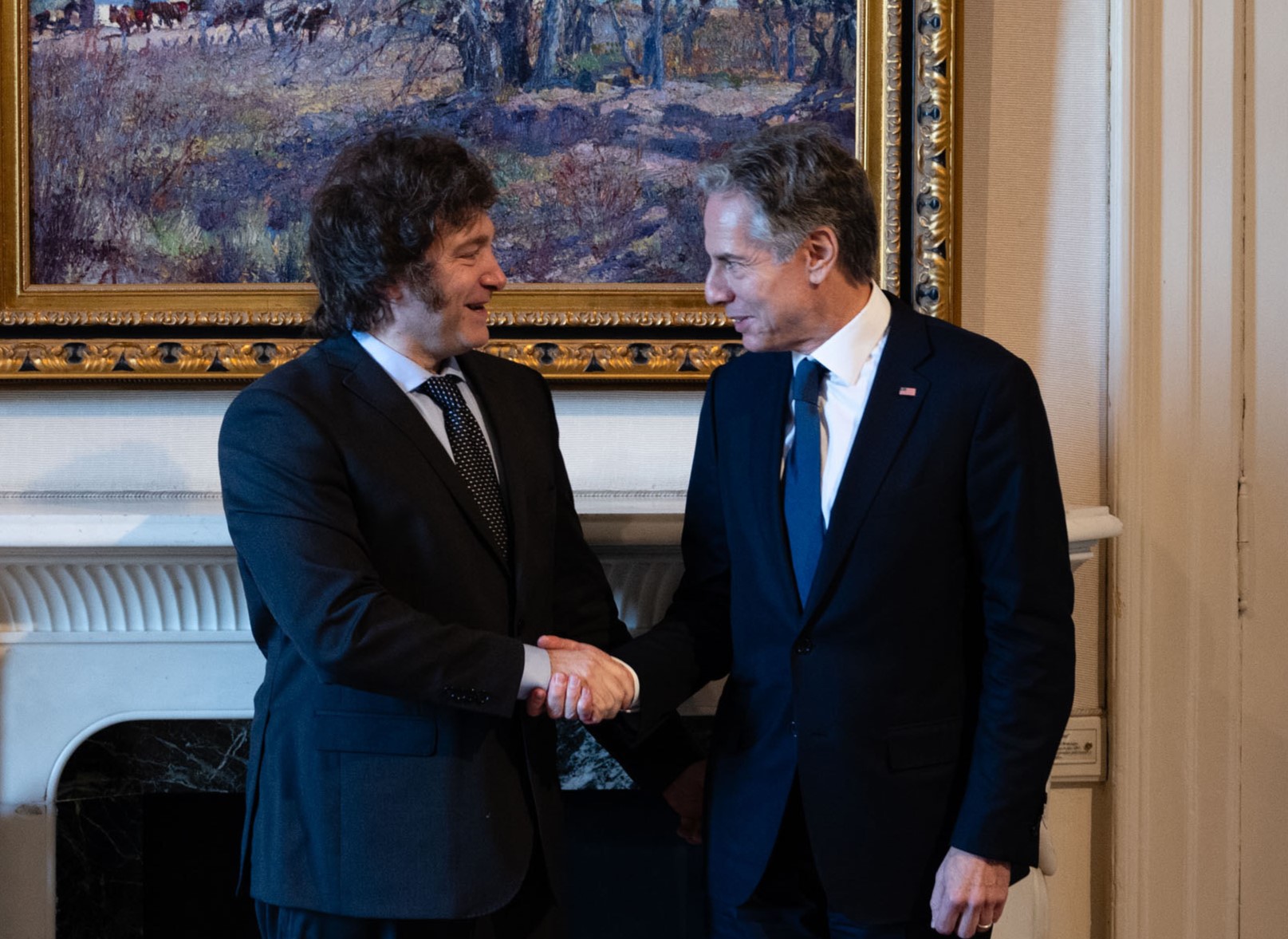
US secretary of State Antony J. Blinken meets with Argentine president Javier Milei in Buenos Aires, Argentina, on February 23, 2024. (Chuck Kennedy / US Department of State via Wikimedia Commons)
Argentina’s president Javier Milei is a throwback. He sports muttonchops and a leather jacket. His favorite band is the Rolling Stones. He is a Cold Warrior, spouting anachronistic anti-communist rhetoric that doesn’t correspond to the geopolitical dynamics of the twenty-first century. But the realities of Argentine and global economics have not deterred Milei from pursuing a program of trade and foreign policy that seeks to realign the country with the United States and its interests, in a pantomime of the Cold War. By drastically cutting spending, privatizing national industries, and deregulating the economy, Milei hopes not just to curb inflation but to draw foreign investment and return Argentina to the fold of the international financial system. In this, too, he harks back to the past and to the country’s long-standing desire to reenter the “first world” — while expressing old anxieties about its decades-long economic decline.
But if Milei truly looked back at the past, he’d realize that overreliance on US support will not help the Argentine economy, or, more importantly, its people. If Argentina is to resolve its fiscal woes and develop the infrastructure and industry necessary for its future, it should turn away from US hegemony and embrace the promise of a multipolar approach to trade and foreign policy. This was an approach already taken up by the previous administration — and one that the opposition should cherish as a vision for Argentina’s future place on the world stage.