For Europe’s Left, International Solidarity Is More Rhetoric Than Reality
Through years of austerity, Europe’s radical-left parties spoke of a common challenge to EU neoliberalism. But without any real shared strategy, parties focused on domestic politics are rarely able to build collaboration across borders.
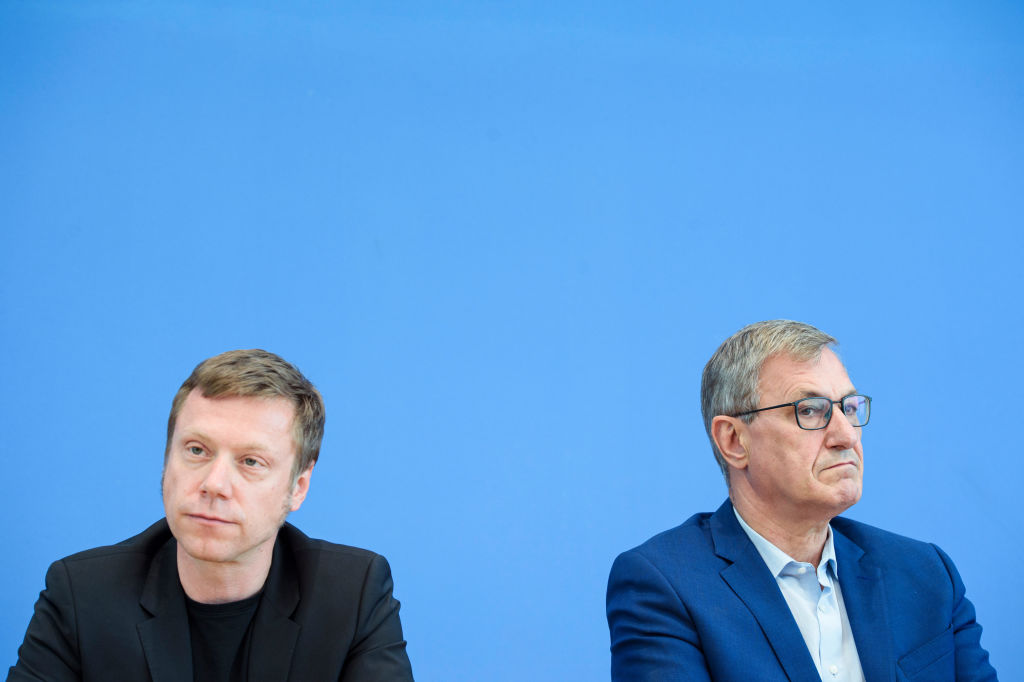
Martin Schirdewan (L), MEP for The Left party, and Bernd Riexinger (R), federal chairman of the Left Party, at a press conference in Berlin, Germany on May 27, 2019. (Gregor Fischer / dpa / picture alliance via Getty Images)
As capitalism’s polycrisis unravels, right-wingers are still winning elections around Europe. Last month the far right won in the Netherlands, and earlier this year conservatives came first both in Greece (where anti-immigrant parties also made a breakthrough) and Spain (where only a deal with regionalists allowed Pedro Sánchez’s social democrats to retain power). Since taking over the government in Italy last October, Giorgia Meloni’s party has easily retained first place, while in Germany the Alternative für Deutschland is second in the polls.
The June 2024 elections for the European Parliament promise a similar picture: the mainstream center-right, and increasingly reactionary, European People’s Party (EPP) is likely to remain the largest group, followed by the social democrats. But the biggest winners in relative terms are set to be two reactionary, and increasingly mainstream, groups: Identity and Democracy (ID) and European Conservatives and Reformists (ECR), looking to gain eighty-seven and eighty-two seats, respectively.
By contrast, the radical-left group, The Left, is likely to remain the smallest force in the European Parliament, with under forty seats. This reflects the weakness of radical-left parties in their own national arenas, despite a couple of notable exceptions (see the Workers’ Party in Belgium and the Austrian Communist Party). The two big success stories of the past decade, Syriza in Greece and Podemos in Spain, have not managed through their participation in government to fundamentally challenge the neoliberal status quo either at home or in the EU; in fact, Syriza’s implementation of cuts and privatizations reinforced both. This year, the two parties scored just half as well as at their peak back in 2015; Syriza concluded its long-term metamorphosis into a centrist party by electing a former Goldman Sachs banker as leader.