Jeremy Corbyn: “History Will Judge Those Who Had the Opportunity to Stop This Massacre”
Jeremy Corbyn argues that we need an immediate cease-fire to stop the slaughter of civilians in Gaza — and that the end of the Troubles in Northern Ireland shows how a cease-fire might pave the way to a just, lasting peace.
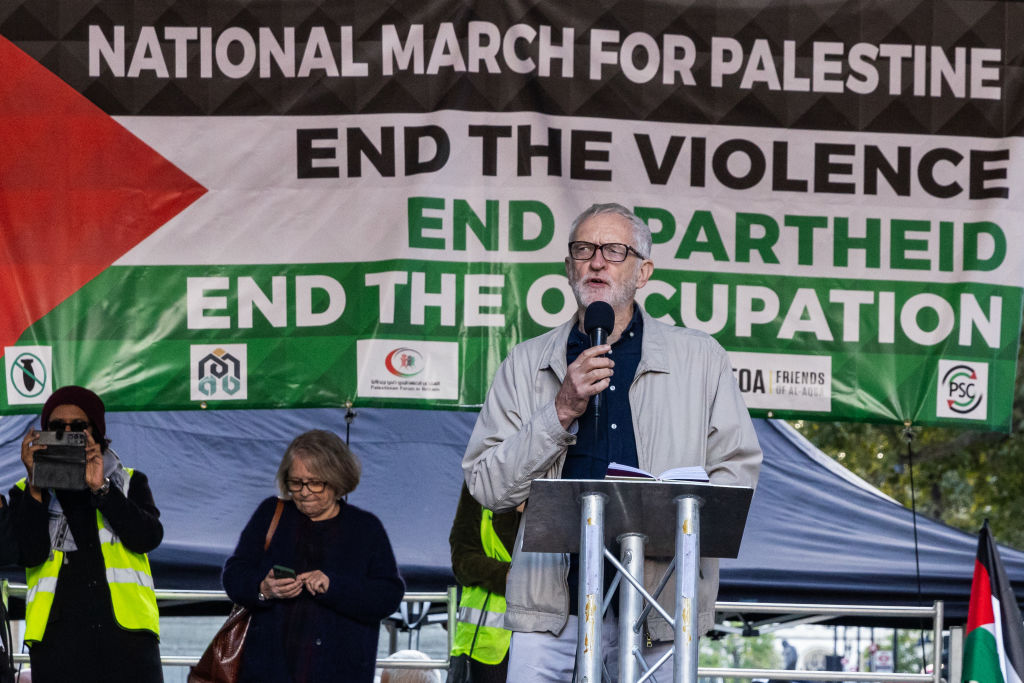
Jeremy Corbyn addresses tens of thousands of pro-Palestinian demonstrators during a rally outside Downing Street in support of the Palestinian population of Gaza on October 14, 2023 in London, United Kingdom. (Mark Kerrison / In Pictures via Getty Images)
“Daddy, I love you very much.” Those were the last words of Gordon Wilson’s daughter, Marie, on November 8, 1987. Both Gordon and Marie had been attending a Remembrance Day parade in the Northern Irish town of Enniskillen when a bomb exploded, planted by the Provisional IRA just behind the cenotaph. Buried under the rubble, Gordon held his daughter’s hand as she drifted out of consciousness. By the time they were rescued, it was too late. Marie was killed. She was just one of the 3,500 lives that were lost over the course of the Troubles.
IRA attacks in Northern Ireland frequently resulted in retaliation by loyalists. On this occasion, however, there was no immediate reprisal. “I bear no ill will. I bear no grudge,” Gordon said only hours after his daughter’s death. “That will not bring her back.” In the depths of darkness, Gordon somehow found the courage to plead with the loyalists not to retaliate. At least temporarily, they listened.
Gordon spent the remainder of his life trying to break the endless cycle of violence for good. “I went in innocence to search for what my heart told me might be a way forward. . . . I got nothing,” Gordon reflected. However, seven years after Marie’s death, his seemingly impossible dream of peace began to come true.