A New Album of Old Labor Songs Revives a Forgotten Era of Class Struggle
On the anniversary of songwriter and union organizer Joe Hill’s execution by firing squad, a new album revives early 20th-century labor movement songs, capturing the original spirit of loud, raucous brass bands.
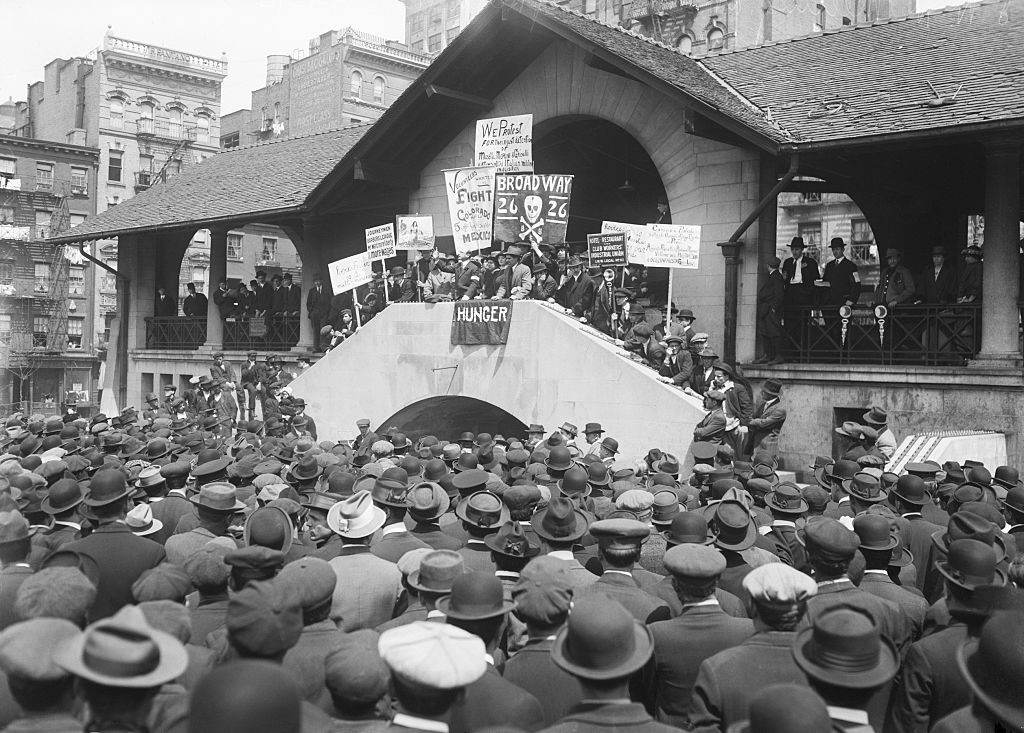
Wobblies rally in solidarity with the Laidlaw, Colorado, strikers on May 1, 1914. (Bettmann / Getty Images)
One hundred and eight years ago today, the great songwriter and union organizer Joe Hill was executed by firing squad in Utah after getting framed on trumped up murder charges. On the anniversary of his death, an album of never-before-recorded songs from the Industrial Workers of the World, as they would have been sung on the street during the union’s heyday, is available for presale from PM Press. Starvation Army: Band Music No. 1 is a historical memory project from conductor Chris Westover-Muñoz; the Brass Band of Columbus, Ohio; and Sing in Solidarity, the choir of the New York City chapter of the Democratic Socialists of America, of which I am a member.
At the height of its power in the early twentieth century, the Industrial Workers of the World (IWW, or “Wobblies”) was renowned not only as a fighting union, but as a singing union. Joe Hill — alongside fellow Wobblies Richard Brazier, John Brill, Ralph Chaplin (lyricist of “Solidarity Forever”), and many other now nameless workers — wrote labor songs that remain popular over a century later. Their Little Red Songbook continues to be the bible of American labor songs, and is in its thirty-seventh printing 114 years after first publication.
In the booklet accompanying the new album, conductor Westover-Muñoz, quoting Jackson Albert Mann in Cosmonaut magazine, describes how The Little Red Songbook was repopularized decades after the IWW’s decline by musicians like Pete Seeger during the Popular Front communist folk revival of the 1940s. “Indeed,” Mann writes, “almost all contemporary recordings of IWW music are done in an Appalachian-derived instrumental style borrowed directly from the CPUSA-affiliated musical group, the Almanac Singers.” But Wobbly songs were not mountain music — they were innately urban, intended to be sung on city streets and in noisy union halls. The songs were often accompanied by brass bands, which grew to interest Westover-Muñoz, a wind ensemble conductor, and inspired him to create a new album of songs from The Little Red Songbook with brass accompaniment.