When Being a Red Meant Risking Your Life
This year marks a century since the First Red Scare, which decimated the ranks of the US left. One of the worst episodes was the Centralia incident — where a reactionary mob tortured and killed a group of IWW members to drive them out of the Washington town.
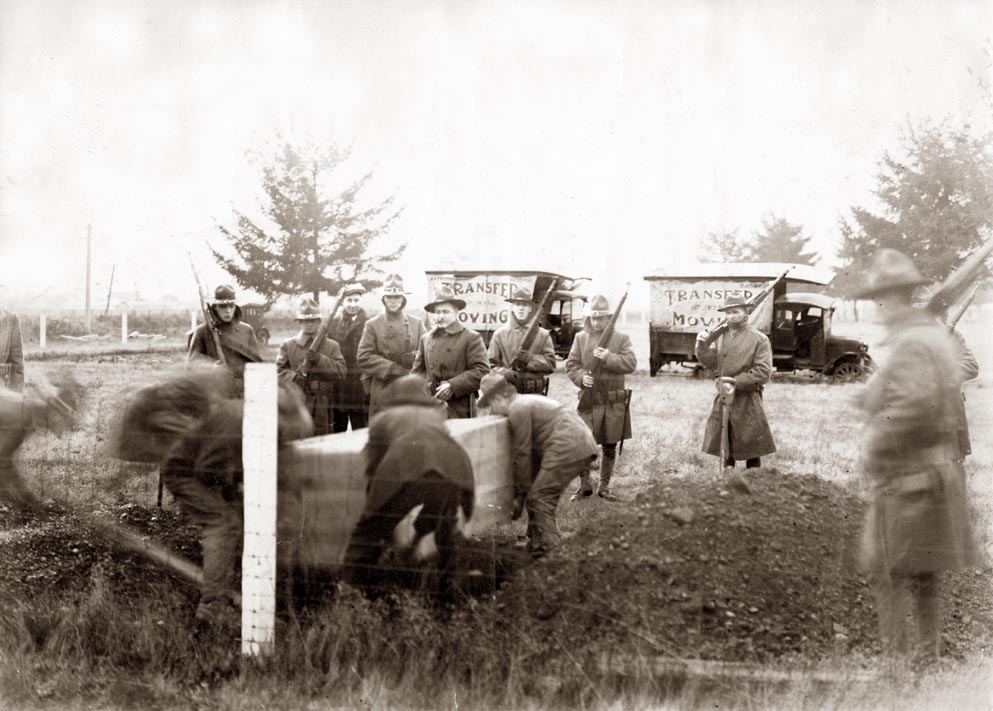
The burial of Wesley Everest, with armed National Guard unit. Wikipedia
“To be a red in the summer of 1919 was worse than being a Hun in the summer of 1917,” wrote John Dos Passos in 1919, his novel of the war years. The nation was war-weary as the year began, still reeling from the deadly influenza — the “Spanish flu.” It yearned and deserved “normalcy,” politicians argued — a return to the familiar, to a rural America, to a country of farms, small towns, and the leafy prosperity of the new suburbs. It wanted to leave behind the battlefields and bloody revolutions of the old world.
Yet the Armistice celebrations — enormous and near universal in the United States — had hardly stilled when that “normal” was erased and new disputes emerged, exposing deep fissures that presaged an extraordinary year to come. On November 11, 1918, clothing workers in New York began a general strike, demanding a forty-four-hour workweek and wage increases. They were joined on picket lines by returning soldiers and sailors. Scarcely a month had passed, and far across the continent, shipyard workers in Seattle voted to strike, rejecting the wage offers of wartime government regulators.
And strike they did, clearing the way for the Seattle General Strike, the first and only one of its kind in the United States, challenging not just managerial authority but civil as well. For a full week in February, committees of ordinary workers saw to it that the sick were cared for, that the garbage was collected, that babies got their milk, and that there was order on the streets.