Narendra Modi’s Electoral Bandwagon Went Off the Road in Karnataka
The Bharatiya Janata Party saw last month’s state election in Karnataka as a crucial test of its ability to win votes in South India. The party’s loss to Congress suggests it could be more vulnerable than anticipated ahead of next year’s national election.
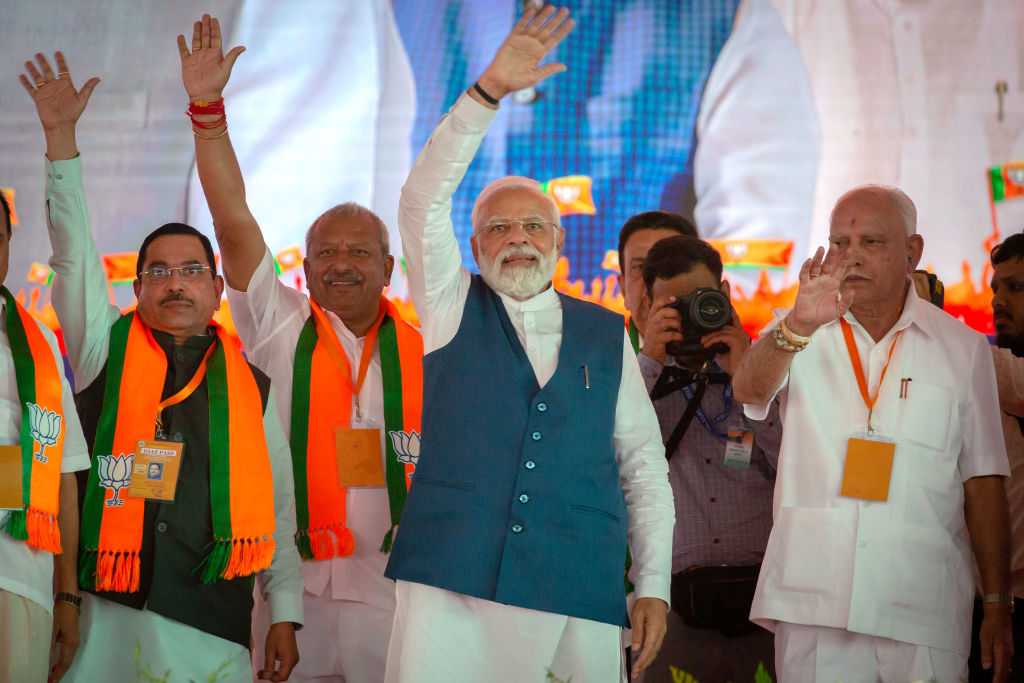
India’s prime minister, Narendra Modi, waves to the his supporters during a political event organized by the Bharatiya Janata Party (BJP) in Davangere, India, on March 25, 2023. (Abhishek Chinnappa / Getty Images)
On May 10, the Indian state of Karnataka went to the polls, and the result was a surprising and decisive defeat for Narendra Modi’s Bharatiya Janata Party (BJP). Modi and his movement have faced setbacks before, but the nature of the BJP’s ambitions in Karnataka made this one especially striking.
Karnataka was the only BJP-ruled state in South India. It took decades of social engineering and political mobilization to make the BJP a viable party in the state, paving the way for its meteoric rise during the 2000s and 2010s. This time, however, the BJP’s momentum was halted.
The nature of its defeat reveals the limits of its overall electoral strategy and sheds light upon the weaknesses of the BJP more generally, as well as the state of India’s opposition with national elections due to be held next year.