Public Schools Have Been Made to Answer for Capitalism’s Crimes
Unwilling to disrupt the economic system that created mass inequality, liberals invested schools with magical powers to fix a broken society. When public schools failed to clean up capitalism’s mess, they ended up on the chopping block.
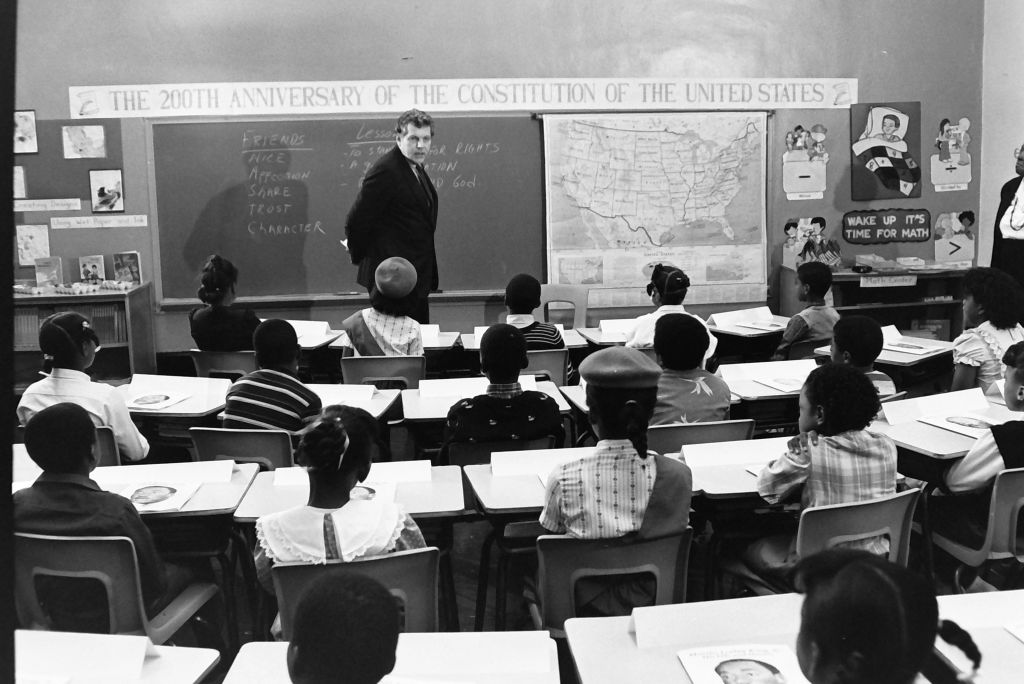
Secretary of Education William Bennett in a classroom in Atlanta, Georgia, January 1, 1986. (Norm Staples / Getty Images)
Anyone who has applied to teach at a public school in the past twenty years has probably felt the need to pack their resume with statements like “used rigorous instruction to build essential college- and career-readiness skills,” or “empowered students to compete in today’s global economy.”
Under neoliberal education reform, the notion that public schooling’s primary aim should be to make individual students more attractive to their future employers has attained the status of common sense. But human capital theory wasn’t always the dominant way of understanding of education’s purpose. Indeed, the concept of schooling to boost employability only became ubiquitous by eclipsing earlier philosophies that elevated the collective, democracy-supporting role of public education.
To understand how, in the education-reform era, the federal government began forcing states to attack teachers and schools in the name of “accountability,” it makes sense to begin the story in 2002. When George W. Bush signed the No Child Left Behind Act (NCLB) into law, high-stakes standardized testing became mandatory for all public school students, with penalties for schools that failed to adequately progress toward the literally impossible goal of 100 percent proficiency.