No, Education Still Won’t Solve Poverty
For more than a century, one of the most persistent ideas in US politics has been that education is the best solution to inequality. But it’s not persistent because it’s true — it’s persistent because it’s a useful myth for political and economic elites jealously guarding their money and power.
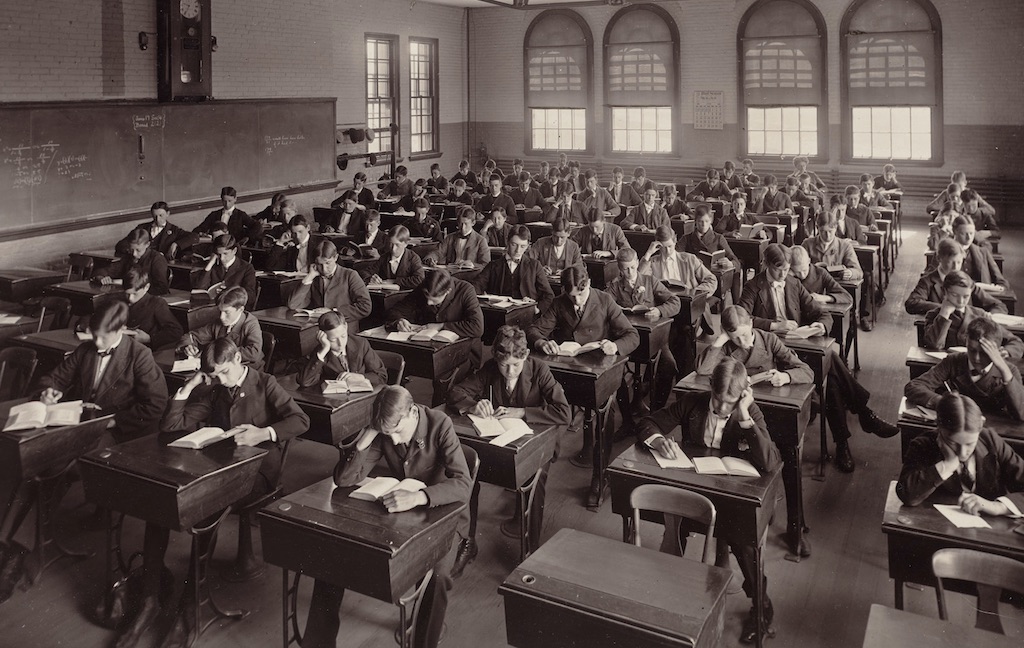
Students at the Mechanic Arts High School in Boston, Massachusetts, 1889. (A. H. Folsom / Boston Public Library)
Since the mid-1800s, the number of children attending school in the United States has steadily increased. Economic equality has not. Yet the idea that schooling is the best way to reduce poverty and close the gap between rich and poor goes almost unquestioned. In her new book, The Education Trap, historian Cristina Groeger addresses this myth head on.
Using Boston as a case study, and focusing her lens on the late nineteenth and early twentieth centuries, Groeger examines the relationship between schools and inequality at a time when public education was expanding rapidly. On the whole, the evidence is clear: the massive growth of public education did not produce broad-based economic prosperity. Schools did train some workers who found higher-wage jobs in the expanding corporate bureaucracy. But by undercutting powerful craft unions and establishing a credentialing system, schools also solidified existing stratification.
Groeger’s book shows the checkered history of education as an anti-poverty tool. Perhaps most importantly, it helps educators and organizers think about the things that actually do reduce inequality: universal government programs and strong unions.