We Can’t Win the School Culture Wars
Flash-in-the-pan school controversies distract us from the Right’s long-standing aim: destroying public education itself. To preserve this audacious experiment in democracy, we must bridge cultural and ideological divisions to find common ground.
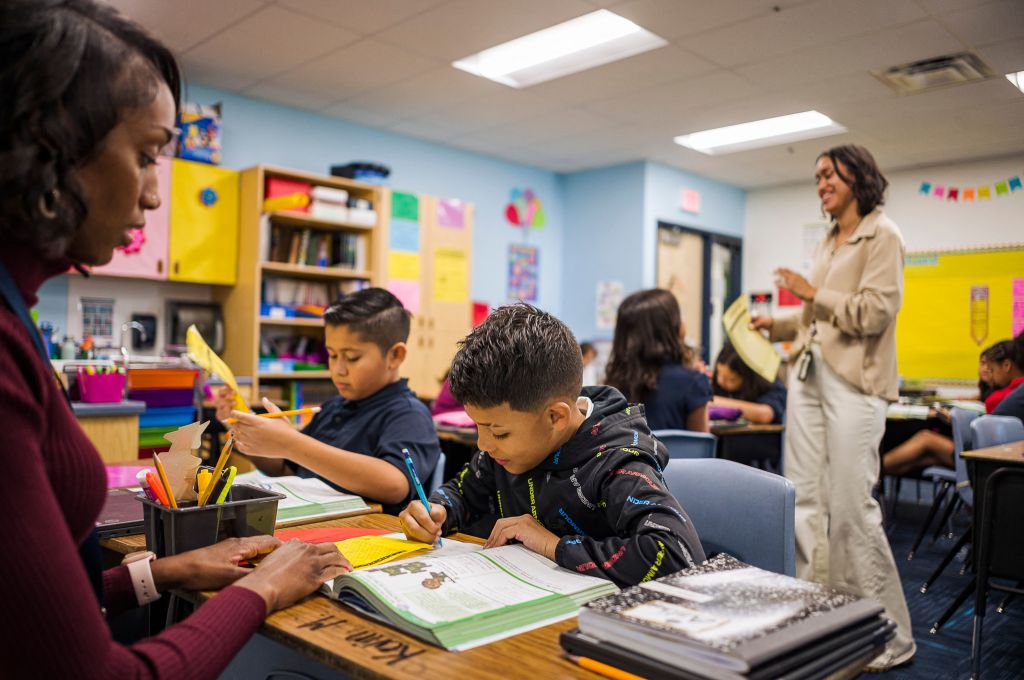
Students work at Nevitt Elementary School, in Phoenix, Arizona, on October 26, 2022. (Olivier Touron / AFP via Getty Images)
There’s a charter school in my Massachusetts town that markets itself as a place where students are immersed in art, music, and hands-on learning. These things appeal to me, and I’ve been tempted to consider applying to it for my almost kindergarten-aged daughter. On the website, it’s clear that the school is pitching itself to a certain brand of crunchy, organic parent; since I’m one of them, I get it.
Our local public school district, on the other hand, is definitionally incapable of pitching itself to a particular sort of family. It’s for everybody, and at times that can feel bland or even messy. It’s harder for me to name the special advantages my daughter will gain from attending the public schools, because those advantages won’t accrue just to her, or to others in our specific sociocultural camp. Rather, we all get to rest assured that the members of our community have access to a baseline of academic and social training, including the experience of working together with heterogeneous others. Our public schools bring the disparate members of my town together for activities both recreational and political. On election day, I cast my ballot in the high school gym, helping to vote in a school committee of my neighbors.
These collective purposes of public schooling are a primary focus of the new book from the authors of A Wolf at the Schoolhouse Door. In The Education Wars: A Citizen’s Guide and Defense Manual, education journalist Jennifer C. Berkshire and education historian Jack Schneider lay out, in compact and accessible terms, the deadly threats posed to our nation’s public schools by deep-pocketed networks of right-wing privatizers. They also highlight how communities across the United States are fighting back against these assaults on public schooling and the public good. With targeted historical context, they build a compelling case that if we are to preserve and strengthen the audacious experiment in democracy that is our public schools, we must bridge cultural and ideological divisions to find common ground.