Who Killed Olof Palme?
The borders of Ukraine are no more arbitrary than those of Italy or Germany. It’s been more than three decades since the Swedish prime minister Olof Palme was assassinated outside a Stockholm cinema, and police have never found the killer.
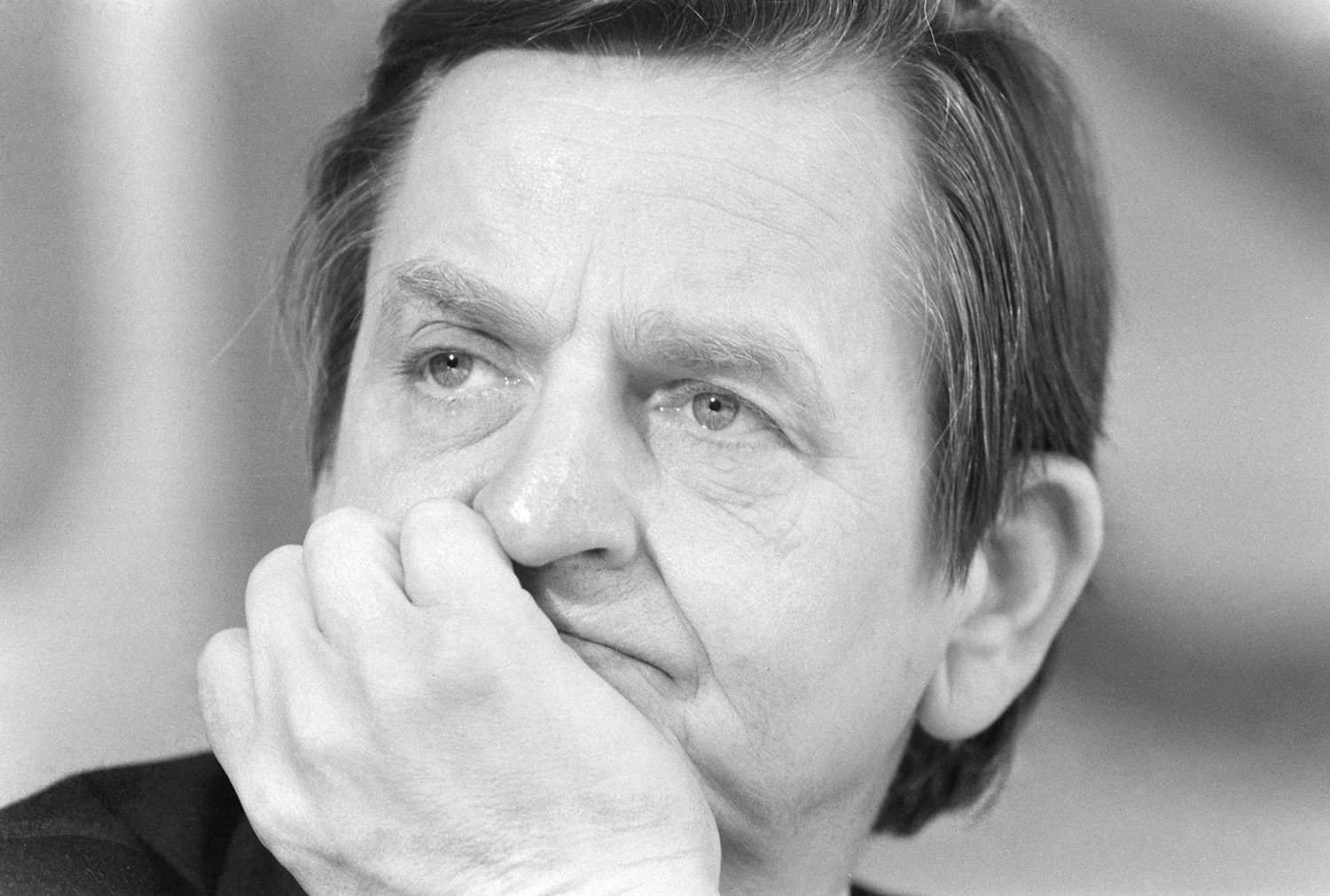
Sweden’s famed social democratic prime minister Olof Palme, pictured three years before his death, January 23, 1983. Palme’s assassination was the first killing of a nationalSwedish leader since King Gustav III in 1792. (Daniel Simon / Gamma-Rapho / Getty Images)
Late one winter evening in 1986, the Swedish prime minister Olof Palme left Grand, an Art Deco cinema in Stockholm’s city center. The internationalist statesman and leader of the Social Democratic Party (SAP) had seen a comedy with his wife, Lisbeth, his son Mårten, and Mårten’s girlfriend. Palme and his wife parted ways with the young couple and started walking home. After only a few hundred yards, someone came up from behind the Palmes and fired two bullets at them. The first bullet entered the back of Olof’s neck and severed his carotid artery. The second missed Lisbeth by an inch. The perpetrator fled the scene before a group of pedestrians arrived to find their prime minister bleeding out on the sidewalk. Just after midnight on March 1, 1986, Olof Palme was declared dead at Sabbatsberg Hospital.
What wasn’t clear was who killed him — or why. The day after the murder, the police received a tip, opening up the first line of inquiry. Two women pointed to Victor Gunnarsson, a thirty-three-year-old man and former member of the European Workers’ Party (EAP), a fringe group that had long been under the watchful eye of the Swedish Security Service (SÄPO). The local branch of the conspiracist LaRouche movement, the EAP had accused Palme of being on the payroll of both the KGB and the CIA.
Given numerous testimonies documenting Gunnarsson’s hatred of Palme, it seemed plausible that he was the perpetrator. When Gunnarsson was brought in for questioning, a technical investigation of particles found on his jacket indicated that he had recently fired a gun, but it wasn’t proven to have been the murder weapon. After a week’s detention, the suspect was released, but he was kept under close watch by a special task force. On May 16, 1987, the investigation into Gunnarsson was closed. Six years later, his body was found in the woods outside Salisbury, North Carolina, with two gunshot wounds to the head.