Turkey’s Election Is About Democracy Itself
Even before February’s earthquake claimed 50,000 lives, President Recep Tayyip Erdoğan had presided over many disasters in Turkey. Defeating him in this month’s election is essential if the country is going to turn away from permanent authoritarian rule.
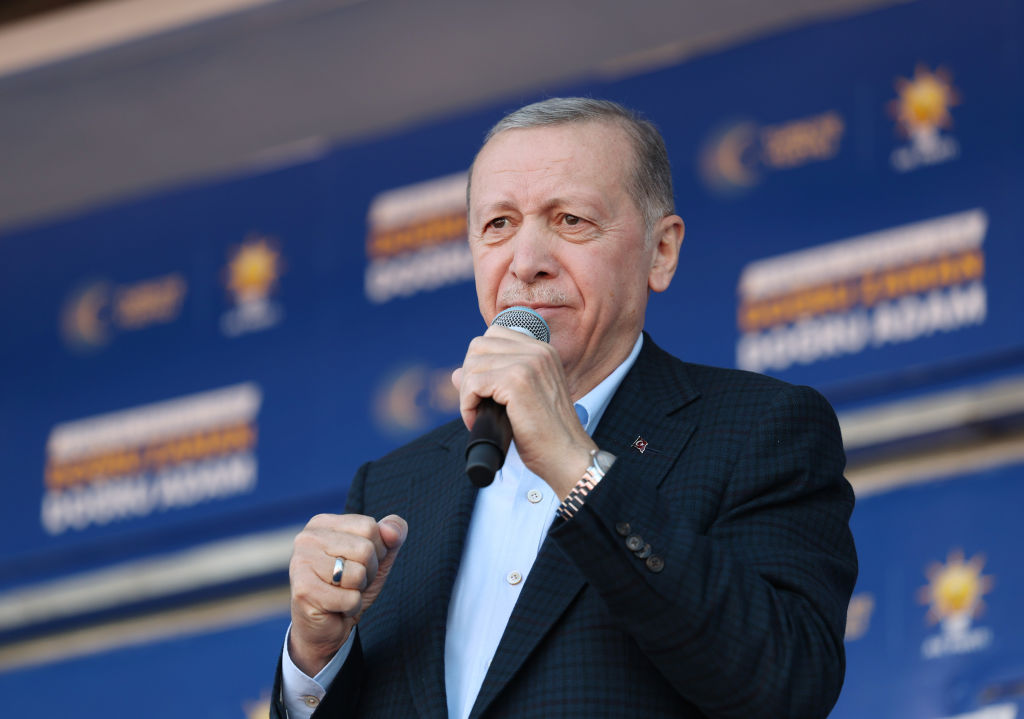
Turkish president Recep Tayyip Erdoğan makes a speech during an electoral rally at Kepez Turgut Ozal Sports Hall, in Antalya, Turkey on May 2, 2023. (Murat Kula / Anadolu Agency via Getty Images)
More than at any point in the past two decades, Turkey is at a turning point. On May 14, the country will elect a new parliament and a new president. Autocratic incumbent Recep Tayyip Erdoğan, who has consolidated his increasingly authoritarian government over the past twenty-one years, is campaigning with the help of all the state institutions he controls. What remains to be seen is whether the Kurds and the opposition are able to make their voices heard, despite his efforts to cling to power and thwart a democratic transition.
“In these elections, it is not only [Turkish] alliances and candidates that are competing against each other,” Erdoğan claimed on April 13 at a rally in Malatya, following the deadly earthquake that official figures say cost over fifty thousand lives across the country: “the West is issuing instructions in these elections. There are also two different mentalities competing, two different goals for Turkey.” He continued, “These elections will not only determine the next five years, but also the next quarter century, the next half century of our country and our nation.”
Doubtless, only a small proportion of the crowd in this disaster-hit area was listening to Erdoğan: the majority were thinking about how to cope with the problems of finding shelter and securing a future after the February 6 earthquake. Not only in Malatya, but almost across Turkey, people are more concerned about their livelihoods than about the elections. Yet people also know that the vote is crucial for their future.