Turkey’s War Against the Kurds Exposes NATO’s Aggression
- Adam Baltner
With all eyes on the war in Ukraine, Turkish president Recep Tayyip Erdoğan is planning a fresh invasion of northern Syria. For 70 years, Turkey has been a key NATO member — and NATO's backing for its aggression shows the alliance is no mere defense pact.
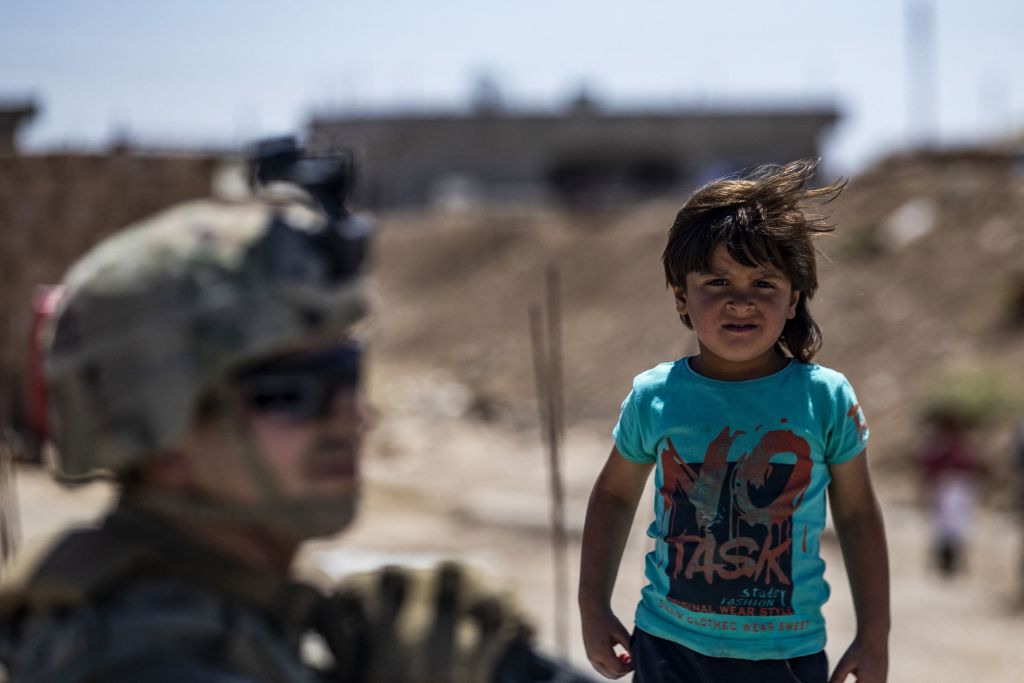
A Syrian boy looks on as US soldiers patrol the countryside of Rumaylan, Syria, near the Turkish border, after President Recep Tayyip Erdoğan said Turkey would launch a new military operation into northern Syria, May 26, 2022. (DELIL SOULEIMAN/AFP via Getty Images)
It’s happening again. Emboldened by NATO member states’ silence, Recep Tayyip Erdoğan and his Justice and Development Party (AKP) government could turn Turkish threats of war against the democratic administration in north Syrian Rojava into a full-fledged invasion. During a public appearance on Monday, May 23, at a military shipyard on the Sea of Marmara, Erdoğan announced his intention to occupy a thirty-kilometer-wide strip of land along northern Syrian border. According to Turkish sources, preparations for the invasion would be complete by the next day.
Elsewhere in Kurdistan, the war has been roiling for weeks — despite lack of public attention or outrage. On April 17, the Turkish army launched an invasion of the Zab region of southern Kurdistan. This was the first culmination of a series of interventions in northern Iraq violating international law. Since then, the mountains of Kurdistan — where numerous villages lie and civilians live — have seen heavy fighting, with soldiers and guerrilla fighters dying every day. In Rojava, too, a low-intensity war against the civilian population and its administration has been in progress for months. As the Rojava Information Center has documented, at least thirty-five Turkish drone strikes have killed more than thirteen people and injured thirty-four.
So far, Erdoğan has been able to pursue these war politics unhindered. Criticism of the NATO alliance, of which Turkey has been a member since 1952, has remained absent. Instead, the war in Ukraine has given even more destructive bargaining power and influence to Erdoğan, who is presenting himself as an ostensible mediator between Russia and Ukraine by hosting negotiations on Turkish soil.