Ramadan Mubarak, Comrades
For over a millennium, Muslims have used hunger as a biological reminder of the need for human solidarity during the holiday of Ramadan. That solidarity is key to building the kind of movement that can win a better world for Muslims and everyone else.
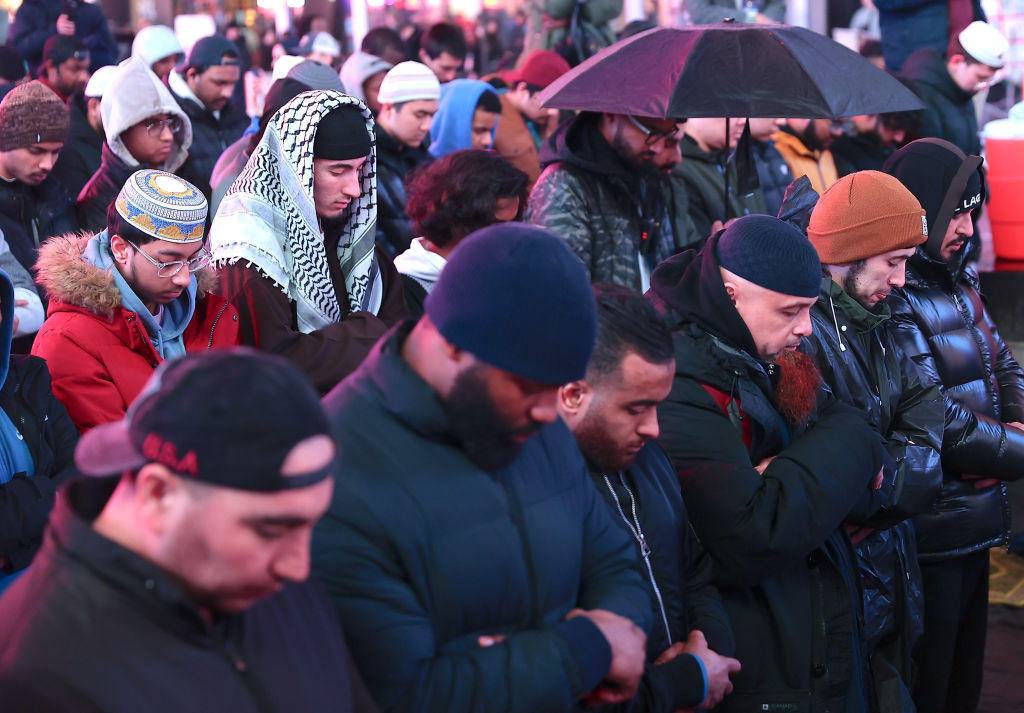
Hundreds of Muslims break their fast and offer congregational tarawih prayers in Times Square, New York City, on March 25, 2023. (Selcuk Acar / Anadolu Agency via Getty Images)
For over a millennium, Muslims have used hunger as a biological reminder of the need for human solidarity during the holiday of Ramadan. Nearly a quarter of the world’s population is Muslim, and many Muslims, year after year, still take up this banner every Ramadan. In the United States, there are 3.5 million Muslims, and despite decades of marginalization, Islamophobia, and state repression like Trump’s Muslim ban and intrusive surveillance, we are still practicing our religion.
Fasting during Ramadan is a collective transformative practice that insists on embodying the idea of equality. The material body, individually and collectively, feels hunger and thirst for a month; the idea that every human being deserves food and shelter becomes physically embodied. People become hungry, thirsty, exhausted, sleep deprived together as a community, and are hopefully transformed because of it. It is a consciousness-raising requirement for every able-bodied person.
It would be wrong to separate these practices from a politics of equality. The injunction to fast this month comes from the same injunction to diligently avoid any type of interest-bearing financial gains. Islam considers usury to be metaphorically the same as going against the grain of life: it’s not halal to benefit from other people’s vulnerability. In the Quran, Allah and His Messenger declare war on the usurers, affirming that fighting against unjust economic systems is a central component of being Muslim. Other economic rules for sharia-compliant Muslims involve prohibitions against overcharging, extracting rent on land that’s cultivated by someone else, and to put it simply, living without thinking of others. Fasting should be understood as part of a broader call to action to fight for the marginalized and build a more just world.