In Catalonia, Class Struggle and National Dispute Have Gone Hand in Hand
Catalonia has a proud history of popular protest, from the 15th-century peasant revolts to an anarchist-led revolution, and the anti-Franco resistance that followed. This has not been hindered by Catalans' desire for independence, but nurtured by it.
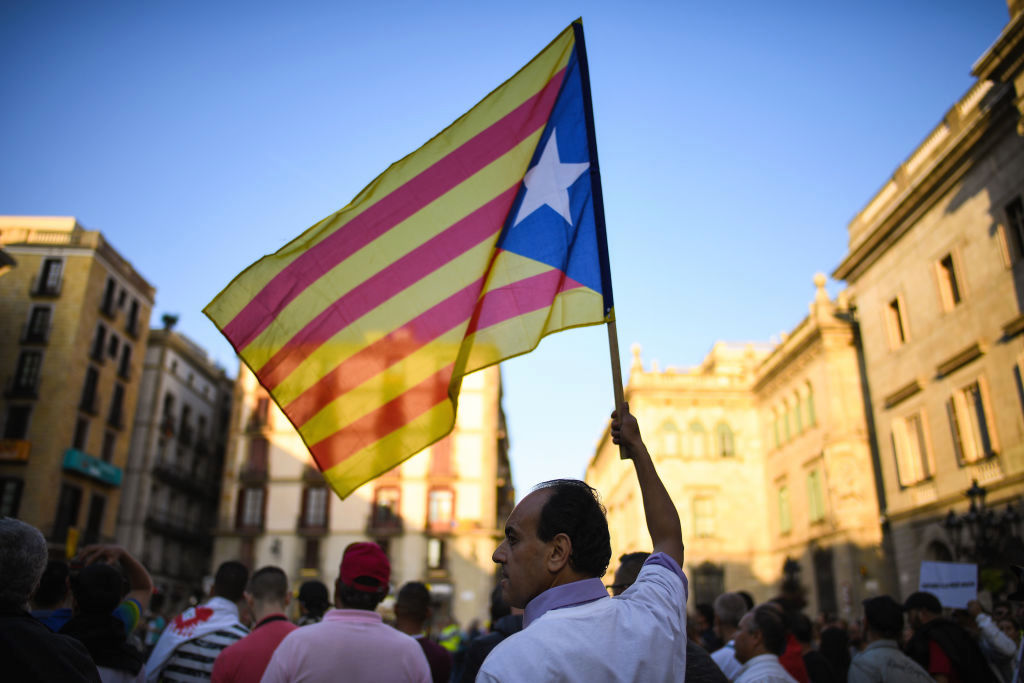
An activist holds a Catalan independence flag during a demonstration on October 28, 2017 in Barcelona, Spain. (Jeff J. Mitchell / Getty Images)
On October 1, 2017, Catalonia became a focus of worldwide attention when over two million people voted in a referendum on independence despite state prohibition and police violence. This peaceful revolt — followed by a declaration of statehood and the imprisonment and exile of leaders and activists — was not the first time that Catalan heroism had inspired internationally. It happened in 1714, when Barcelona’s inhabitants resisted a joint Spanish-French siege for months — the defeat of which led Catalonia to lose its centuries-old institutions and public use of its language. It also occurred in 1936–37, when armed workers stopped Francisco Franco’s uprising across Catalonia and went to push back his armies in Aragon, initiating a deep social revolution in the process. That experience was famously witnessed by George Orwell and recorded in his Homage to Catalonia.
In A People’s History of Catalonia, locally based Michael Eaude provides an impressive and accessible roller-coaster history. It is spiced with biographies of key individuals, ranging from Buenaventura Durruti to Black Carlota (leader of the slave revolts in Spanish Cuba), literary quotes, and cultural references. A stated goal of A People’s History of Catalonia is to provide a background to Spanish hostility toward Catalan self-determination and statehood and demonstrate why the Left should embrace both (rather than seeing them as a distraction or simply divisive). Crucially, Eaude does this by telling the story “from below.”
A Historic Nation
A synopsis of Catalonia’s national history could be as follows. It was the dominant component in the Crown of Aragon, becoming an early trading and military empire (conquering Valencia and the Balearic Islands by the thirteenth century, and Sardinia, Sicily, Naples, and Athens not long after). In the same period, it developed representative and political institutions, which while restricted to elites, was somewhat effective in limiting monarchical power.