Abe Shinzo Haunts Japan From the Casket
From the Moonies to military revanchists, Abe Shinzo was in bed with some dangerous oddballs. His funeral was a battle over their place in Japanese politics.
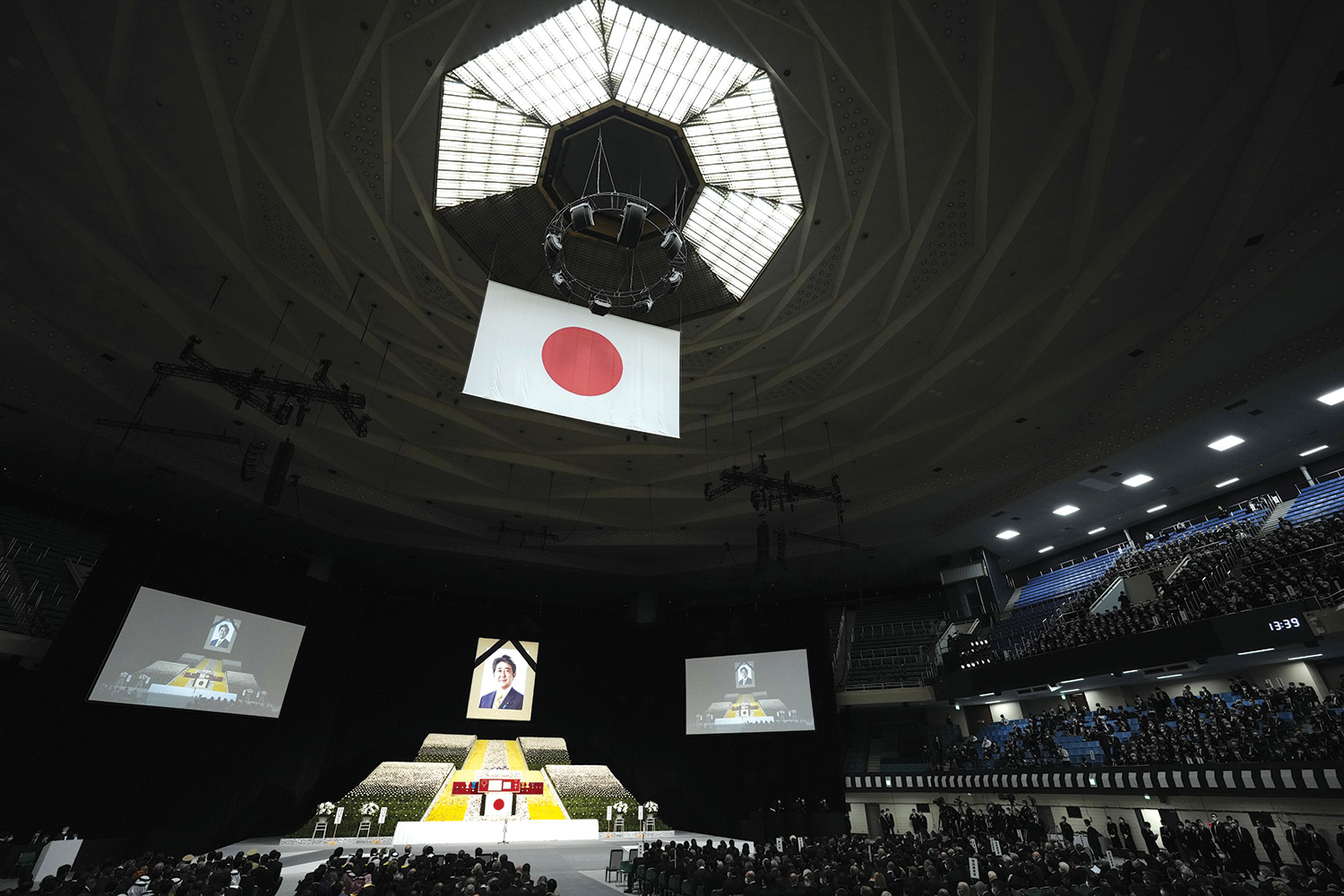
A state funeral for former prime minister Abe Shinzo was held at the Nippon Budokan, an indoor arena, in Chiyoda, Tokyo, September 27, 2022. Many current and former heads of foreign states were in attendance, along with thousands of citizens. (Franck Robichon-Pool / Getty Images)
When an assassin fatally shot former Japanese prime minister Abe Shinzo at an election rally in Nara on July 8, two days before a parliamentary upper house election, shock waves spread quickly around the world. Following a private funeral, Prime Minister Kishida Fumio announced that a state funeral for Abe would be conducted on September 27. It would, he insisted, demonstrate that Japan would not “submit to terrorism,” while publicly recognizing Abe’s long contribution to the country, especially as prime minister during two stints, from 2006 to 2007 and 2012 to 2020.
No former prime minister had been honored in this fashion since the 1960s.
Some began to draw dark parallels with the assassinations or attempted assassinations of serving and former prime ministers in prewar Japan, such as those of Hara Takashi in 1921, Hamaguchi Osachi in 1930, Inukai Tsuyoshi in 1932, and Saitō Makoto and Takahashi Korekiyo in 1936. Others recalled, even more darkly, the Aum Shinrikyo cult that carried out the March 1995 sarin chemical attack on the Tokyo subway, followed by the arrest, trial, and execution of its key members. Might twenty-first-century Japan be on the verge of going off the rails again?