Capitalist Inequality Won’t Last Forever
You must have an incredibly dismal view of both human agency and human nature to believe that we will continue to live in the future much as we live today.
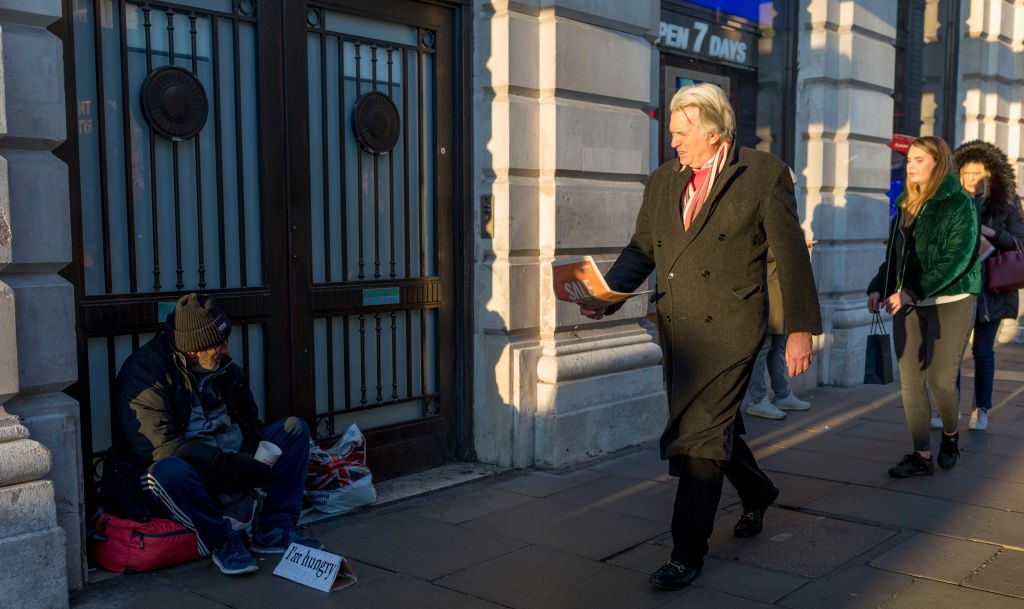
Passersby ignore a man begging with a sign saying “I’m hungry,” on the sidewalk in Piccadilly, London. (Richard Baker / In Pictures via Getty Images)
Branko Milanovic’s Capitalism, Alone: The Future of the System That Rules the World begins, provocatively, with two quotes written roughly two centuries ago that describe our world-system today. The implication is that what began then was not only foreseeable but also largely unstoppable. At the very least, we have known enough about the system for long enough that if we were to have changed the course of events, we would have done so by now. Instead of any alternatives gaining significant ground, “We live in a world where everybody follows the same rules and understands the same language of profit-making.” The exceptions to this mantra are so trivial that none of them, Milanovic explains, “influence the shape of things and the movement of history.”
This is a bold book. At its core is Milanovic’s long-term interest in collating data on income inequalities. He shows that, as capitalism became all-encompassing, worldwide income inequality rose to a peak in the 1950s and 1960s at the very same time that it was falling locally within most of the richest countries. The beginnings of that localized fall, around 1914, only slightly dented the relentless upward rise in inequality among all people on Earth. However, at some point in the 1990s, global income inequality began to fall abruptly for the first time in centuries. Thus, we begin with a conundrum: capitalism is utterly dominant, but global income inequality is now declining. Milanovic does not see this particular drop in income inequality as a sign that something fundamental may be changing. He views the plunge as mainly a short-term effect of the recent success of what he calls political capitalism in China.
The measure of inequality used here matters. It is the Gini coefficient, which takes the differences among all people into roughly equal account. Had the author instead concentrated on the very poorest, or on the top 1 percent or 0.1 percent, or on both extremes, then the book would have begun with a different story and probably ended with a very different message — one suggesting that we cannot allow current inequities to continue to grow at both extremes. However, because most people worldwide do not fall into either of these extreme groups, by concentrating only on the Gini coefficient, this book presents more of an every-person account of what capitalism produces, for whom, and why. As a result, Milanovic is less damning than he might be. He is not looking for reasons why capitalism should be challenged or opposed, but instead suggesting that the system will be so resilient that we just need to adapt to it.