The 1962 Missile Crisis Was a Turning Point for the Cuban Revolution
Sixty years ago, the world seemed on the brink of nuclear war before the superpowers reached an agreement. The missile crisis led Cuba’s leaders to distrust their Soviet ally — an attitude that ultimately helped their revolutionary system to outlast the USSR’s.
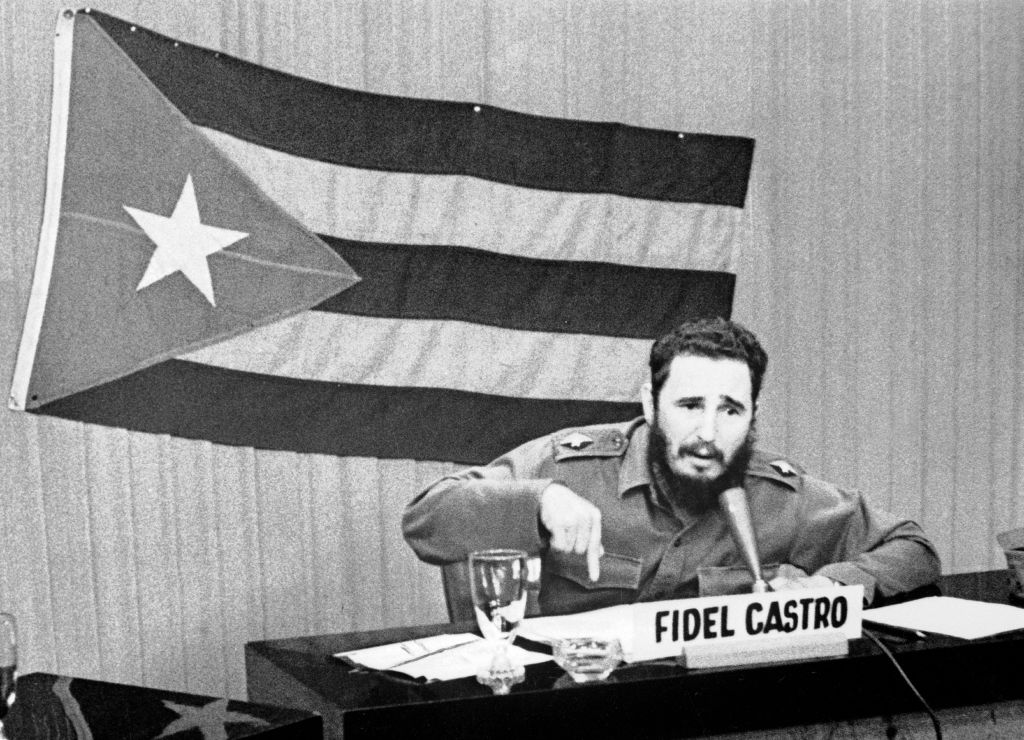
Fidel Castro giving a speech on October 22, 1962, during which he speaks about the antagonistic measures taken by the United States toward Cuba. (Photo by Keystone-France / Gamma-Keystone via Getty Images)
As academics and the media recall and reassess the Cuban missile crisis sixty years on, their focus will primarily be on the two superpowers — the United States and the USSR — that seemingly came close to nuclear war. However, it is also timely to reconsider those who found themselves in the middle of the would-be conflict: the Cuban leaders, whose willingness to accept Soviet missiles triggered the crisis in the first place, and the ordinary Cuban people, as the reality of the threat dawned on them.
While the rest of us held our breath and then breathed a sigh of relief when the moment of crisis had passed, Cubans were increasingly aware that in any nuclear clash, they would simply be obliterated. The final scenes of Tomás Gutiérrez Alea’s 1968 film, Memorias del Subdesarrollo (Memories of Underdevelopment) showed eloquently, in grim black and white, the somber but determined mobilization of Cubans to defend their uncertain future. After three years of economic, political, and even military combat, this might really be the final battle.
It wasn’t, of course: Cuba survived, along with the rest of humanity. But the missile crisis had a profound impact on the country’s history. In particular, it fostered a distrustful attitude toward Cuba’s erstwhile Soviet ally, which left its mark on Cuban policy throughout the Cold War, and ultimately helped the system that arose from the revolution of 1959 to survive long after the demise of the USSR.