When Cuba Provided Crucial Military Aid to African Independence Movements
Under Fidel Castro, Cuba backed independence movements across the Third World. This support was decisive in battling South African apartheid, thwarting US covert operations, and securing self-rule across southern Africa.
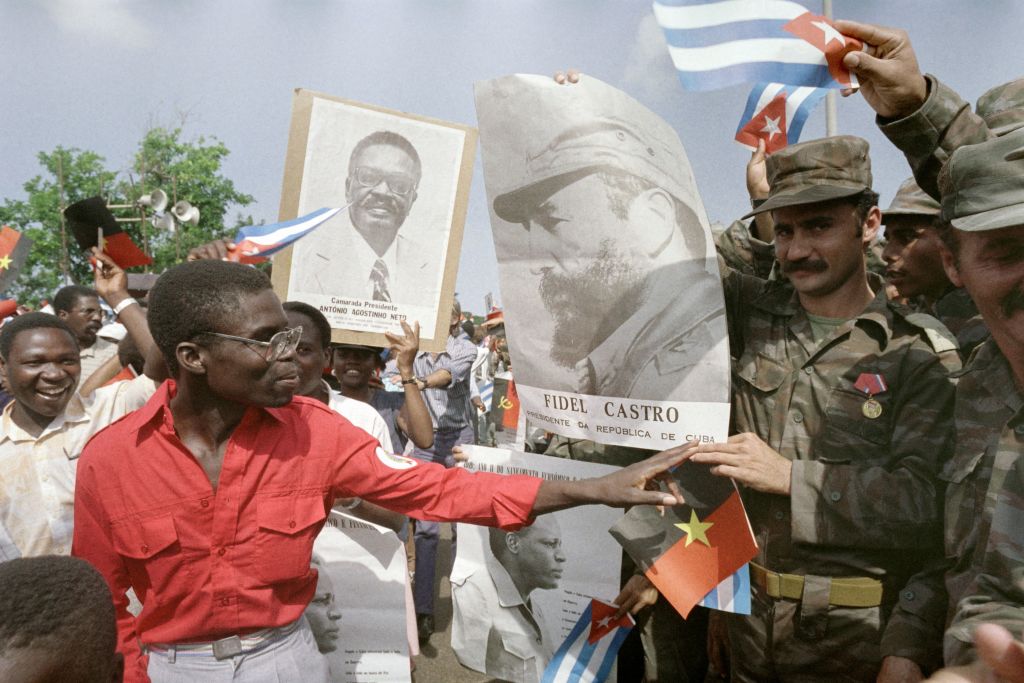
Cuban soldiers display a poster of Fidel Castro on January 9, 1989, during a ceremony held at the Cuban training camp of Punda, near Luanda, Angola. (Pascal Guyot / AFP via Getty Images)
In the 1970s, hope for southern Africa seemed bleak. Angola, Mozambique, and Guinea-Bissau were under Portuguese control. After the collapse of Portuguese rule, the United States collaborated with South Africa to crush Angolan guerrilla movements. In South Africa, the apartheid regime was firmly in place and extended control over Namibia.
Cuban intervention in the region was decisive in changing the course of liberation movements against the United States and South Africa. For the Jacobin Radio podcast The Dig, Daniel Denvir spoke with Piero Gleijeses, a history professor at Johns Hopkins University and author of Visions of Freedom: Havana, Washington, Pretoria, and the Struggle for Southern Africa, 1976–1991, to learn the story of Cuba’s military defense of the Angolan government and its impacts on the course of South African apartheid. You can listen to the episode here.
Daniel Denvir
Southern Africa was one of the last regions to undergo decolonization. Up until 1974, the Portuguese were in charge of Angola and Mozambique. Hope for change in the region seemed bleak. Set the stage for us on the eve of Angolan independence.
Piero Gleijeses