The Structural Crisis of the New Deal Order Gave Us Neoliberalism
The rise of neoliberalism wasn’t simply about centrist and right-wing politicians deciding to unleash market forces. It reflected a genuine crisis of the postwar economic order — and the absence of a powerful working-class movement to push a left alternative.
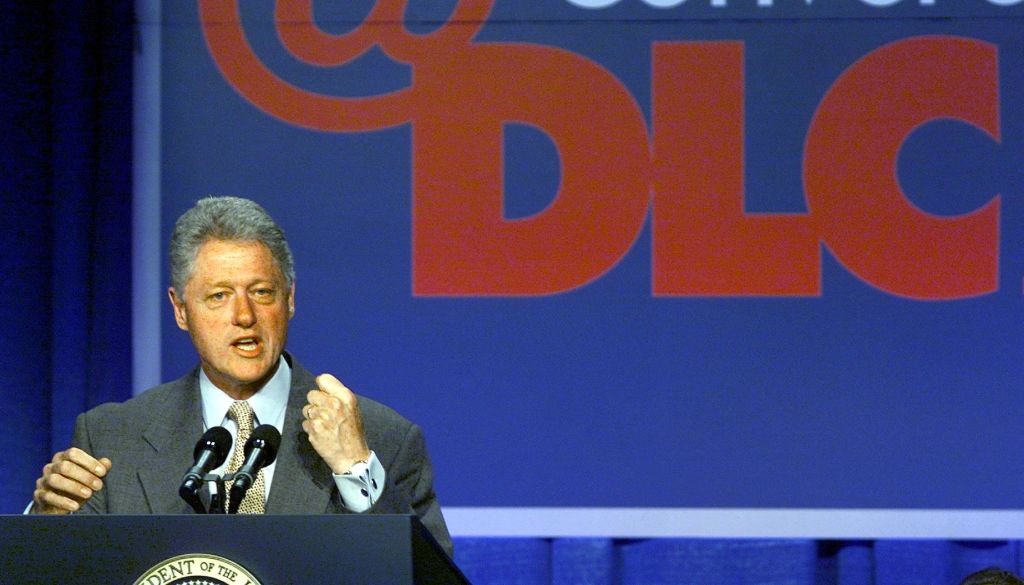
US president Bill Clinton delivers a speech at the 1999 Democratic Leadership Council National Convention in Baltimore, Maryland. (Paul J. Richards / AFP via Getty Images)
By any measure, economic inequality has shot up over the last half-century. Since 1970, the share of national income claimed by the bottom half of earners has fallen from 21.3 percent to just 13.6 percent, while the share pocketed by the top 1 percent has nearly doubled — from 11.6 percent to 19.1 percent. Although social programs have substantially reduced poverty over that span, stingy eligibility criteria and state-level discretion have eroded the livelihoods of low-income families. The racial wealth gap, sustained by generations of exploitation and exclusion in private realty and public programs, is as wide now as it was in the 1960s.
A common story dresses up these trends in partisan garb: the Democrats struggled to extend or shore up the New Deal; the Republicans — out of ideological fervor or slavish deference to private interests — just as determinedly tried to tear it all down. There is a glimmer of truth to this tidy narrative, but just a glimmer. In fact, the return of inequality to levels not seen since the Gilded Age has been a frequently bipartisan project: the Democrats have held the upper hand (controlling both the House and Senate, or the presidency and one or both chambers) for thirty of the last fifty-four years. Their fingerprints, to varying degrees, are on every single policy that drove up inequality during this stretch.
That rap sheet is the central thread of Left Behind, historian Lily Geismer’s provocative examination of the Bill Clinton presidency, its political and intellectual roots, and its lasting impact. Left Behind opens by tracing the now-familiar story of the Democratic Leadership Council (DLC), founded in 1985, and its determination to cut the party loose from its “special interests” (unions, racial minorities, the feminist movement, etc.) and split the unlikely difference between the Great Society and Reaganomics. As Geismer argues, Clintonite invocations of a “third way” or “a bridge to the twenty-first century” could scarcely conceal the real intent and the result: to abandon the bottom half of the income distribution in favor of market solutions that would make Friedrich Hayek blush.