The Death of Neoliberalism Has Been Greatly Exaggerated
Despite predictions of its demise, the neoliberal power bloc of think tanks and lobby groups is still deeply entrenched and pushing into new territory, from health care to space exploration. Neoliberalism won’t be over until the Left can challenge that power.
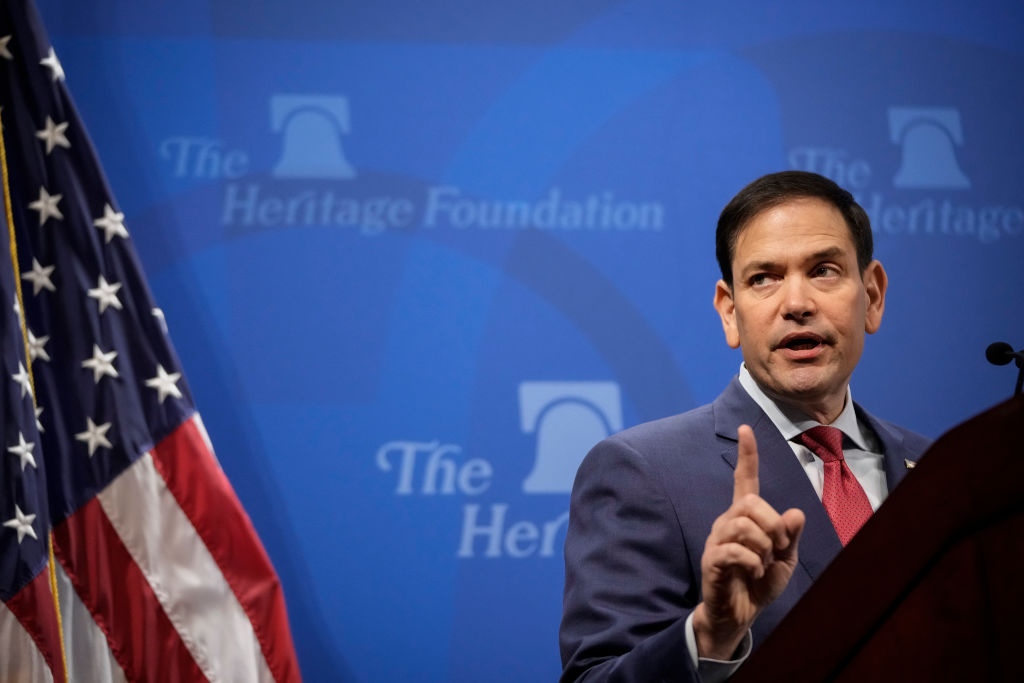
Florida senator Marco Rubio speaks at a Heritage Foundation even on March 29, 2022. (Drew Angerer / Getty Images)
It is unnerving to realize we live in an era when everyone seems to be relieved that the COVID-19 pandemic is done and dusted when, in fact, all that is really over are the concerted public health measures to control its spread and propagation. “Wishing makes it so” is hardly a sound policy upon which to build political movements, yet that threatens to be the default stance toward most of the current crises we face, be it global warming, loss of biodiversity, Trumpism, economic inequality, the pandemic, or even the war in Ukraine.
One instance of such “termination fascination” that seems glaringly apparent on the Left is the widespread conviction that somehow the era of neoliberalism is likewise past, or at least on its way out. One can’t help but suspect that this particular hankering for a terminus is a consequence of feelings of helplessness combined with the tiresome refrain that neoliberalism can’t be satisfactorily defined. To clarify the debate, we first need to discuss the different ways in which people on the Left have used the term “neoliberal.”
Defining Neoliberalism
First off, a wide range of people use “neoliberal” to designate a subset of either national or global history. This may simply be a convenient shorthand or may gesture toward something more — a historian’s attempt to periodize epochs, as in the “age of enterprise” or the “New Deal era.”